SEO, GEO and AEO for professional services firms: How to make your experts discoverable.
SEO, GEO and AEO are converging. For professional services firms, the opportunity is to make their experts and expertise easier to find, understand and trust across Google and AI search.
 Aaron EdwardsContent Executive, Profile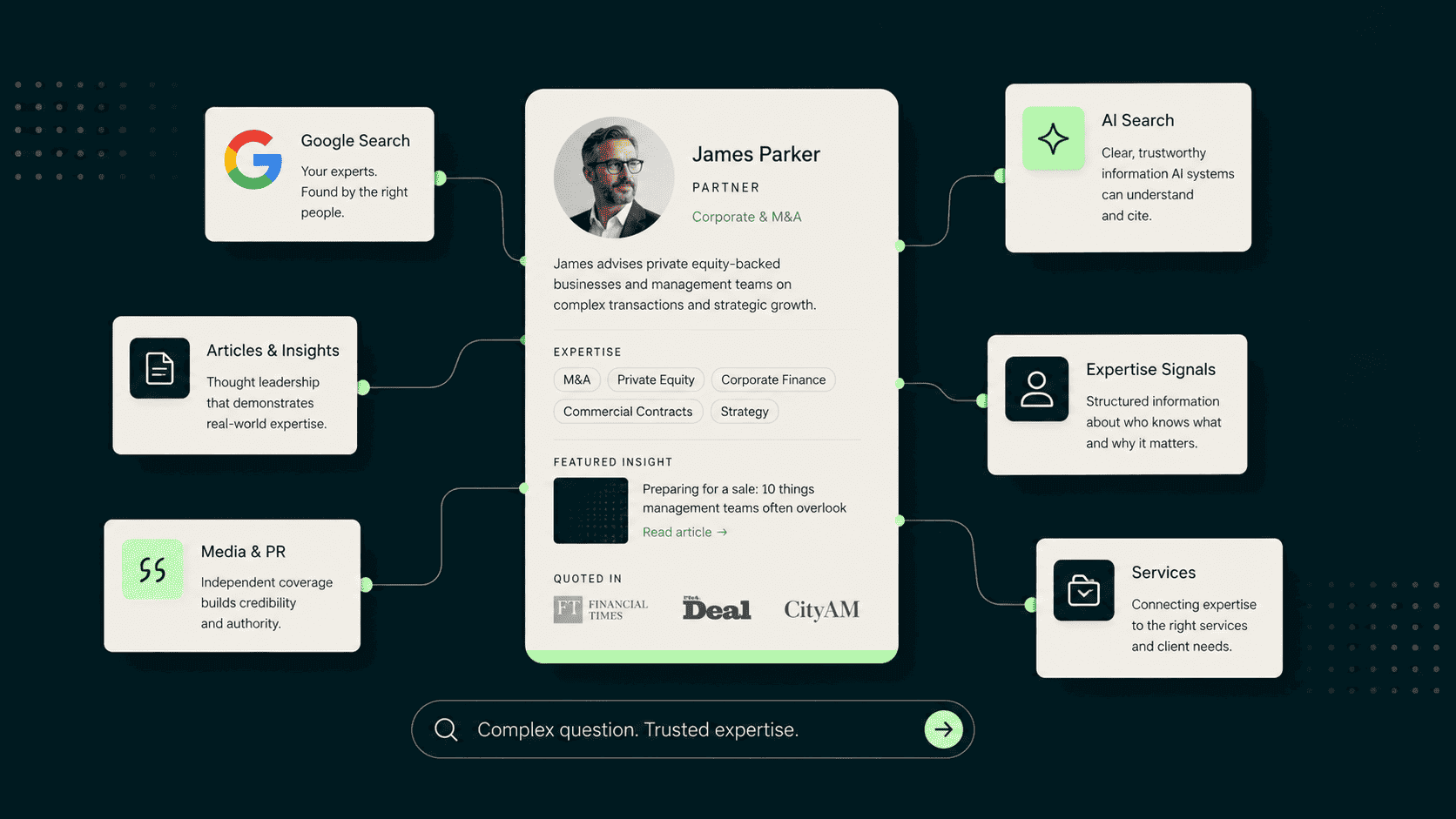
Professional services firms should stop thinking about SEO, GEO and AEO as three completely separate disciplines.
The bigger question is whether a firm's expertise, and the people behind it, can actually be found, understood and trusted wherever prospective clients are searching.
For professional services firms, that matters more than simply ranking a service page.
Clients want confidence in the people they may eventually work with. They want to know who understands their problem, who has relevant experience, who has a credible point of view and who is recognised by others in the market.
Search is increasingly part of that process.
Google says its AI search experiences are enabling people to ask longer and more complex questions, while the same foundational SEO principles continue to apply when its systems surface information in AI Overviews and AI Mode.
So the opportunity is bigger than traditional website rankings. It is about making genuine expertise easier to find, understand and trust.
What do SEO, GEO and AEO mean?
SEO, or search engine optimisation, is the established practice of improving a firm's visibility in traditional search results, particularly on Google.
GEO, or generative engine optimisation, is a newer term used to describe efforts to make information easier for generative AI systems to understand and potentially reference.
AEO, or answer engine optimisation, focuses on providing clear and useful answers to the questions people ask, whether through featured snippets, AI-generated results or other answer-led search experiences.
The terminology differs, but the underlying challenge is increasingly similar.
People are asking more specific and complex questions. The systems responding to those questions need reliable information about who knows what, why they are credible and where that information comes from.
For professional services firms, that puts expertise at the centre of search visibility.
Why search is different for professional services firms.
For many professional services businesses, the thing clients are ultimately buying is expertise.
Whether choosing a law firm, accountancy practice, consultancy or advisory business, prospective clients are assessing whether the people inside the firm understand the issues they face.
In other words, they are not only looking for the right firm. They are often looking for the right person at the right firm.
That is particularly important in B2B buying.
The 2025 Edelman-LinkedIn B2B Thought Leadership Impact Report found that more than 40% of B2B deals can stall because of internal misalignment, illustrating how many different stakeholders can influence a purchase.
Its 2024 research also found that 73% of decision-makers saw thought leadership as a more trustworthy basis for assessing an organisation's capabilities than conventional marketing materials.
Visibility therefore cannot be separated neatly into SEO, reputation, thought leadership and PR. Each helps prospective clients build an understanding of the expertise behind a business.
Why traditional expert profiles are often not enough.
Most professional services firms already have profile pages for their partners, consultants and subject matter experts.
But many look remarkably similar.
They include a name, title, qualifications, a short biography, several areas of expertise and perhaps a list of representative clients. Then a contact button.
That works reasonably well when someone already knows the expert's name.
It is much less useful when someone is searching for expertise around a particular problem.
A strong expert profile should help answer questions such as:
- What is this person actually known for?
- Which problems do they understand particularly well?
- What is their point of view on the issues affecting their market?
- What have they written or commented on?
- Where have they been quoted, interviewed or published?
- What evidence supports their expertise?
- How does their expertise connect to the firm's services?
That is the difference between simply having an expert profile and building genuine expert visibility.
From our work with professional services firms, we rarely see a shortage of expertise.
The problem is that much of it remains inside client work, internal conversations, meetings and individuals' heads. Very little of it makes its way into a structured digital footprint.
The challenge is making that expertise visible, attributable and easy to understand.
What makes an expert discoverable across Google and AI search?
Google's guidance places significant emphasis on qualities such as experience, expertise, authoritativeness and trustworthiness when assessing useful, reliable content.
E-E-A-T is not a single ranking factor, but the underlying principle is relevant well beyond traditional SEO.
For an expert to be discoverable and credible across search environments, five areas matter.
1. Identity.
Search engines, AI systems and prospective clients need to understand who an expert is, which organisation they belong to and what they do.
A clear and consistent digital identity creates the foundation for everything else.
2. Expertise.
The subjects an individual genuinely understands should be clearly represented across their profile, content and wider digital presence.
A long list of generic capabilities is less useful than a clear picture of the topics, problems and industries for which that person has genuine expertise.
3. Evidence.
Claims of expertise become more credible when there is evidence behind them.
That might include professional experience, qualifications, case studies, publications, speaking appearances, interviews, media coverage or other credible signals.
4. Content.
Experts need a body of useful material that demonstrates what they know.
Articles, commentary, interviews, research and other expert-led content give search engines, AI systems and prospective clients more information with which to understand a person's expertise.
5. Authority.
Recognition beyond the firm's own website matters too.
Independent publications, reputable media, industry organisations and other third-party sources provide external evidence that an individual is recognised for what they know.
Don't just tell people your experts are credible. Make the evidence easy to find.
Why expert-led content matters for SEO.
A strong professional services SEO strategy should not be built around keywords alone.
Expert-led content gives a firm a reason to be relevant.
When an expert explains a complex issue, challenges an assumption, shares first-hand experience or offers a clear perspective on a developing topic, they create something generic service content cannot easily replicate.
That content can answer the specific questions prospective clients are searching for while helping a firm build authority around commercially important topics.
Over time, it can also create a more connected content ecosystem.
An expert profile can link to relevant articles. Those articles can connect to services, related experts and other content. Instead of publishing a collection of disconnected blog posts, the firm begins to build clear clusters of expertise around the subjects it wants to own.
This is where thought leadership and SEO become particularly powerful together.
The strongest B2B thought leadership contains genuine individual thinking, rather than generic content with an executive's name attached to it.
The 2025 Edelman-LinkedIn research found that more than 70% of decision-makers see thought leadership as a more effective way of demonstrating an organisation's potential value than traditional product or marketing materials.
For professional services firms, expert-led content can therefore support both visibility and demand generation.
Firms looking at how to operationalise this can also compare the main thought leadership and expert visibility platforms for professional services firms.
Why expert-led content matters for GEO and AEO.
The same principle becomes even more important when search moves from presenting a list of links to generating an answer.
There is already an enormous amount of generic online content explaining services, regulations and industry terminology.
Original expert insight is different.
First-hand lessons from client work, a clear view on where an industry is heading or an expert interpretation of a regulatory change provide more distinctive information around which useful answers can be built.
But quality alone is not enough.
That expertise also needs to be clearly attributable.
AI and search systems need sufficient context to understand who produced the information, what they are an expert in and how the content relates to the wider subject.
That means firms should think about the connections between:
- the expert;
- their areas of expertise;
- the content they produce;
- the services they support;
- the organisation they belong to; and
- independent evidence of their authority.
The clearer those connections are, the easier it becomes for both people and machines to understand what an expert should be known for.
GEO and AEO therefore should not replace SEO.
They reinforce the need for high-quality, authoritative and clearly attributable information.
What should professional services firms actually do?
The practical starting point is not a separate SEO, GEO and AEO strategy.
It is an expert visibility strategy.
Identify the experts you want to make visible.
Start with the people whose expertise is commercially important to the firm.
Trying to build visibility for everybody at once usually creates generic profiles and generic content.
Decide what each expert should be known for.
Define the subjects, problems and perspectives around which each individual has genuine authority.
The objective is not simply to associate someone with a broad service area. It is to make their expertise specific enough to be understood.
Build stronger expert profiles.
Profiles should bring together expertise, experience, content and evidence rather than functioning as static biographies.
Someone arriving on the page should quickly understand what that individual knows and why they are credible.
Capture expertise consistently.
Most firms already have the raw material for valuable content.
Regular interviews and structured conversations can turn the knowledge sitting inside the organisation into articles, commentary, research and other useful material without placing an unrealistic content burden on busy partners and experts.
A single expert conversation can also be developed into multiple formats, from longer-form insight to commentary and media opportunities, rather than treating every piece of content as a separate task.
Connect experts, content and services.
Content should not sit in isolation.
Build connected topic clusters that make the relationship between experts, their content and the firm's services clear.
For a law firm, that might mean connecting individual partners with the specific legal issues and niches they advise on. For an accountancy firm, it could mean organising expertise around the tax, reporting or regulatory questions clients are actually asking.
The same principle applies in sectors such as technology, where buyers may be looking for very specific technical or operational expertise rather than a broad company capability.
Build authority outside your own website.
Owned content creates the foundation, but third-party recognition provides additional evidence.
Media commentary, interviews, contributed articles and industry recognition help demonstrate that an expert's authority exists beyond the firm's own claims.
That external recognition can then strengthen the wider expert footprint, rather than existing as a one-off piece of coverage.
Keep it current.
Expert visibility is not a one-off website project.
People develop new areas of expertise, publish new thinking, appear in the media and respond to changes in their industries.
Their digital presence should evolve with them.
SEO, GEO and AEO are becoming one visibility strategy.
It is easy to get distracted by the terminology surrounding AI search.
SEO remains the foundation.
But as people increasingly discover information through generated answers, conversational queries and more complex searches, professional services firms need to think beyond where an individual webpage ranks.
The better question is whether the firm's expertise is clear, credible, connected and visible wherever someone goes looking for it.
That brings SEO, GEO, AEO, thought leadership, content and digital reputation much closer together.
From firm visibility to expert visibility.
The next stage of search visibility for professional services firms is not simply about making the company easier to find.
It is about making the people who make that company valuable easier to find too.
That means moving beyond websites dominated by service pages and standard biographies towards a connected ecosystem of expert profiles, expert-led content, evidence, thought leadership and third-party authority.
At Findwell, that is the problem we focus on.
We help professional services firms turn the expertise already sitting inside their organisations into stronger expert profiles and content, connecting people, expertise and services so they are easier to discover across Google, AI search and the wider web.
Because being visible should mean more than appearing in a search result.
It should mean being recognised as someone worth listening to.
Make your firm's experts easier to find across Google and AI search. Book a demo of Findwell.
See your experts, found.
A 30-minute walkthrough, tailored to your firm, of where your experts would rank and what it would take.