Passle alternatives: 7 options for thought leadership and expert visibility in 2026.
Passle is a well-established thought leadership platform for professional-services firms. This guide looks at the main alternatives across content creation, distribution, expert visibility and AI search.
 Tyler NgoMarketing Manager
Key takeaways.
- Findwell is the strongest fit for firms that want expert profiles, content, media visibility and search/AI visibility managed together.
- ChorusWorks is closer to Passle when the priority is helping more people inside the firm create and publish content themselves.
- Mondaq, JD Supra and Lexology are primarily distribution and discovery plays rather than replacements for the content-production workflow.
- Searchable is more relevant when AI-search measurement is the main requirement.
- The best choice depends less on the feature list and more on where the firm's current visibility process is breaking.
Passle alternatives at a glance.
Passle has grown beyond a simple publishing tool. Its current platform combines a Thought Leadership Suite for professional-services firms with CrossPitch AI, which focuses on cross-selling and relationship intelligence. That breadth is why there is no neat one-for-one substitute. Passle describes the platform as covering thought leadership, cross-selling and relationship intelligence.
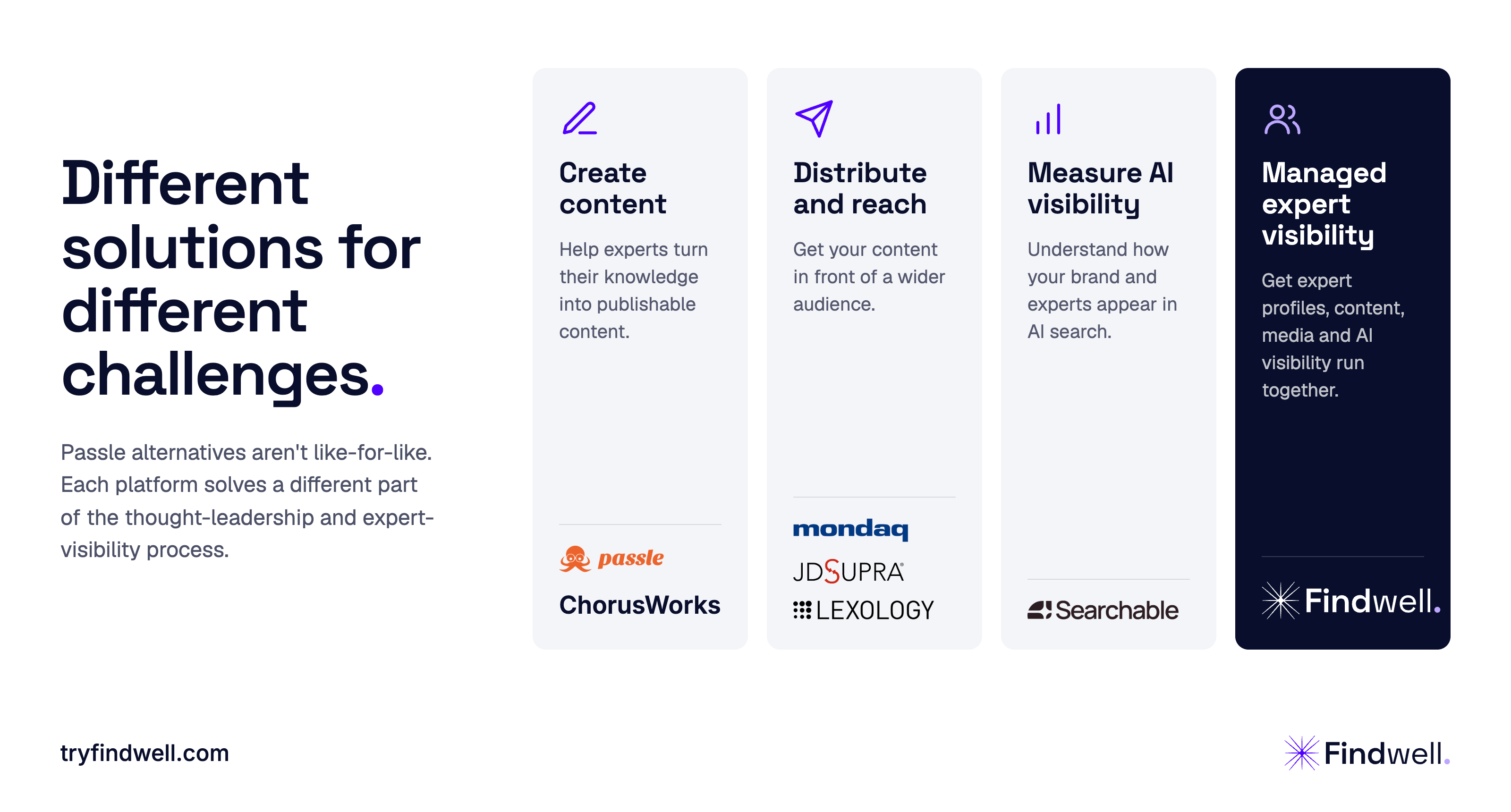
For most firms, the comparison falls into four broad areas: creating content, taking work off busy experts, distributing existing insight, and measuring visibility in search and AI.
| Option | Best fit | Model | Where it differs most from Passle |
|---|---|---|---|
| Findwell | Firms that want expert visibility run for them | Managed platform + service | Brings expert profiles, content, media coverage and search/AI visibility into one managed programme |
| ChorusWorks | Firms that want more people creating on-brand content | Software | Stronger focus on AI-assisted creation, shared planning and individual voice |
| Mondaq | Firms already producing content that need more reach | Distribution + analytics | Amplifies existing content and adds readership intelligence |
| JD Supra | Law firms that want legal and in-house audiences | Distribution + audience intelligence | Built around legal thought-leadership distribution and readership data |
| Lexology | Law firms that want global legal research visibility | Publishing + research platform | Places expert content inside a large legal intelligence ecosystem |
| Searchable | Teams focused on AI-search performance | AI visibility software | Tracks brand visibility, prompts, citations and competitors across AI search |
| Your own stack | Larger teams with strong internal marketing resource | Multiple tools + internal team | More control, but more operational overhead |
Findwell: best for managed expert visibility.
Full disclosure: Findwell is our platform. It belongs in this comparison because it tackles much of the same underlying challenge as Passle, but with a different operating model.
Passle makes it easier for professionals to create and share their own thought leadership. Findwell is built for firms that would rather take more of that work away from the expert.
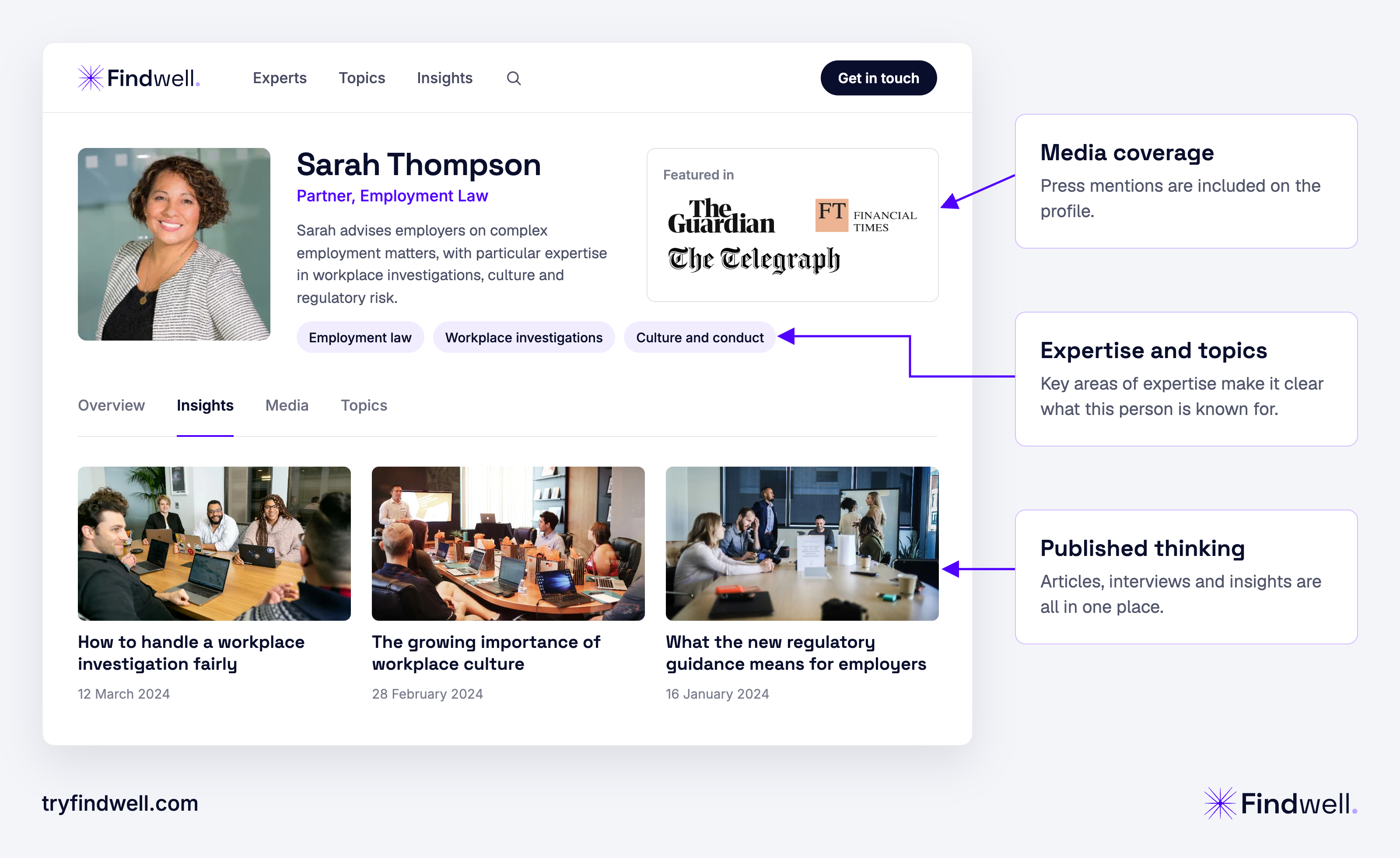
A Findwell hub sits on the firm's own domain. Each selected expert gets a permanent profile page that brings together their expertise, published thinking and press coverage. New material is added over time, so the page becomes a growing record of what that person knows rather than a biography that is updated once every few years.
Findwell expert profile pages are designed to give search engines, AI systems, journalists and prospective clients a clearer view of the person behind the expertise.
The wider service combines:
- expert profile pages
- topic pages
- an expert directory
- expert content
- media coverage
- newsletters
- AI visibility monitoring
- analytics and reporting
The editorial and press work is handled by Profile's team. The platform is where that work is organised and made visible. Findwell's services currently cover expert content, media coverage and expert newsletters.
For firms where partner time is the real constraint, that difference is significant. The programme does not rely on every expert becoming a regular writer, publisher or LinkedIn creator.
Findwell also puts more weight on the visibility of the individual expert. A firm can rank well for a service while the people who actually deliver that service remain difficult to find. The hub is designed to connect subjects, content, press coverage and named experts more clearly.
Findwell's AI visibility feature extends that into answer engines, with monitoring around whether experts are appearing for the questions buyers ask.
Findwell fits best when.
- expertise is commercially important but partner time is limited
- team biographies are static and do little to demonstrate authority
- useful content and press coverage are scattered across different parts of the web
- the firm wants to improve the visibility of named experts, not only the corporate brand
- marketing wants one programme spanning owned content, media, search and AI visibility
It is less suitable when.
The requirement is mainly a self-service publishing tool for a large number of employees. Firms that want hundreds of people logging in, drafting and publishing for themselves are closer to Passle's traditional use case.
- Expertise
- Published thinking
- Media coverage
- Topics
ChorusWorks: best for helping more people create content.
ChorusWorks sits much closer to Passle on the creation side of the market.
It describes itself as an "expertise-to-content system" for expertise-led businesses. The product brings research, planning, content creation, review and publishing into one workspace, with individual voice profiles and company messaging shaping the drafts. It can also capture raw material such as voice notes and turn it into material for articles, LinkedIn posts and branded content. ChorusWorks' product overview sets out that workflow in detail.
The appeal is straightforward for a marketing team that knows the expertise exists but struggles to turn enough of it into publishable material. Colleagues can contribute in different ways: some can supply an idea, some can draft, and some can prepare content on behalf of a senior person for approval.
Human review remains part of the process, which is useful in professional services where tone, accuracy and reputation matter.
Passle and ChorusWorks therefore overlap more directly than most of the options in this guide. Both are designed to increase the amount of useful expertise a firm publishes. ChorusWorks leans heavily into AI-assisted creation, shared planning and maintaining individual voice across a team. Passle has a longer-established professional-services publishing workflow and a wider platform that now extends into cross-selling through CrossPitch AI.
ChorusWorks fits best when.
- the firm's experts are willing to contribute but need a much easier creation process
- marketing wants to capture ideas from across the business
- personal voice and central brand control both matter
- the team wants a shared content workspace rather than a fully managed service
Mondaq: best for extending the reach of content you already have.
Mondaq is less about producing thought leadership and more about what happens after it has been published.
The platform describes itself as a global provider of content marketing, data and analytics for professional-services firms. More than 1,500 firms contribute content to Mondaq, and the company says its platform reaches 20 million readers worldwide. It also provides readership data and integrations that can support CRM, reporting and business-development activity. Mondaq's company overview gives the current figures and distribution model.
For a firm with an established editorial operation, that can be more useful than another writing tool. Good content already exists; the missing piece is distribution.
Mondaq also distributes material through external publishing partners. That makes it useful for extending the life of insight that would otherwise sit primarily on the firm's own site and social channels.
It is better thought of as a complement to a creation workflow than a direct replacement for one. A firm could use Passle, an internal editorial team or another system to create the material and use Mondaq to increase reach and gather audience intelligence.
Mondaq fits best when.
- the firm already publishes consistently
- distribution is a bigger constraint than production
- marketing wants better insight into who is reading
- readership data can feed into BD or CRM activity
JD Supra: best for legal thought-leadership distribution.
JD Supra is particularly relevant to law firms because its audience and distribution model are built around legal and business expertise.
Its Visibility product distributes thought leadership through JD Supra's site, subscriber channels, editorial coverage and wider syndication. The platform also provides readership intelligence so firms can see more than raw pageviews. JD Supra's Visibility overview explains how that distribution works.
The case for legal thought leadership is not based only on search traffic. JD Supra and LIMELIGHT's 2026 research found that corporate counsel and senior business leaders continue to consume legal thought leadership frequently. The 2026 JD Supra/LIMELIGHT report explores how that content influences trust, relevance and buying behaviour.
For a law firm already producing strong commentary, JD Supra can therefore address a very specific problem: getting that expertise in front of legal buyers and people who actively consume legal analysis.
The limitation is equally clear. Distribution cannot rescue a weak or irregular content programme. If the bottleneck sits with authorship, editing or approvals, it needs to be fixed earlier in the process.
JD Supra fits best when.
- the firm is already producing strong legal insight
- in-house counsel and senior legal buyers are priority audiences
- readership intelligence matters to marketing and BD
- distribution, rather than creation, is the main gap
Lexology: best for legal research and discovery.
Lexology has a broader legal-intelligence role.
Its platform currently carries content from more than 900 contributing law firms across more than 170 jurisdictions and 50 work areas. Alongside articles and guides, Lexology offers research tools, regulatory monitoring, cross-jurisdiction comparison and AI search. Lexology's About page sets out the current scale and product mix.
This makes Lexology useful to firms that want their expertise to appear inside an established research environment used by legal professionals. It is not primarily a system for persuading a partner to write more often.
For firms with a substantial library of legal insight, the value is in external discovery. Content can remain on the firm's own domain while also gaining exposure in places where lawyers and in-house teams already conduct research.
That means Lexology and Passle can sit in the same stack. One can support the firm's internal thought-leadership operation while the other broadens where that expertise is encountered.
Lexology fits best when.
- legal research audiences are important
- the firm already has a regular flow of useful content
- international or cross-jurisdiction visibility matters
- the priority is discovery rather than authoring workflow
Searchable: best for AI visibility measurement.
Searchable addresses a newer part of the visibility stack.
Rather than focusing on professional-services publishing, the platform tracks how brands appear across AI search. Its current product covers prompt tracking, citation tracking, competitive analysis, site audits and reporting across services including ChatGPT, Google AI Overviews and Perplexity. Searchable's current plans start with 100 tracked prompts per model on its Pro tier and scale up for larger teams.
This is useful once a marketing team needs evidence rather than anecdotes about AI visibility. A handful of manual ChatGPT searches will not show whether a brand's visibility is improving, which prompts matter most, or which competitors are being surfaced more consistently.
It still solves a different problem from Passle.
Passle supports the production and distribution of expertise. Searchable measures how brands and content perform in AI-generated results.
Measurement may reveal a visibility gap, but it does not remove the work required to close it. If an expert is absent from AI answers, the underlying issue may sit with the quality of their owned pages, subject-specific content, third-party references or the clarity of the signals connecting that person to the topic.
Searchable fits best when.
- the firm already has the resources to create and optimise content
- AI visibility is now a meaningful reporting requirement
- marketers need prompt, competitor and citation data
- measurement is the gap rather than execution
Building your own stack: best for teams with enough resource to run it.
A single platform is not the only route.
A mature marketing function can build its own system from the tools and suppliers it already uses. That might include the firm's CMS, an editorial team, PR, LinkedIn, email, Mondaq or Lexology, SEO software, AI visibility monitoring, analytics and CRM.
The upside is control. Each part can be selected independently, and the firm is not forced into one vendor's workflow.
The cost is coordination.
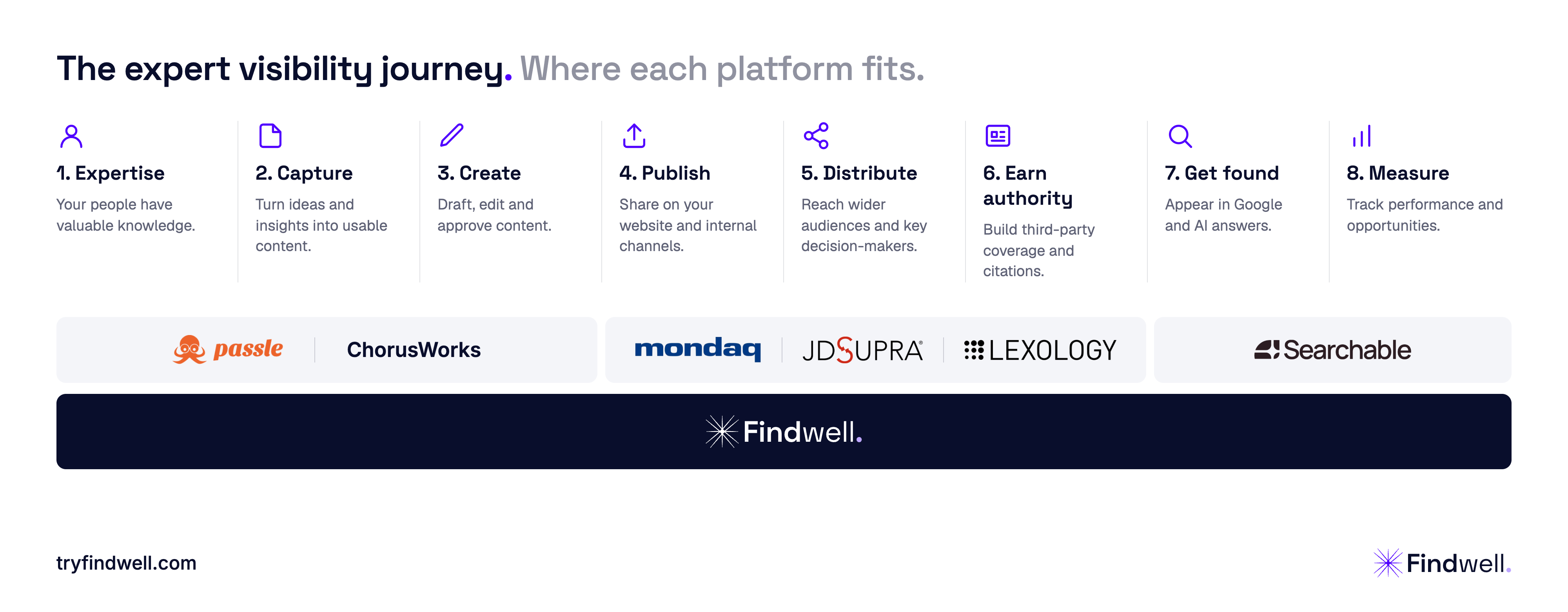
Someone still has to decide which experts to prioritise, capture their ideas, commission or write the content, manage approvals, publish it, distribute it, pitch relevant media, repurpose the strongest material and connect the results back to marketing or pipeline.
For teams with enough people and a mature process, that may be exactly the right model. For leaner teams, the operational burden is often the reason they look for a platform or managed service in the first place.
A custom stack fits best when.
- the firm already has substantial editorial, PR, SEO and marketing operations
- specialist tools are preferred over one integrated system
- internal ownership is clear
- the team has enough capacity to manage the hand-offs
The useful comparison is the bottleneck, not the feature list.
Most Passle-alternative pages reduce the market to a large feature table. That can be useful for procurement, but it is a poor starting point for strategy.
The products above sit at different points in the same visibility process.
| Current bottleneck | Options worth looking at first |
|---|---|
| Experts have useful ideas but do not publish consistently | Passle / ChorusWorks |
| Strong experts are difficult to find or assess online | Findwell |
| The firm produces plenty of content but reach is limited | Mondaq |
| Legal buyers and media are the main audience | JD Supra |
| Legal research and international discovery matter | Lexology |
| The team cannot measure performance in AI search | Searchable |
| The firm wants full control and has the resource to manage it | Build your own stack |
| The firm wants expert pages, content, PR and visibility managed together | Findwell |
Six things worth checking before you choose
1. The amount of work left with the expert.
This is one of the biggest practical differences between the options.
A platform can look excellent in a demo and still fail if the operating model depends on partners finding time every week to write, edit and publish.
Some firms have highly engaged authors and want to make that behaviour easier. Others need to remove most of the production work from their experts. The product should fit the behaviour that exists in the firm, not the behaviour marketing hopes will appear after launch.
2. Creation and distribution are separate problems.
Low publishing volume and low readership can look similar in a dashboard, but they need different fixes.
A firm publishing two pieces a month because nobody has time to write needs a better creation process.
A firm publishing forty strong pieces a month that attract very little of the right audience needs better distribution.
Buying against the wrong bottleneck simply adds another tool.
3. Owned visibility still matters.
Third-party platforms can deliver valuable reach, especially in sectors such as legal services where buyers already use specialist publications and research products.
The strongest programmes still build an owned asset at the same time.
For an individual expert, a permanent page on the firm's domain gives their expertise, content and external proof a stable home. It also means a search for that person can lead to a source controlled by the firm rather than only LinkedIn, directories or third-party articles.
Findwell's expert profile pages are built around that principle.
4. Expert visibility is not the same as brand visibility.
A firm can be well known while many of its individual specialists remain difficult to discover.
That matters in professional services because buyers, journalists and referrers often need a person, not a logo.
The stronger the connection between an expert, the subjects they cover, the content they have produced and the external sources that reference them, the easier it becomes to assess their relevance.
This also matters for AI search, where vague corporate claims are less useful than clear evidence connecting a named person with a specific subject.
5. Publication should create more than one asset.
A strong piece of expert insight can work much harder than a single webpage.
The same material might support a LinkedIn post, newsletter, media pitch, client email, topic page, expert profile and future sales conversation. External coverage can then add another layer of evidence around the expert.
A content platform that only increases the number of URLs published may improve output without improving visibility.
6. Measurement should match the commercial objective.
Pageviews are useful, but professional-services marketing rarely ends with pageviews.
Depending on the programme, stronger measures may include:
- readership from target companies
- repeat visitors
- organic search impressions and clicks
- named expert searches
- newsletter subscribers
- earned media coverage
- backlinks and citations
- visibility in AI answers
- enquiries
- influenced opportunities
Mondaq and JD Supra both make audience intelligence a visible part of their propositions, while Searchable focuses specifically on AI visibility and citations. Findwell combines visibility data with the expert pages and content being managed inside the hub.
Choosing between the main options.
Findwell makes the most sense when the firm wants a managed programme built around the visibility of named experts, with owned profiles, content, media and search/AI visibility connected in one place.
ChorusWorks is a stronger fit when the main aim is to help more people inside the business capture ideas and turn them into on-brand content themselves.
Mondaq suits firms with a healthy content engine that need wider professional-services distribution and richer readership data.
JD Supra is particularly relevant for law firms that want stronger distribution to legal and business audiences.
Lexology suits legal teams that value global research visibility and discovery inside a mature legal-intelligence ecosystem.
Searchable makes sense when AI-search measurement has become a priority and the firm already has the people needed to act on the data.
A custom stack remains a good option for large marketing teams with the resource to own every part of the workflow.
Where Findwell sits.
Findwell was built around a problem we kept seeing in professional services: firms had credible people, useful ideas and occasional media coverage, but the evidence around each expert was fragmented.
The website bio lived in one place. Articles lived somewhere else. Press coverage disappeared into an archive. LinkedIn had another version of the person's expertise. None of it formed a particularly strong picture of what that individual should be found for.
Findwell brings those signals together around the expert.
The profile provides the permanent owned page. Topic pages organise the subjects the firm wants to own. New content gives the expert something useful to say. Media coverage adds independent evidence. Search and AI monitoring show whether that work is translating into visibility.
It is not a publishing tool with a few extra reporting features, and it is not simply an AI rank tracker.
It is a managed expert-visibility programme for firms that want their people to be findable, and worth finding.
See how Findwell works
Frequently asked
What is Passle?
Passle is a platform built for legal and professional-services firms. Its current offering combines a Thought Leadership Suite, designed to help professionals create and distribute expertise, with CrossPitch AI for cross-selling and relationship intelligence. Passle's current platform overview explains both parts of the product.
What are the main alternatives to Passle?
The main alternatives depend on the job the firm needs to solve. Findwell offers a more managed expert-visibility model. ChorusWorks focuses on helping teams create on-brand thought leadership. Mondaq, JD Supra and Lexology are stronger on distribution and discovery. Searchable focuses on AI-search measurement. Larger marketing teams can also build the workflow themselves using several specialist tools.
Is Findwell a direct Passle competitor?
There is overlap, but the operating models are different. Passle is built around enabling professionals to create and distribute more of their own thought leadership. Findwell builds an owned expert hub and pairs it with content, media coverage and search/AI visibility work delivered by Profile's team.
Can a firm use Passle and Findwell together?
Potentially, yes. A firm could use Passle as a publishing workflow across a broad group of professionals while using Findwell more selectively around priority experts whose profiles, content, media presence and search / AI visibility need deeper investment. The two products do not have to be mutually exclusive.
Can an existing CMS replace Passle?
For some firms, yes. A CMS can handle publishing perfectly well. What it usually does not provide by itself is the operating model around expert participation, editorial workflow, distribution, audience intelligence or AI visibility. Firms with strong internal marketing teams can build those layers themselves.
Does thought leadership help with AI visibility?
Useful expert content can strengthen the evidence connecting a person or firm with a topic, especially when it sits alongside clear owned pages and credible third-party references. It does not guarantee that ChatGPT or another answer engine will cite the expert. AI visibility is influenced by a wider set of signals than publishing volume alone.
Which Passle alternative is best for a law firm?
For a law firm, the choice depends on the bottleneck. Findwell is relevant when the firm wants a managed expert-visibility programme. ChorusWorks is closer to the content-creation problem. JD Supra and Lexology are strong distribution and discovery options for legal audiences. Searchable is more relevant when measuring AI-search visibility is the priority.
See your experts, found.
A 30-minute walkthrough, tailored to your firm, of where your experts would rank and what it would take.