The expert-page structure that Google rewards in 2026.
A field guide to the on-page signals that move specialist profiles up the results, and the ones that quietly hold them back.
 Jordan GreenawayFounder, Profile
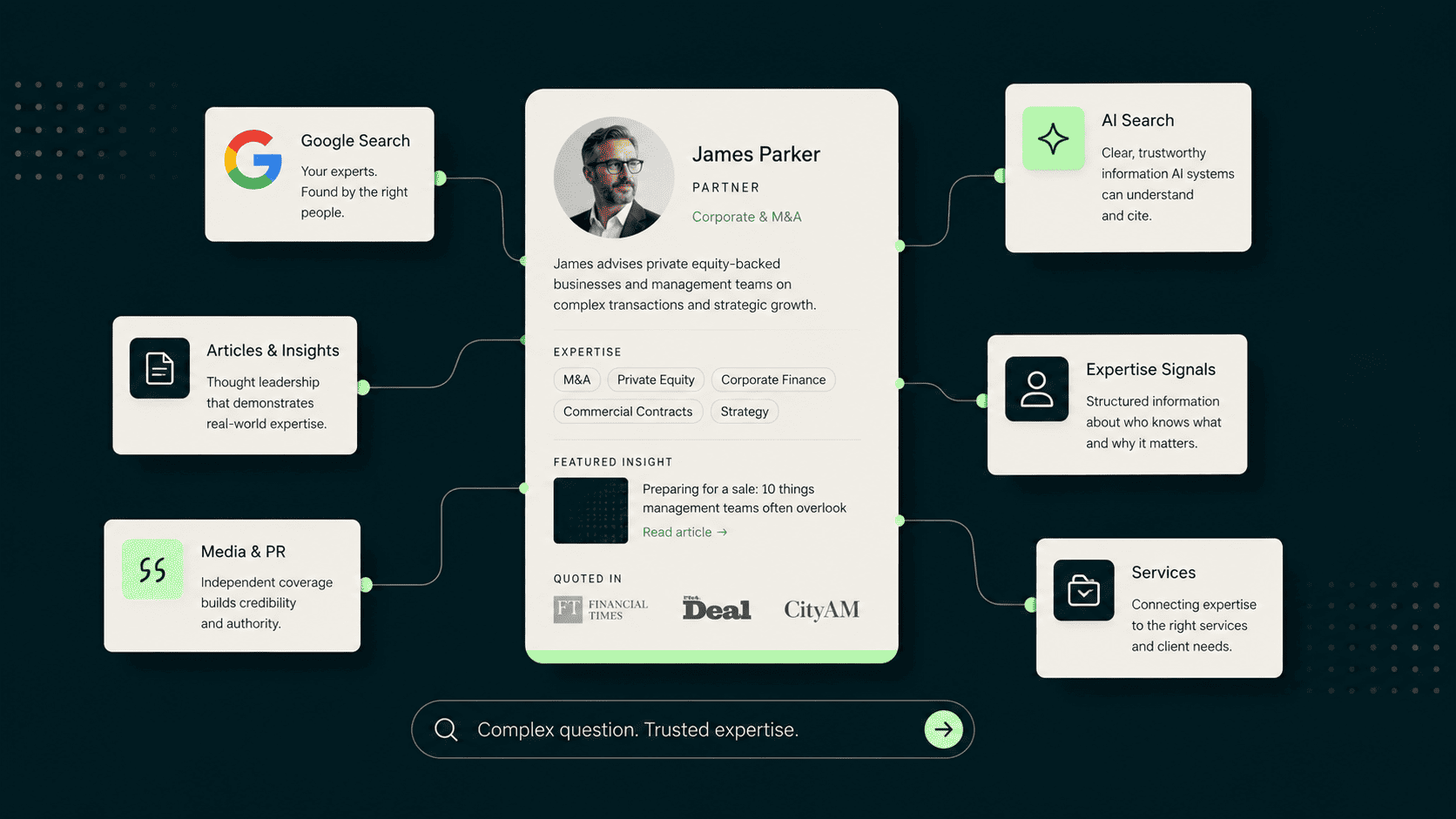
Most firms have a people page. Very few have expert pages that rank. The difference is not design, and it is not word count. It is whether the page gives a search engine enough to understand who this person is, what they know, and why anyone should believe it.
Here is the structure that works, in the order we build it.
Start with the entity, not the page.
Before anything else, settle how the person is named. One spelling, one form, everywhere. Your site, LinkedIn, conference listings, bylines, the lot.
This sounds trivial. It is the single most common reason a well-written profile fails to gather any authority, because three name variants means three weak entities instead of one strong one.
Tie it together explicitly. Link from the profile to the person's professional accounts and their published work elsewhere, and make sure the same links point back where you control them.
Give the page something to be about.
A profile that lists a job title, a qualification and a phone number is a directory entry. It ranks for the person's name, which they were going to win anyway, and nothing else.
An expert page earns its keep when it states a view. What does this person actually think about the two or three questions clients bring them? Put that near the top, in their words, in full sentences.
The test is simple. Could a journalist quote a paragraph of this page and have it stand up as a comment? If not, there is nothing here for a search engine either.
Structure the page predictably.
- One h1, the person's name. Not "Our team", not the job title.
- A stated specialism in the first fifty words. Plain language, the words clients use, not internal service-line names.
- Sections with real headings. Areas of focus, recent thinking, selected coverage, qualifications. Headings are how both readers and crawlers navigate.
- Recent thinking, on the page. Not a link to a separate blog index. The three most recent pieces, with dates, right there.
- Selected coverage, with outbound links. Where this person has been quoted or published, linked to the original.
See how your experts' pages score against this today.
Add the structured data.
Mark the page up as a Person, connected to your Organization, with sameAs links to the profiles you just tidied. Where the person has published articles, mark those as Article or BlogPosting with a real author reference back to the Person.
This does not make anyone rank on its own. What it does is remove ambiguity, and ambiguity is what stops a search engine from treating your specialist as a known entity rather than a string of text on a page.
Keep it alive.
Recency is doing more work than it used to. A profile that last changed eighteen months ago reads as an archive, however good it is.
The fix is not to fiddle with the page. It is to publish. Every new piece of thinking updates the profile, adds an internal link, and gives the page a reason to be recrawled.
A realistic cadence.
One substantial piece per expert per month is plenty, and it is achievable if someone else does the writing. Two a year is not a programme, it is a gesture, and it will not hold a ranking.
What we would fix first.
If you only change one thing this quarter, make it the entity. Get every expert named identically everywhere, link the profiles together properly, and mark them up. It is unglamorous, it takes a week, and it is the foundation everything else compounds on.
Design, tone and page speed all matter. They matter after this.
See your experts, found.
A 30-minute walkthrough, tailored to your firm, of where your experts would rank and what it would take.