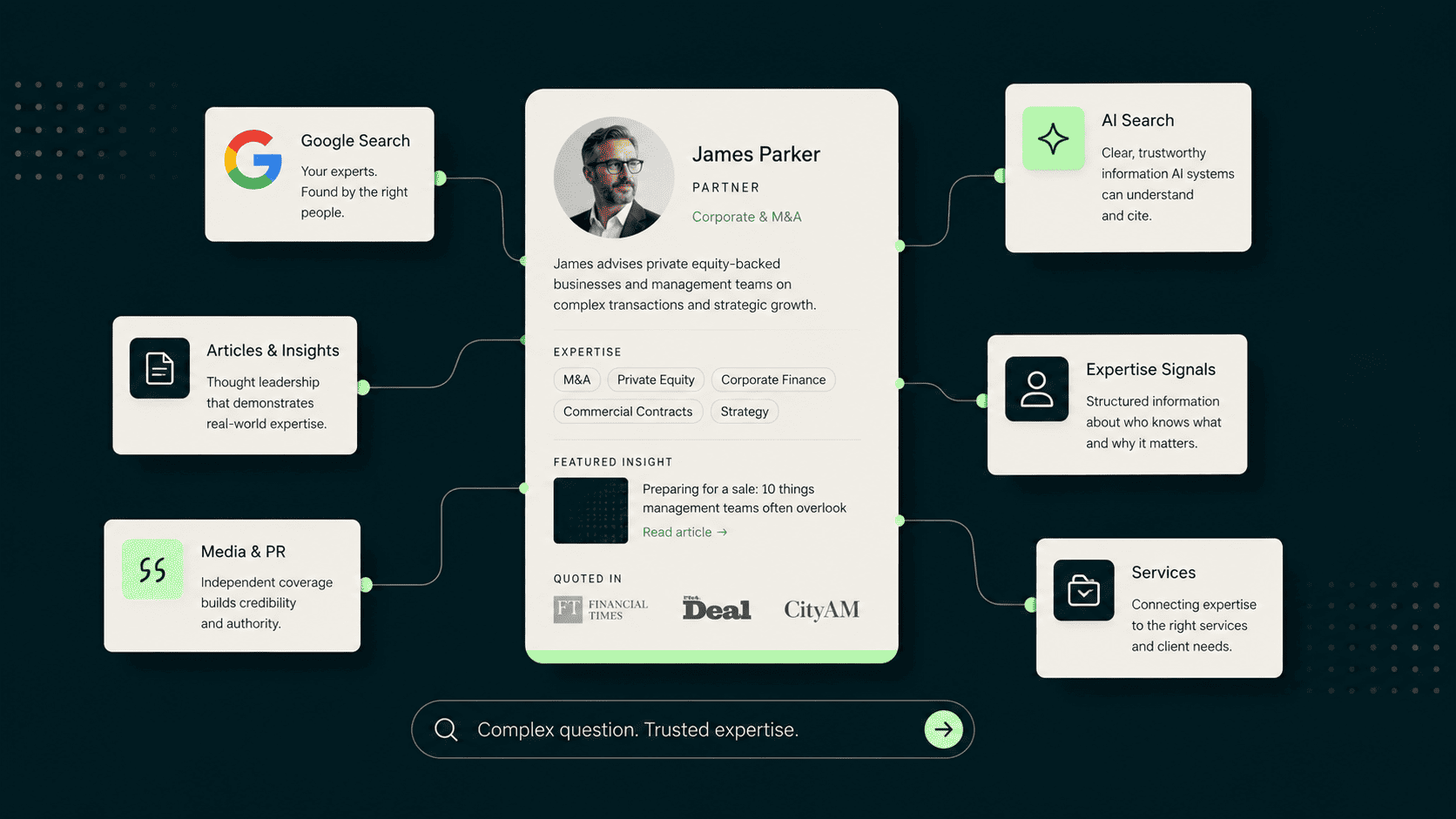
Why your best expert is invisible to ChatGPT, and how to fix it.
Buyers now ask an answer engine before they ask a colleague. Here is what actually decides whether your experts get named in the reply.
 Jordan GreenawayFounder, Profile
Key takeaways.
Your strongest expert may be the person clients call when the problem gets difficult.
Search their name online and their credentials look solid. Ask ChatGPT the same kind of question those clients would ask, though, and somebody else appears.
That does not necessarily mean the competitor is more authoritative.
It means that somewhere between the public web and the final AI answer, your expert is being filtered out.
The useful question is not “How do we rank in ChatGPT?” It is “Where is the visibility chain breaking?”
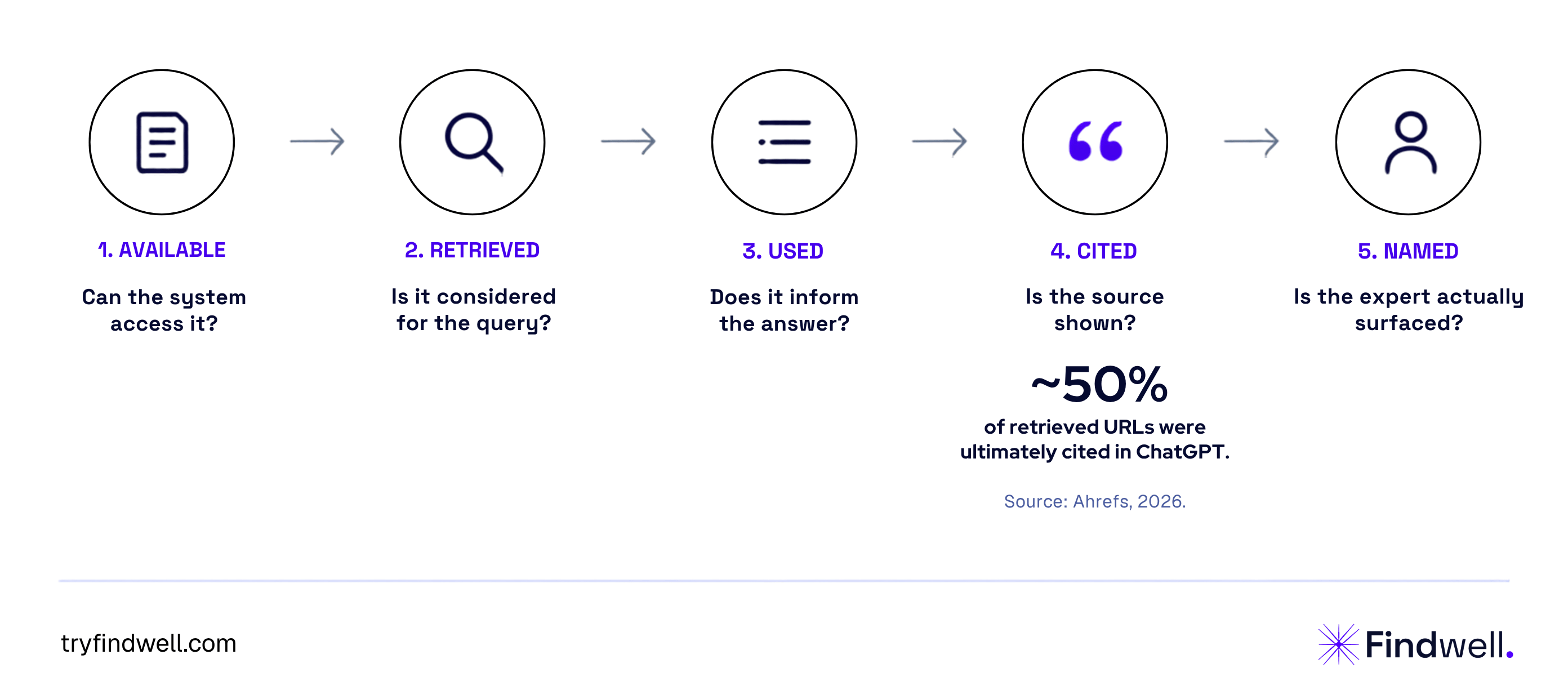
In a 2026 study of 1.4 million prompts, Ahrefs found that ChatGPT ultimately cited only around half of the URLs that appeared in its retrieval pipeline.
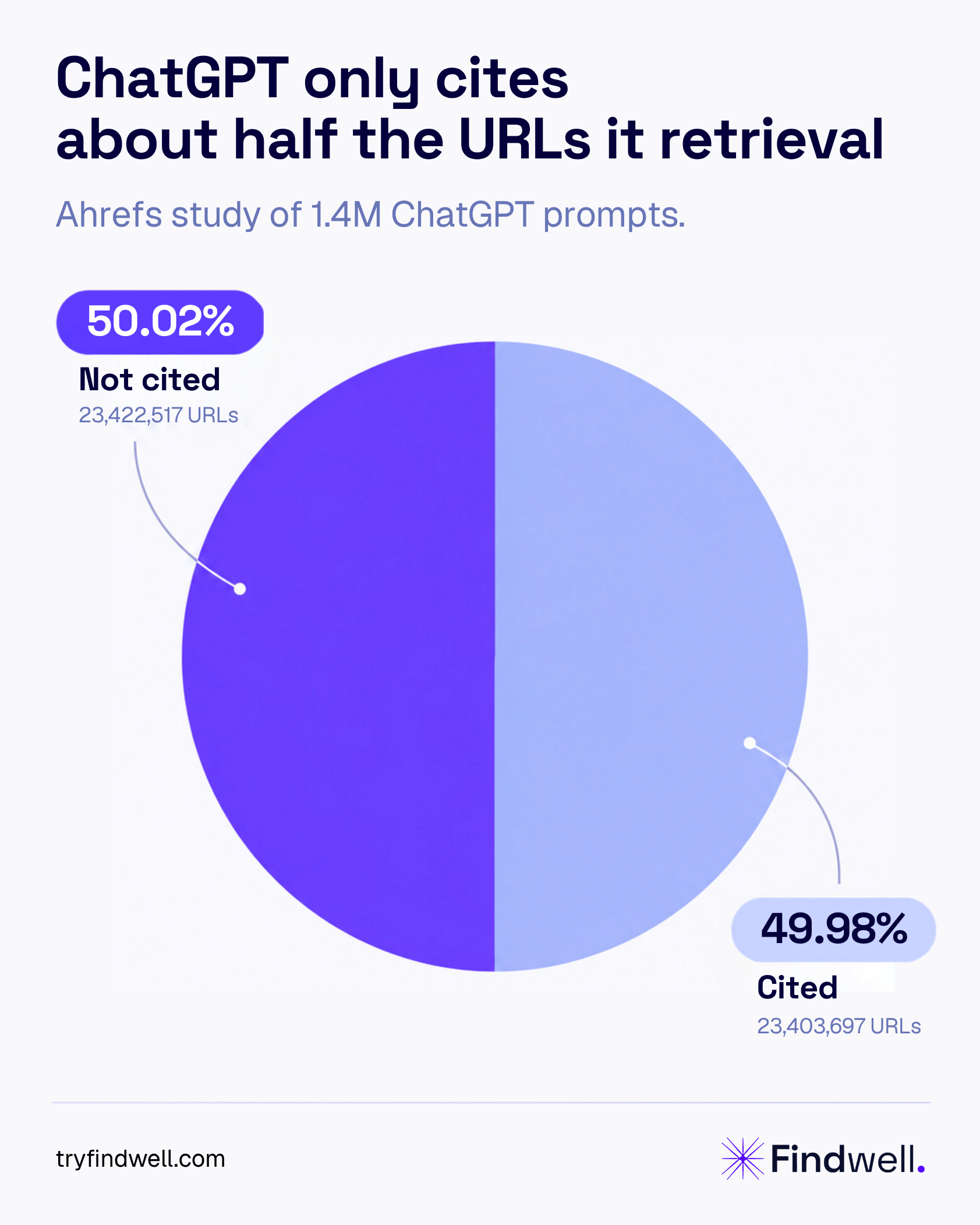
That distinction is the starting point for diagnosing AI visibility properly.
Being online is not the same as being visible.
"AI visibility" is often treated as if it were one event.
In practice, there are several stages between publishing information and seeing an expert named in an answer.
| Stage | What to check |
|---|---|
| Available | Can the system access the information at all? |
| Retrieved | Does the page enter the candidate set for the question? |
| Used | Does the information contribute to the answer? |
| Cited | Does the page become a visible supporting source? |
| Named | Does the answer connect the expertise to your person or firm? |
A page can rank in Google and still not be cited by ChatGPT. A firm's article can be cited while the individual expert is never named. An expert can appear for one wording of a question and disappear when the prompt changes.
That is why it helps to think in stages rather than chase one vague "AI visibility" score.
A 2026 academic review of 45 GEO studies describes generative search in similar terms: a multi-stage, partially observable process covering discovery, retrieval, context selection, citation and downstream behaviour. The same review found no technique that had yet demonstrated a stable, long-term, cross-platform causal effect on organic AI discoverability.
So before trying to optimise anything, work out which stage is actually failing.
Five checks to diagnose an invisible expert.
1. Can AI systems access the expert's content?
Start with the boring checks.
Is the profile public and indexable? Can normal crawlers reach it? Is the useful information present in accessible HTML rather than hidden inside an old PDF, image or gated document?
For ChatGPT Search specifically, OpenAI says any public website can appear and recommends allowing OAI-SearchBot if publishers want their content to be discovered, surfaced and clearly cited.
Quick check:
- robots.txt
- noindex directives
- broken or redirected expert pages
- internal links to the profile
- important information hidden behind forms or logins
If all of that is fine, move on.
The problem is probably not technical access.
2. Can the web identify the expert consistently?
Next, test identity.
Try three searches:
- "Full Name" + firm
- "Full Name" + specialist topic
- "Full Name" -site:firm.com
You are not doing a vanity search. You are checking whether the public web presents a coherent picture of the same person.
Look for a consistent name, current role, clear authorship and repeated association with the same areas of expertise.
A useful diagnosis If the first search returns the right profile, the second returns almost nothing relevant and the third removes nearly all evidence of expertise, the person may be easy to identify as an employee but difficult to identify as an authority on the subject.
Findwell's expert profile pages are designed to give that identity and body of work one consistent home.
3. Is the expert actually associated with the right subjects?
Expertise can be obvious internally and almost invisible externally.
Choose three subjects the expert should genuinely be known for and search each one alongside their name.
For example:
- "Full Name" + cross-border restructuring
- "Full Name" + directors' duties
- "Full Name" + distressed M&A
Then look at what actually appears.
Do you see substantive content, a useful profile, interviews and commentary? Or just a broad biography?
Expertise that exists only in people's heads cannot be retrieved from the web.
The fix is not to publish dozens of pages. It is to make the relationship between the person and the subject clearer with genuinely useful evidence.
For the broader strategy behind that, see our AEO for law firms guide and our breakdown of the expert-page structure that Google rewards.
4. What sources are shaping the answer?
This is where many AI visibility audits stop too early.
They ask: Did our firm appear?
A better first question is: What sources did the answer use?
Take one commercially relevant buyer question and record:
- which domains were cited
- what type of sources they were
- which experts or firms appeared
- whether owned content was used
- whether specialist publications appeared
- how the source mix changed when the question changed
This matters because AI systems do not use the same sources for every type of query.
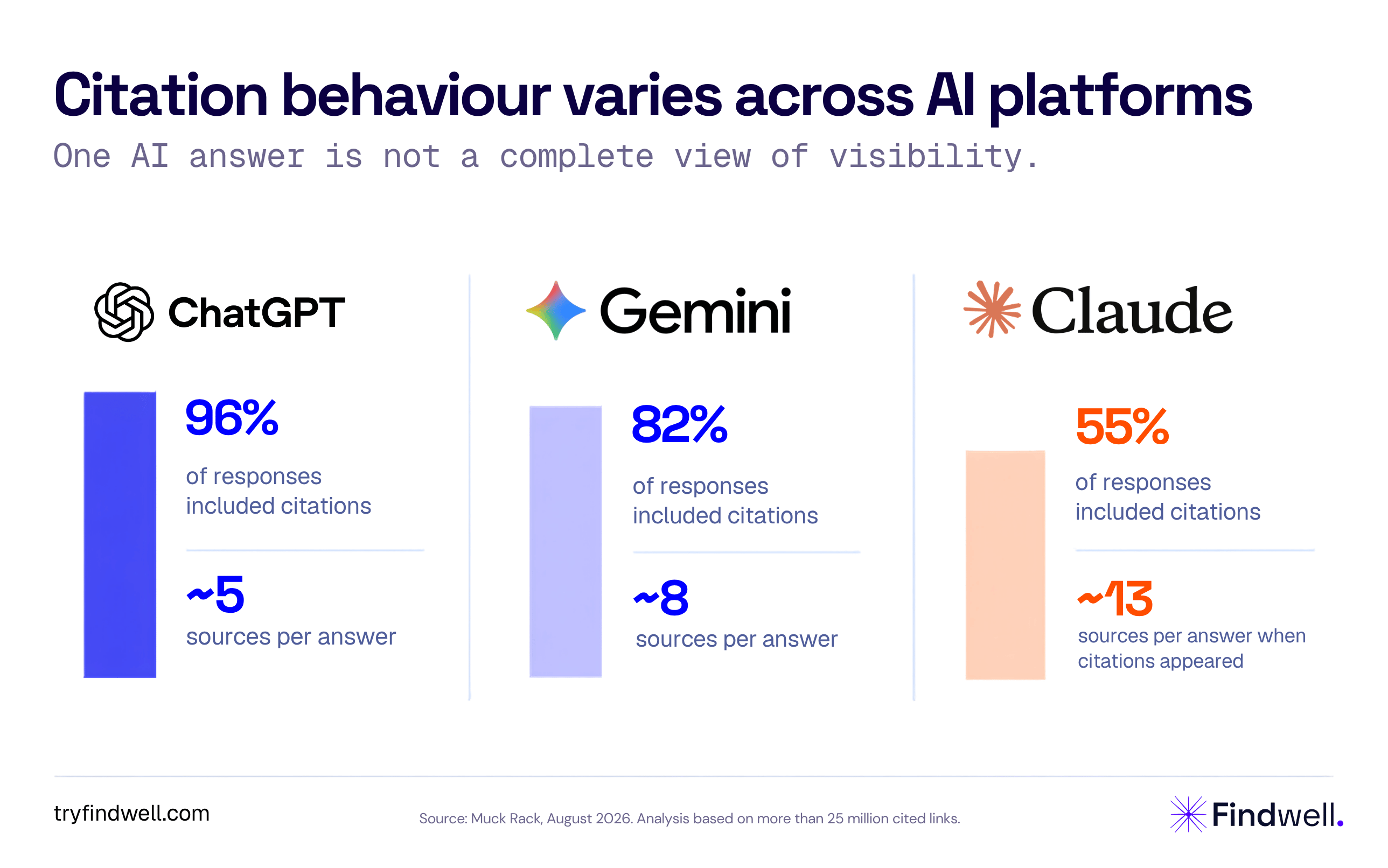
Muck Rack's August 2026 analysis of more than 25 million cited links found meaningful differences by query type, industry and platform. In its dataset, industry-trend questions relied on journalism much more heavily than how-to and comparison questions.
Its broader research has also found a large role for earned media in AI citations, but the more useful takeaway is not "get more PR". It is to identify which sources already shape the conversations you care about.
| Instead of asking | Better ask |
|---|---|
| How much coverage do we have? | Which sources are influencing the answers we want to appear in, and are our experts represented there? |
Findwell's media coverage approach is built around relevant authority rather than coverage volume for its own sake.
5. Is this really a ChatGPT problem, or a prompt and platform problem?
One answer is not a dataset.
Test the same underlying intent several ways.
If the buyer question is:
Which advisers have experience with X?
also try:
- Who are the specialists in X?
- Which firms are known for X?
- Who has written recently about X?
- What sources should I read to understand X?
Then repeat the set.
Muck Rack's 2026 research found substantial differences in citation behaviour and source mix across ChatGPT, Gemini and Claude. The academic GEO review also highlights run-to-run variability and recommends repeated measurements and prompt paraphrases rather than relying on one output.
One screenshot is an anecdote. Repeated prompts are measurement.
A 30-minute expert visibility audit.
You do not need a large software project to get an initial diagnosis.
| Test | What to do | What it tells you |
|---|---|---|
| Access | Check the profile and key content are public, indexable and available to relevant crawlers | Whether there is a technical barrier |
| Identity | Search the expert's full name with the firm | Whether public identity is consistent |
| Topic association | Search the name with three priority subjects | Whether the web connects the person to the expertise |
| Independent footprint | Search the name while excluding the firm's domain | Whether meaningful evidence exists beyond owned content |
| AI answer | Run 10 representative buyer questions | Where the expert appears and for which intents |
| Sources | Record the cited domains and pages | What evidence is shaping the answer |
| Competitors | Record firms and experts appearing instead | What they have that you may not |
| Repeatability | Repeat the same set over time | Whether visibility is becoming more consistent |
Do not score this out of 100 after one run. The point is to identify the gap.
What the latest research actually tells us.
Search still feeds AI discovery.
Ahrefs found that general web search was an important route through which URLs entered ChatGPT's citation pipeline.
That does not mean ranking number one on Google guarantees a ChatGPT citation.
It means traditional search discoverability still matters because search is one route through which candidate sources enter the system.
Google makes the same broader point in its own guidance. Its 2026 generative AI search guidance says normal SEO foundations still matter and places particular emphasis on valuable, unique, non-commodity content based on genuine knowledge and experience.
Relevance matters more than vague presence.
Ahrefs also found that cited candidates tended to align more closely with the question and retrieval context than candidates that were not cited.
That is correlation, not a guaranteed optimisation tactic.
But it supports a sensible diagnostic principle:
If the page is only loosely related to the question, do not assume authority alone will carry it.
External evidence matters, but context matters more than volume.
Muck Rack's research shows that editorial and earned sources make up a substantial part of the citation ecosystem in its datasets.
Its newer work also shows why that should not be simplified into "get more press". Different questions rely on different source types.
The useful task is to understand which sources shape your category and your buyer questions.
Fix the failure you actually found.
| If the problem is... | Fix this first |
|---|---|
| Content cannot be accessed | Crawlability, indexing and internal linking |
| Identity is fragmented | Profile, name, role, bylines and professional references |
| Topic association is weak | Useful expert-led material around the missing subject |
| Competitors dominate cited sources | Investigate those sources and the evidence competitors have there |
| Your page is retrieved but not used | Relevance, framing, distinctiveness and expert attribution |
| Visibility changes every run | Expand the prompt sample before changing strategy |
Do not jump from "we are not appearing" straight to "we need more backlinks" or "we need more PR".
The evidence may point somewhere else.
Findwell's expert content is built around capturing the missing expertise without asking the expert to become a full-time writer.
What not to conclude from an AI visibility audit.
"We need more backlinks." Maybe. But the issue may be identity, relevance or source selection instead.
"We need more PR." Not necessarily. A large volume of unrelated coverage is not the same as appearing in the sources shaping the questions your buyers ask.
"We need an llms.txt file." Not for Google Search. Google's current guidance says no special AI file or markup is required for its generative search features.
"We need hundreds of AI-targeted pages." Google explicitly recommends useful, distinctive, people-first content rather than scaled pages targeting every possible query variation.
"The expert appeared once, so we have fixed it." One output does not demonstrate stable visibility.
Make your experts easier to find.
Diagnosis is the first step.
The harder part is fixing the gaps consistently across dozens of busy experts.
Findwell connects each expert to the subjects they should be known for, the content that demonstrates that knowledge, relevant external coverage and the visibility signals that show whether those relationships are becoming easier to find.
It gives the expertise a structured home without asking the expert to become a full-time content creator.
See where your experts are invisible
Frequently asked
Why doesn't my expert appear in ChatGPT?
There is rarely one reason. The problem may sit at the access, identity, topic, relevance, source or citation stage. Start by diagnosing where the evidence chain breaks rather than assuming you simply need more content.
Does ranking highly on Google mean ChatGPT will cite you?
No.
Search visibility can help content enter retrieval pathways, but ranking in Google does not guarantee that ChatGPT will use, cite or name the source.
Does ChatGPT only trust third-party sources?
No.
Both owned and external sources can appear in AI answers. The source mix varies by platform, industry and type of question.
Does media coverage guarantee AI visibility?
No.
Relevant media coverage can create additional public evidence around an expert, but no individual article or publication guarantees that the expert will appear in an AI answer.
How should I test an expert's ChatGPT visibility?
Use a defined set of commercially relevant questions, create several prompt variations, record the experts and sources that appear, and repeat the same process over time.
How often should we check AI visibility?
A monthly reporting cadence is a practical starting point for most marketing teams. The point is consistency of measurement, not because AI systems are known to operate on a monthly ranking cycle.
See your experts, found.
A 30-minute walkthrough, tailored to your firm, of where your experts would rank and what it would take.