AI search optimisation checklist for professional services firms (2026).
A practical 15-point audit for professional services firms, with technical checks, expert-profile improvements and a monthly AI visibility scorecard.
 Tyler NgoMarketing Manager, Profile
Key Takeaways.
- AI search visibility starts with good SEO. Indexable pages, accessible content and clear internal linking remain essential. There is no special markup that guarantees an appearance in AI-generated answers.
- Your experts need to be discoverable, not just your firm. Connect individual profiles to their specialisms, published insights, relevant experience and media coverage.
- Being cited is not the same as being recommended. Track firm mentions, named experts and source citations separately to understand where your business actually appears.
- Independent evidence matters. Original research, credible publications and attributable expert commentary help people assess your expertise beyond claims made on your own website.
- Measure progress against real business outcomes. Establish a consistent AI search baseline, then review visibility alongside profile engagement, qualified enquiries and opportunities.
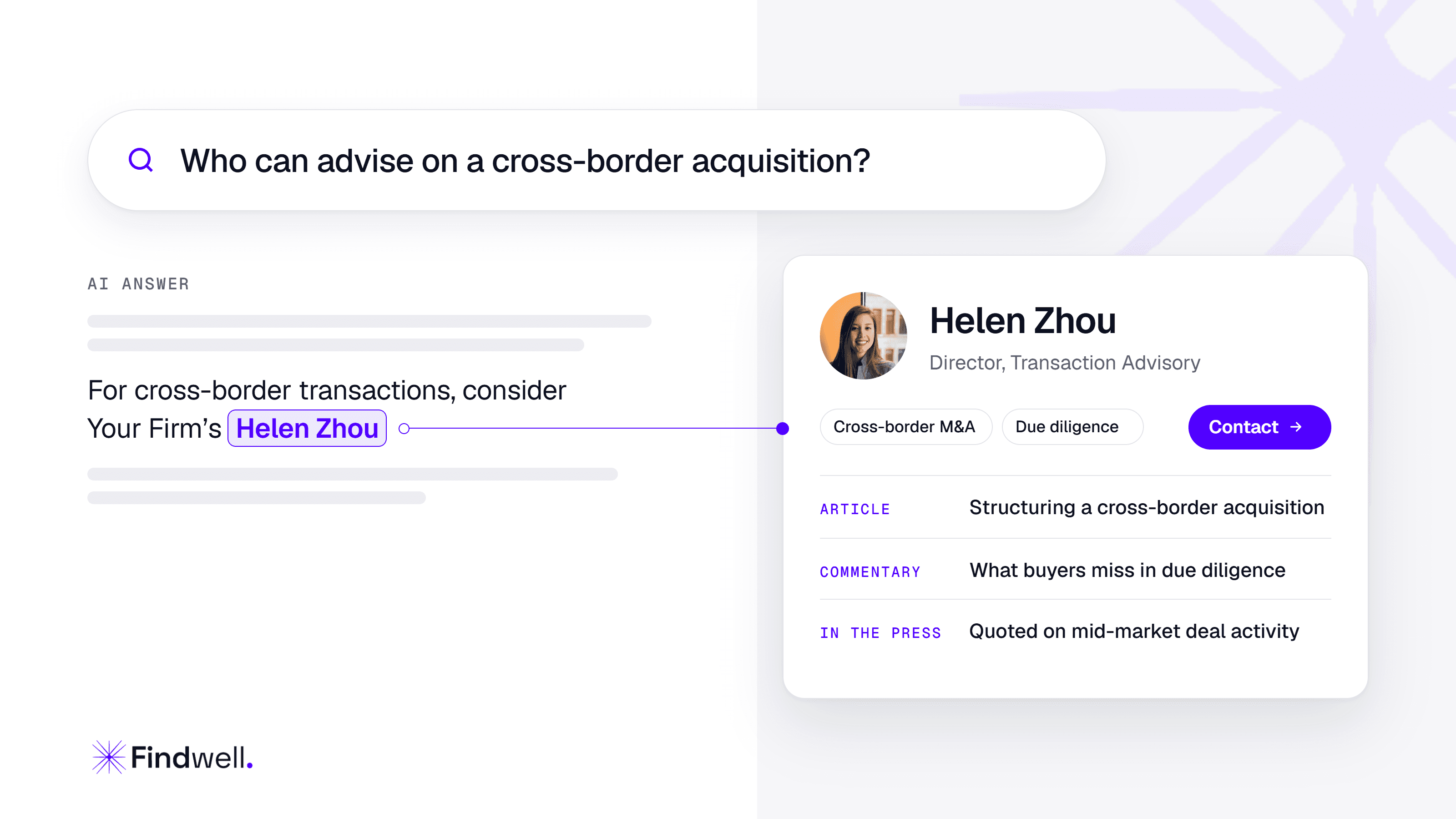
A potential client asks an AI assistant to recommend a tax adviser for a cross-border acquisition. Your firm has someone who deals with exactly that work. Does the answer mention the firm, name the adviser, or point somewhere else entirely?
That is the question worth testing. Not whether a website has enough mentions of "AI", or whether every article has been rewritten as a series of FAQs.
This 15-point AI search optimisation checklist is designed for professional services firms whose clients buy expertise: law and accountancy practices, financial advisers, consultancies, healthcare specialists and technical businesses. It covers the technical foundations, the evidence behind individual experts, and the numbers a marketing or business development team can actually measure.
It is a companion to our guide to SEO, GEO and AEO for professional services, not another explanation of the acronyms.
Why run an AI search audit in 2026?
B2B research does not begin and end on a firm's website. In the UK government's Business Data Survey 2026, 28% of businesses handling digitised data reported using AI to research information. That is not a measure of how many buyers use AI to choose an adviser. It does, however, show why AI-assisted research is no longer a hypothetical behaviour.
At the same time, visibility and website traffic are becoming less interchangeable. An Ahrefs analysis published in February 2026 found that an AI Overview was associated with a 58% lower average click-through rate for the top-ranking page in its study. This is an observed correlation across the queries studied, not a prediction of how much traffic an individual firm will lose.
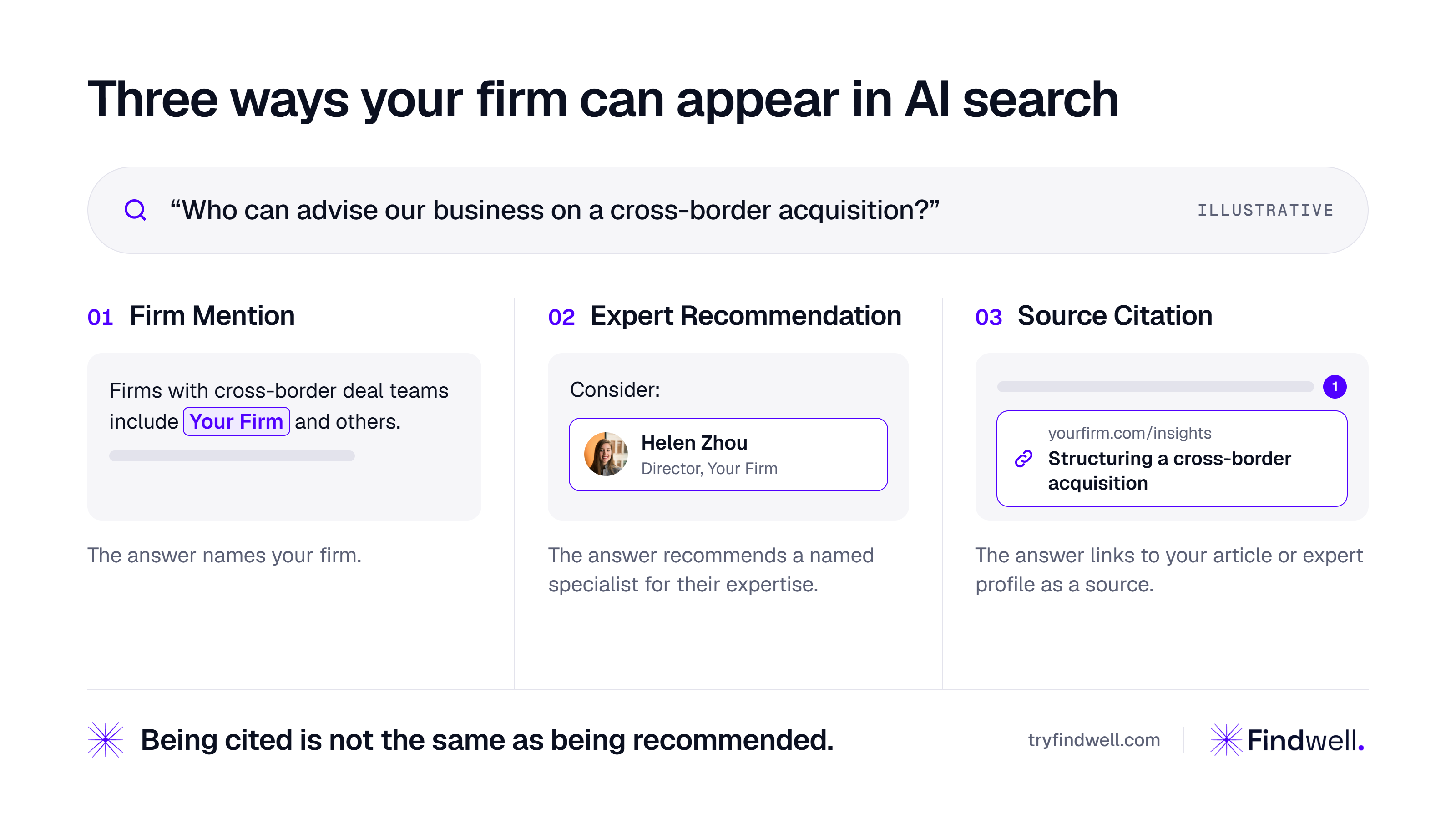
There is an equally important distinction between being cited and being recommended. An assistant might link to your firm's article as background without naming any of your partners as someone a client should instruct. Both are worth measuring; they are not the same outcome.
Google's 2026 guidance on generative AI search is refreshingly straightforward: conventional SEO fundamentals still apply, and useful, original content matters more than supposed GEO shortcuts. The checklist below starts there.
The 15 checks, at a glance.
Use this list to mark what is complete before working through the detail below.
- [ ] Define priority services and twelve real buying questions.
- [ ] Test those questions in Google and relevant AI assistants.
- [ ] Record firm mentions, named experts and source citations separately.
- [ ] Check indexing and canonical URLs for priority pages.
- [ ] Review search crawler access, including OAI-SearchBot.
- [ ] Make expert and service information accessible in readable HTML.
- [ ] Verify authorship and accurate structured data.
- [ ] Audit three to five commercially important expert profiles.
- [ ] Link service and topic pages to the relevant named specialists.
- [ ] Publish original, approved expert insight.
- [ ] Support claims of expertise with checkable evidence.
- [ ] Connect relevant independent coverage to the expert.
- [ ] Track Google generative AI impressions in Search Console.
- [ ] Review Bing AI citations and repeat the same prompt sample.
- [ ] Connect visits and enquiries to qualified opportunities where possible.
Part 1: Establish what buyers can find today.
1. Start with real buying questions, not a list of keywords.
Choose three commercially important services and write down four questions a prospective client might ask about each. Include different stages of a decision: understanding the problem, comparing approaches, identifying a specialist and choosing a provider.
For example:
- Accountancy: "Who can advise a UK business on the tax implications of acquiring a company overseas?"
- Consulting: "Which consultants help mid-sized manufacturers improve operational performance after an acquisition?"
- Law: "Who advises employers on complex workplace investigations in Manchester?"
- Financial services: "What should a business owner ask before appointing an investment adviser?"
These are illustrative prompts, not evidence that any particular firm currently appears for them. Use language taken from enquiries, sales calls and client meetings wherever possible. A dozen useful questions is a better starting point than 200 invented ones.
Keep: A dated prompt sheet with the service, intended audience, location and reason the question matters commercially.
2. Test Google and the AI services your buyers actually use.
Run the same questions in Google Search and two relevant AI assistants, recording the date, product, model or search mode where available, and location settings. Capture the full answer or result, not just the name of the first company mentioned.
Ask four separate questions of each result:
- Was the firm mentioned?
- Was a named expert recommended?
- Was an owned page linked or cited?
- Was a third-party source used to support the answer?
Results change with prompts, location, product updates and model behaviour. Treat this as a repeatable sample, not a universal ranking of who AI considers best.
Keep: Screenshots or exported answers, with the original prompt intact.
3. Separate recognition, recommendations and citations.
Do not combine all positive-looking AI results into a single "visibility score". A firm's name appearing in a list is different from its lead partner being recommended for a specific matter. A source citation is different again.
Record each outcome separately. A useful first baseline might be "named expert appeared in 2 of 12 prompts tested", with the provider, date and prompt set attached. That describes your test. It does not imply a 17% chance of being recommended across all searches.
Keep: A simple baseline for firm mentions, named-person recommendations and cited URLs.
Part 2: Fix the foundations that can block discovery.
4. Check that priority pages are indexed and eligible to appear.
Start with the ten URLs you would most want a buyer to find: key service pages, individual expert profiles and your strongest substantive articles. In Google Search Console, use URL Inspection to check indexing, the Google-selected canonical URL and whether anything is preventing inclusion.
Review accidental noindex tags, inconsistent canonicals, broken links, redirects and content restricted behind a login. Google says a page must be indexed and eligible to appear with a snippet to be considered as a supporting link in its AI search features. Indexing is necessary for that route to visibility, but does not guarantee selection.
Keep: A URL list labelled indexed, needs investigation or deliberately excluded.
5. Review crawler access without confusing search with AI training.
Check robots.txt and any CDN, firewall or bot rules for the pages you want publicly discoverable. Googlebot and Bingbot need appropriate access for their search products. For ChatGPT search, OpenAI identifies OAI-SearchBot as its search crawler. GPTBot is a separate control associated with potential model-training use; choosing to block it does not automatically mean blocking ChatGPT search.
See OpenAI's crawler documentation for the current distinction. Do not indiscriminately allow or disallow crawlers without considering confidentiality, licensing and your organisation's policy.
Keep: A record of crawler policies and any access blocks confirmed in server or security logs.
6. Make the useful information readable on the page.
Visit a priority profile on a phone and ask a colleague unfamiliar with the firm to find three things: what the person specialises in, evidence of that experience and how to contact them. If those answers are hidden inside a PDF, image, complicated widget or inaccessible navigation, fix the page first.
Use descriptive headings, HTML text, transcript or summary text for meaningful video content, and ordinary internal links between the profile, relevant services and supporting articles. This helps visitors and makes the site easier to crawl and understand. It is not a special "AI content chunking" technique.
Keep: A short list of content and accessibility problems with an owner for each fix.
7. Make authorship and structured data accurate.
Check that articles show a real author, a useful byline, an accurate date and a link to the author's profile. Where relevant, implement supported Article, Person or Organization structured data and make sure it describes what readers can see on the page. Use Google's Article structured data guidance as the starting point.
Do not invent qualifications, quote attributions or sameAs relationships to make a profile seem more authoritative. There is no special schema markup required to appear in Google's AI Overviews or AI Mode. Similarly, Google does not require an llms.txt file for those features.
Keep: One validated, correctly attributed article and one correctly represented expert profile as the implementation standard.
Part 3: Give buyers evidence of who knows what.
8. Audit your highest-priority expert profiles.
Pick three to five people whose expertise wins work. Their profiles should answer something more useful than where they studied and when they joined the firm. Can a stranger tell which problems they handle, what they have recently said about those problems and how to reach them?
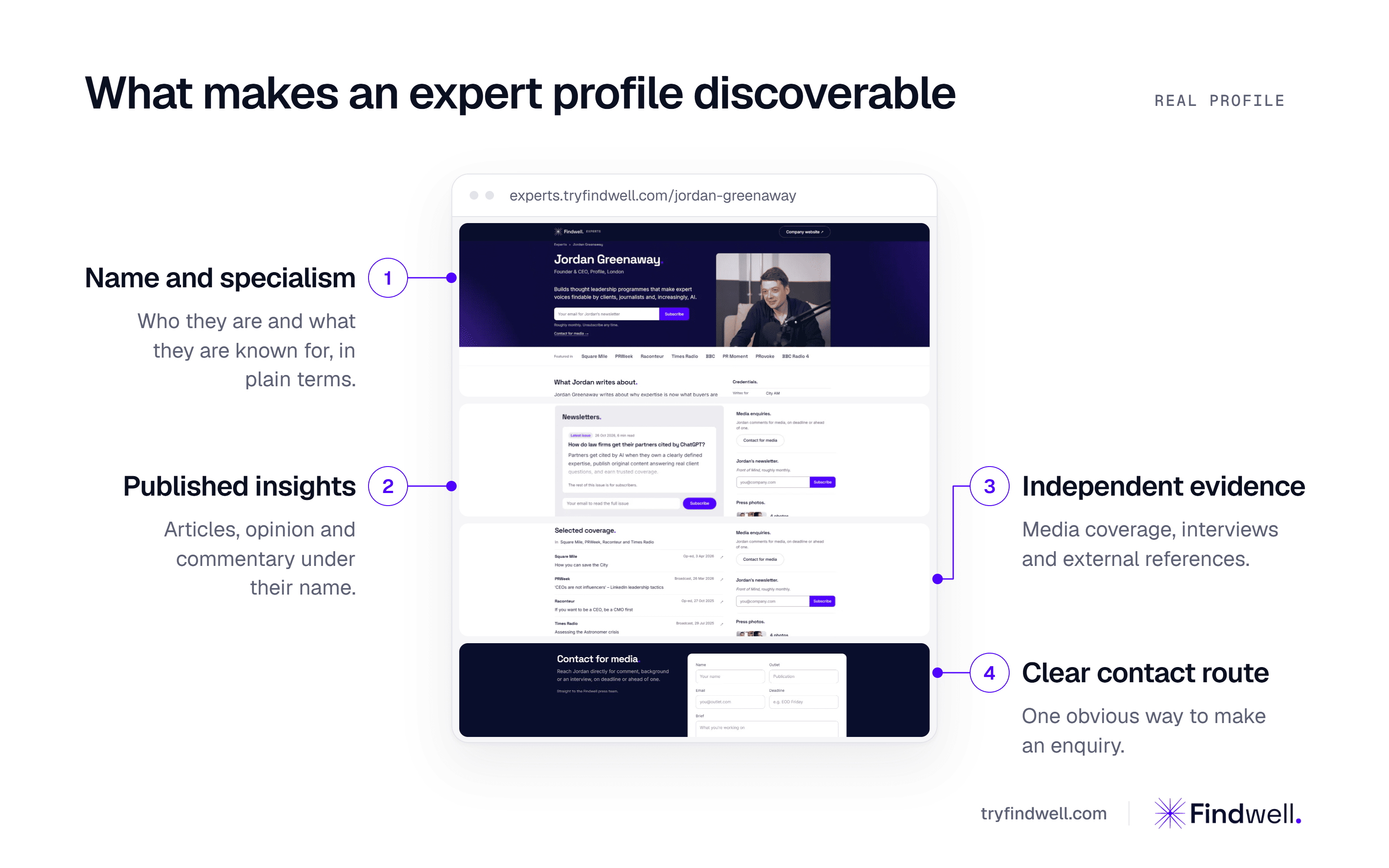
An expert profile is strongest when it brings together a clear specialism, published thinking, relevant experience, media contributions and contact information. This is also the logic behind Findwell's expert profile pages: the evidence sits with the person, rather than being scattered across a website.
Keep: A list of missing elements on each priority profile, not a generic instruction to "improve E-E-A-T".
9. Connect each expert to the questions they can answer.
A services page about corporate tax might rank for a broad phrase, while the person who advises on cross-border transactions is barely mentioned. Add useful links between the service page, a topic-specific explanation, and the relevant adviser. Make the anchor text descriptive rather than repeating "learn more".
For B2B services, narrow problems often matter more than broad job titles. "Tax partner" tells a buyer less than an adviser who has published a clear analysis of the tax consequences of a particular type of transaction.
Keep: An internal-link map for each priority topic, with at least one route from the service page to a named person.
10. Publish something a generic summary cannot replace.
An AI-generated recap of a new regulation is easy to reproduce. An expert's interpretation of the practical consequences is harder to substitute. Interview a specialist about what clients keep misunderstanding, the trade-offs involved and where common advice falls short. Check factual claims, respect confidentiality and have the expert approve the final piece.
Use a meaningful headline, a direct opening answer and enough context to make the analysis useful in its own right. Original research, transparent calculations, first-hand observations and worked examples give readers a reason to seek out the source. They do not guarantee citations.
Keep: One genuinely original article per priority topic, signed off by the responsible specialist.
11. Attach credible evidence to claims of expertise.
A profile saying "leading specialist" is not evidence by itself. Link to material that substantiates the claim: a published article, a recorded talk, a professional appointment, original research or an independent interview. Date the evidence so readers know what is current.
Where client confidentiality or professional rules limit what can be shared, use approved, anonymised explanations of the work and its lessons. Never publish client details or imply a regulated professional endorsement that has not been given.
Keep: A verified evidence list for each priority expert, including source URL, date and permission status.
12. Look beyond your own website, without buying manufactured authority.
In its October 2026 'What Is AI Reading?' study, Muck Rack reported that more than 84% of AI-cited links in its dataset came from earned and third-party sources, a broad group covering journalism, government, research, encyclopaedias and other independently hosted content. Journalism alone accounted for 22% of citations in September; the two figures should not be confused.
This does not mean that a press mention automatically leads to an AI recommendation. It does support treating credible third-party coverage as part of an expert's discoverable footprint. Keep accurate publication links on the profile, contribute where the expert can genuinely help, and avoid paid mentions disguised as independent validation.
Keep: A list of verifiable external appearances associated with the right people and topics.
Part 4: Measure visibility without mistaking it for pipeline.
13. Use Google's new generative AI reporting alongside normal Search Console data.
In June 2026, Google introduced separate generative AI performance reports for Search and Discover, with worldwide rollout noted as complete by 31 August. The reports show impressions and the pages surfaced in Google's AI features, with breakdowns such as date, country and device where supported.
Compare those impressions with ordinary search queries, indexed pages and organic clicks. An impression is evidence of display, not proof that the user read an answer, clicked or contacted the firm. Do not treat Google AI feature impressions as equivalent to mentions in ChatGPT or Perplexity.
Keep: A monthly export or screenshot for priority URLs, with changes annotated.
14. Check Bing AI citations and repeat your named-expert tests.
Microsoft launched AI Performance in Bing Webmaster Tools in February 2026. It reports cited URLs and aggregated citation activity in supported Copilot and Bing AI experiences, plus related grounding queries. It does not show every exact prompt, and citations do not equal clicks or recommendations.
Repeat your original twelve prompts each month using the same test settings where possible. Keep the raw answers so the team can distinguish real changes from wording differences. Report separately on firm mentions, named experts, citations and referrals.
Keep: A consistent monthly comparison, including the unsuccessful searches.
15. Connect visibility to enquiries, not just a prettier dashboard.
Finally, look at what happened after someone found the firm. In your analytics and CRM, track visits to expert profiles, relevant articles, newsletter subscriptions, contact-form submissions and qualified enquiries where consent and attribution allow.
OpenAI says ChatGPT search referral links include utm_source=chatgpt.com, which can help with channel reporting. But a B2B buyer may encounter an expert in several places before speaking to a firm. Last-click attribution will miss part of that journey. Ask new prospects what prompted their enquiry, record the answer, and distinguish sourced opportunities from those merely influenced by content.
Keep: A monthly scorecard with visibility, engagement and qualified commercial outcomes in separate columns.
A practical monthly AI visibility scorecard.
You do not need a proprietary "AI authority score" to start. Use a small number of measures you can explain to a managing partner or marketing director.
| Measure | How to record it | What it does not prove |
|---|---|---|
| Named-expert presence | Number of tracked prompts naming a relevant person, with sample and date | A universal probability of recommendation |
| Google AI search exposure | Generative AI impressions and pages in Search Console | Clicks, leads or appearances in every AI product |
| Bing AI citations | Cited URLs and citation trends in Bing Webmaster Tools | Rankings, direct traffic or sales |
| Engagement with expertise | Visits to relevant profile and content pages, subscriptions | That the visitor is a qualified buyer |
| Commercial response | Qualified enquiries and CRM opportunities with source/context | That one article alone caused the deal |
Read the figures together. If an adviser is increasingly named but nobody visits the profile, the next problem may be relevance or the route to contact. If profiles draw good traffic but few appropriate enquiries, review the audience, the offer and the contact experience before publishing another ten articles.
What our Manchester research illustrates.
Findwell's 2026 Manchester Law Firm Visibility Index reviewed 378 Greater Manchester law firms. In a defined set of firm-level Google searches, only two of 465 classified results centred on a named individual solicitor. Most results led to firm websites instead.
That is a finding about the particular searches and methodology in the study, not a claim that only two Manchester solicitors are discoverable online. It illustrates why firms should audit people separately from brands. The same distinction matters for accountants, consultants and specialist advisers.
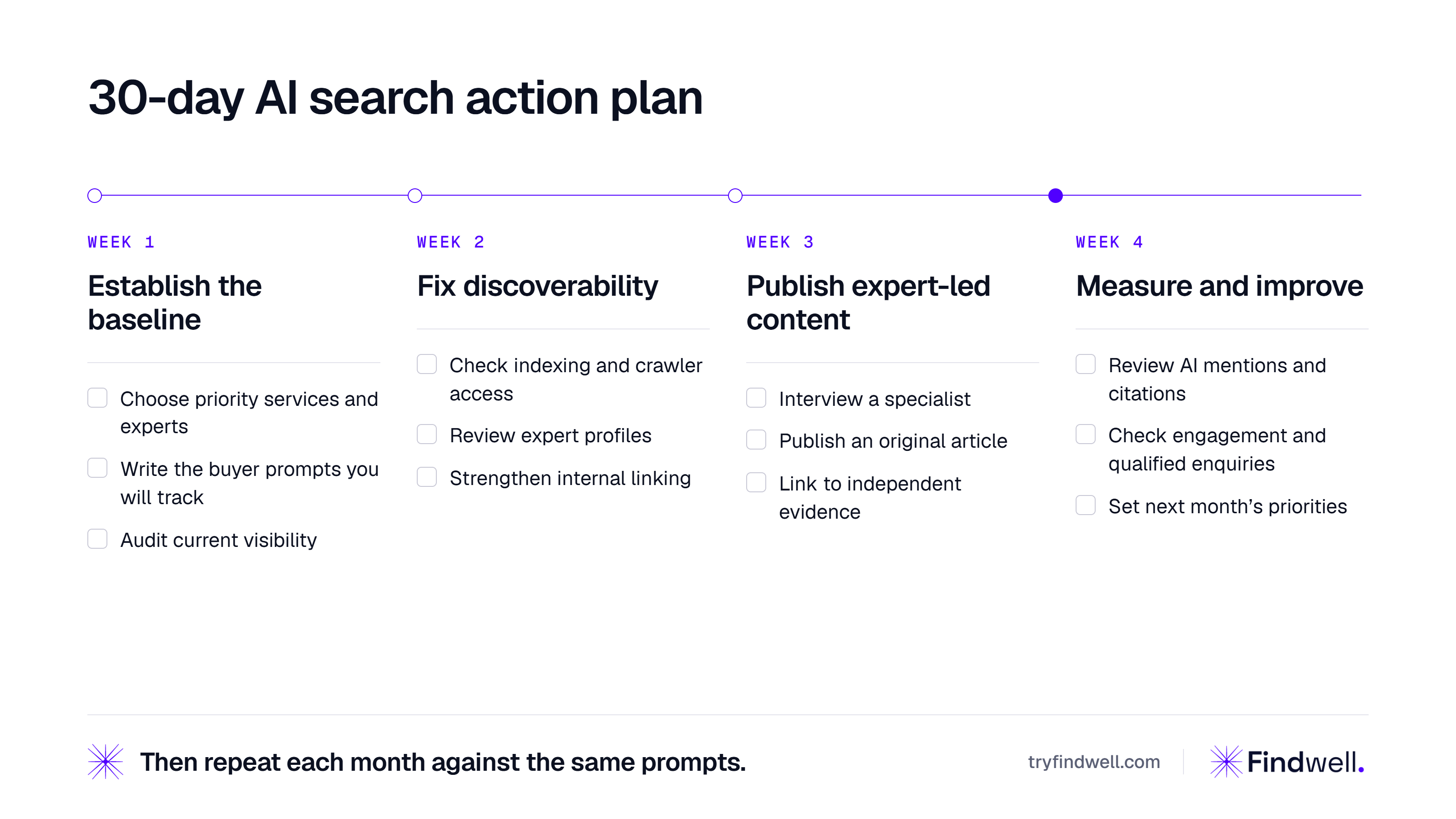
What to fix in the first 30 days.
| Week | Priority | Actions | Deliverable |
|---|---|---|---|
| Week 1 | Establish your baseline | Select priority services, identify buyer questions, test Google and AI search results | Initial visibility audit |
| Week 2 | Fix discoverability issues | Review indexing, expert profiles, internal links and crawler access | Updated priority pages |
| Week 3 | Publish expert-led content | Interview a specialist, create original content and connect relevant media coverage | One approved expert article |
| Week 4 | Measure and improve | Review AI mentions, citations, traffic and enquiries | Monthly visibility scorecard |
The goal of the first month is not to promise a new AI ranking. It is to remove obvious obstacles, establish a defensible baseline and make the next investment decision with evidence.
The point of the checklist.
You can complete this audit without buying a new tool. Begin with the pages and people who matter most, fix what is demonstrably broken and keep a record of what changes.
If your firm has plenty of expertise but no consistent way to publish it, connect it to individual people and measure its visibility, Findwell's expert hub brings those pieces together on your own domain. We build the profiles, create the content and connect the evidence, so your team can focus on the work it does best.
See how Findwell works
Frequently asked
Is AI search optimisation different from SEO?
There are differences in how results are presented and measured, but Google says its existing SEO foundations continue to apply to AI Overviews and AI Mode. For a professional services firm, the additional practical work is to test whether individual specialists are mentioned and whether useful sources support the answer. Our SEO, GEO and AEO guide explains the terms in more detail.
Is this checklist only for law firms?
No. The checks apply to businesses where clients choose people for their expertise, including accountancy, financial services, healthcare, consultancy, technology and architecture. The buyer questions and evidence of competence will differ by sector, but the audit method is broadly the same.
Do we need an `llms.txt` file or special AI schema?
Not to appear in Google's AI features. Google explicitly says there is no extra AI-specific markup requirement and advises against treating llms.txt or content-formatting tricks as shortcuts. Accurate, conventional structured data can still help describe visible information, and crawler access rules should be reviewed separately for each provider.
How often should we check AI search visibility?
Monthly is a practical starting point for B2B firms, with the same documented prompt sample and a record of platform changes. Investigate large shifts before treating them as performance improvements or declines. One answer on one afternoon is not a reliable trend.
Can AI search optimisation guarantee leads or recommendations?
No. Search and AI providers decide what to show, and their answers vary. A sensible programme can improve the accessibility, usefulness and evidence behind a firm's expertise, then measure whether visibility and commercial response improve. It should not promise a position in an AI-generated shortlist.
See your experts, found.
A 30-minute walkthrough, tailored to your firm, of where your experts would rank and what it would take.