AI visibility audit: a practical guide for professional services firms.
Most AI visibility audits stop at whether a firm's name appears in an answer. This practical guide shows how to check the people, prompts and sources behind those answers, and decide what to fix first.
 Tyler NgoMarketing Manager, Profile

Key takeaways.
- A useful AI visibility audit records what buyers actually see, not just whether a firm appears when its own name is entered.
- Check named experts separately from the firm. A brand mention, a named recommendation and a citation to a source are different outcomes.
- Keep the prompts, platforms, dates and answers. Without a repeatable baseline, month-on-month comparisons mean very little.
- Check the evidence behind the answers before commissioning more content. The problem might be a missing expert page, weak subject coverage, poor access to a page or a lack of independent sources.
- End the audit with a short list of fixes, owners and measurements rather than a single unexplained visibility score.
What an AI visibility audit should tell you.
An AI visibility audit examines how a firm, its people and its published expertise appear when prospective clients use AI-assisted search. It should show which questions bring the firm into view, who gets named instead, what sources the answers rely on and what needs changing.
For a professional services firm, the distinction between the business and the individual matters. A buyer might recognise a law firm's name and still have no idea which partner handles a particular employment issue. An AI answer might name the firm but recommend a solicitor from somewhere else. Neither outcome is captured by a brand-mention total alone.
Our Manchester Law Firm Visibility Index illustrates the gap. The study assessed 378 Greater Manchester firms. Across its AI answers, only 32 firms registered in Greater Manchester were named. When AI was asked to identify individual lawyers, 114 people were named, but only 41 worked at a firm registered in Greater Manchester. These results are a snapshot from a defined research exercise, not a permanent ranking of legal expertise.
That is the point of a good audit. It replaces a vague ambition to 'show up in ChatGPT' with evidence about particular subjects, questions, people and sources.
What to measure.
| Signal | What it records | What it does not prove |
|---|---|---|
| Firm mention | Your firm's name appears in an answer | That the firm was recommended or that anyone clicked |
| Named expert | An identifiable person at the firm is named | That the recommendation is accurate or favourable |
| Recommendation | The firm or expert is put forward as an option for the task | That it appeared in every run or for every user |
| Citation | A link to your site or another source is shown in support of an answer | That the source's content was quoted faithfully or led to a visit |
| Accuracy | Names, roles, specialisms and locations are correct | That the firm is more prominent than competitors |
| Downstream action | A measurable visit, enquiry or other outcome follows | That one AI answer alone caused the conversion |
Record these separately. A citation to an owned page is useful, but it is not the same as having the right expert named in the answer.
The five layers of expert visibility worth checking.
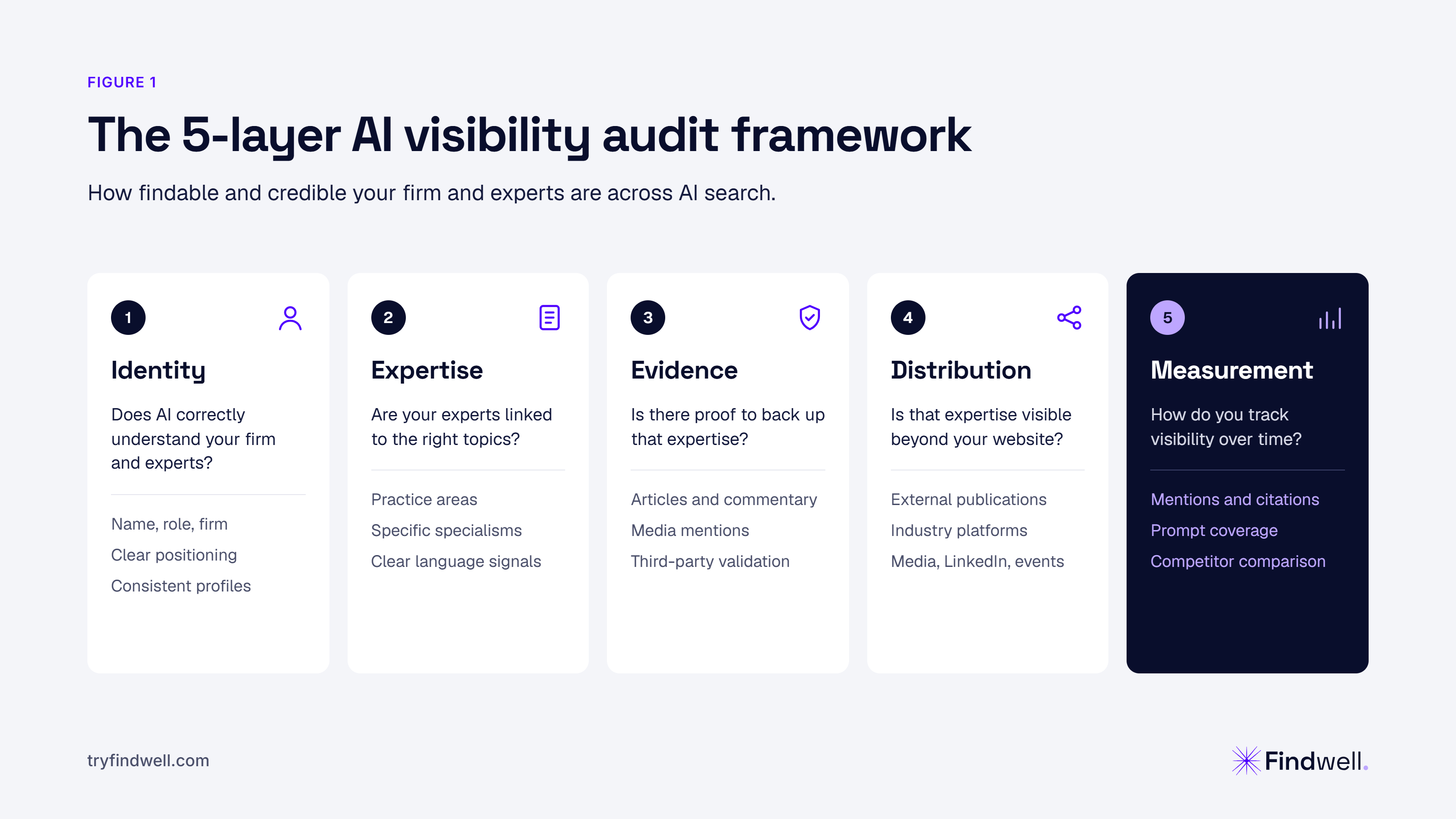
The answer log tells you what happened. The next job is to understand why. For a professional services firm, five layers are worth checking before deciding to publish more content.
| Layer | The question to ask | What to examine |
|---|---|---|
| Identity | Can the system distinguish this person from the firm and other people with similar names? | Current role, employer, location, consistent profiles |
| Expertise | Is this expert associated with the work clients would hire them for? | Specific services, niche subjects, clear bylines and topic pages |
| Evidence | What public material supports that association? | Substantive articles, relevant cases or work where publishable, interviews, credible third-party references |
| Distribution | Does the evidence exist beyond one isolated page? | Internal links, external publications, directories, professional bodies and media coverage |
| Measurement | Can the team show what was observed, where and when? | Saved answers, named-expert appearances, citations, factual errors and downstream actions |
These are audit lenses, not five independent SEO ranking factors. An AI answer may never cite a particular source even when it is publicly accessible. The framework helps diagnose gaps; it does not promise that fixing them will make a model recommend anyone.
Start with the questions clients are likely to ask
A test made entirely of branded prompts will produce a flattering, and mostly unhelpful, result. Asking an answer engine about a firm by name checks whether it knows the firm exists. It says little about whether the firm is being discovered by somebody who has not chosen a supplier.
Instead, build a question set around commercially important work. We suggest 24 prompts as a manageable starting point, rather than a statistically representative sample of the market.
The Findwell audit workbook uses these 24 prompts across four AI platforms, with two runs per prompt, giving you 192 planned observations. You can adapt the questions to your firm's services, clients and location, then repeat the same tests to track changes over time.
The prompts fall into four groups:
| Prompt group | Suggested number | Purpose | Example for a Manchester law firm |
|---|---|---|---|
| Provider discovery | 8 | Find firms without supplying a brand name | 'Which Manchester law firms advise employers on redundancy consultations?' |
| Named expertise | 6 | Find a person with a particular specialism | 'Who advises UK employers on TUPE issues in Manchester?' |
| Comparison and shortlist | 6 | See which names enter a buying decision | 'Compare Manchester employment law firms for a mid-sized business.' |
| Verification | 4 | Check factual understanding of a known expert or firm | 'What employment law work does [named solicitor] specialise in?' |
These are illustrative prompts, not results from a Findwell test. Your own panel should reflect your services, clients, geography and the language prospects use.
For an accountancy firm, a useful named-expertise prompt might concern R&D tax relief, VAT disputes or corporate restructuring. For a life sciences consultancy, it might concern clinical regulatory strategy or market access. Avoid padding the list with generic questions that have little bearing on who hires you.
Keep some prompts completely unbranded. Keep some with an explicit location or buyer type. Record the exact wording and resist changing it every week simply because an answer was disappointing. For repeat tests, also record when a prompt was not suited to an engine or did not trigger an AI feature, rather than quietly deleting it.
A repeatable five-part audit.
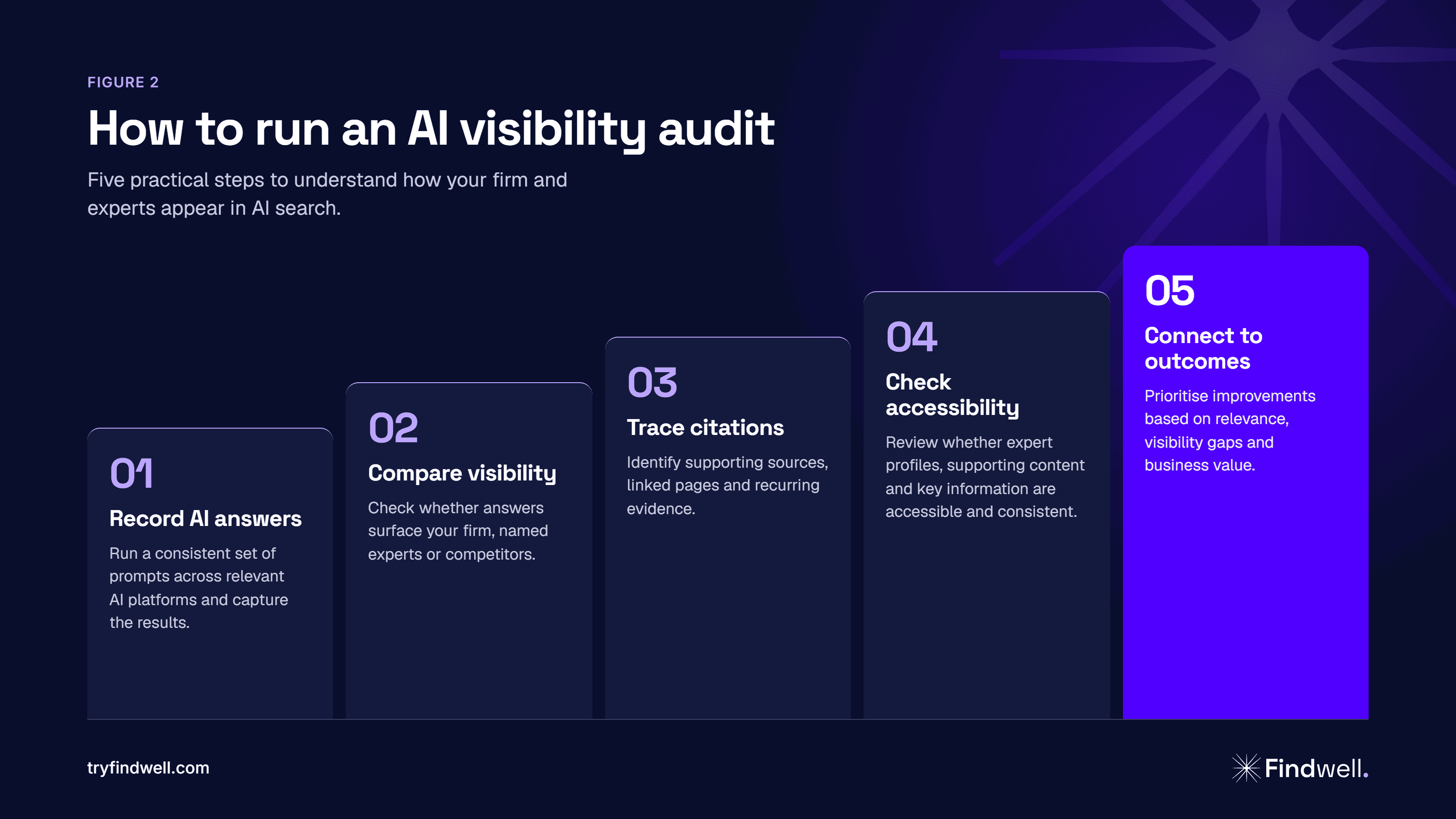
1. Record what the answer actually shows.
Run your question panel in the AI search experiences that matter to your buyers. Include the platform, model or mode where visible, country, date, and whether web search or grounding was enabled. Do not combine results from web-enabled and non-web-enabled modes as though they were the same test.
A practical starting point is to run 24 prompts across four AI search platforms, with two runs per prompt. That gives you 192 planned observations. Repeating each question helps expose variation between answers, although the results remain directional rather than statistically representative.
Verification prompts that include your firm or expert by name should be assessed for accuracy, not added to unbranded discovery rates. If Google AI Overviews does not appear for a query, record 'not triggered' rather than treating that as proof that your firm was excluded.
For every observation, save the answer and note:
- whether your firm appears
- whether a named expert appears
- whether the firm or expert is recommended, merely mentioned or omitted
- which competing firms and experts appear
- which URLs are cited, if citations are shown
- any incorrect claims about your people or services
Do not score an answer you could not retrieve as a negative result. Mark it as unavailable and keep the reason.
2. Separate firm-level from expert-level visibility.
This is especially important in legal, accountancy, consulting and advisory businesses. A firm can be a plausible recommendation for a service without any of its individual specialists being known to the answer engine.
Audit both kinds of question. For instance, 'employment law firms in Manchester' and 'Manchester solicitors experienced in collective redundancy' are not equivalent. The first may return organisations. The second asks the system to connect a subject with a real person.
Once a person is named, verify their current role, employer, location and specialism against a reliable source. An answer naming a former partner at the wrong firm is an accuracy problem, not a visibility win.
Our earlier guide to why experts can be invisible to ChatGPT explains the identity and evidence problem in more detail. The audit adds the missing operational step: recording the actual answer and checking whether it is correct.
3. Follow the citations and check the underlying evidence.
When an answer engine provides sources, open them. Note whether a citation leads to the firm's own site, a directory, a publisher, a regulator, a professional body or another third party.
Then look at the page itself. Is the named expert there? Is their subject expertise clear? Does the page explain what they have done or written, or is it just a title and a biography? If the answer relies on a dated directory listing rather than the current expert profile, log that distinction.
A citation audit is not simply a backlink count. You are checking which public evidence is being used to describe or recommend a person.
Useful evidence might include a detailed expert profile, substantive commentary on a narrow issue, a bylined article, a credible media quote or a relevant publication by a professional body. Neither quantity nor third-party coverage guarantees selection in an AI answer, but the source trail tells the team what is present and what is missing.
For firms building their own content programme, expert profile pages and topic pages can help keep a person's work connected to the subjects they should be known for.
4. Check whether the important pages can be discovered and understood.
Before commissioning another set of articles, confirm that the strongest existing material is available to search engines and relevant AI search crawlers.
For Google, check indexing, canonical URLs, internal links and whether important information is present on the rendered page. Google's guidance for AI features says that the same foundational SEO requirements apply to AI Overviews and AI Mode. There is no separate markup that guarantees inclusion.
For ChatGPT search, check relevant crawler permissions. OpenAI's publisher guidance specifically recommends allowing OAI-SearchBot to access content intended for ChatGPT search discovery. Robots.txt permissions and security rules are worth reviewing, but opening crawler access alone does not guarantee a mention.
On the pages themselves, look for practical gaps:
- no clear page dedicated to the person
- vague specialisms such as 'commercial advice' with no further detail
- articles with no visible expert attribution
- media coverage that is not connected back to the expert
- contradictory job titles or employer details across public sources
- important content behind a form, blocked page or inaccessible script
- no natural route from a topic to the relevant expert and their contact information
Keep technical faults separate from editorial weaknesses. One may be resolved by development work; the other needs better content and proof.
5. Connect visibility to something the firm can use.
An audit is more useful when it identifies where clients could go next.
Review the pages an answer engine links to. Can a visitor understand what the expert does, read relevant work and get in touch? Is the expert connected to the right service page? Does the site give a journalist an obvious way to contact them?
For measurement, use what each system can genuinely provide. Google has a dedicated Generative AI performance report in Search Console, showing impressions and linked pages for AI Overviews and AI Mode. Google says these insights were rolled out worldwide by 31 August 2026, though a property may still not show the report if it has too little data. The report does not replace a named-expert prompt audit or show every answer in which a firm was discussed.
Alongside that report, track AI referral traffic where it can be identified, engagement on the linked pages, enquiries and changes in the fixed prompt panel. Do not claim every later lead was caused by AI search. Attribution will often be incomplete, particularly when people read an answer and contact the firm through another channel.
Findwell's analytics and reporting is organised around expert-level and subject-level performance because a firm-wide traffic chart alone cannot show which specialists are becoming easier to find.
Want to run the checks on your own firm? The free AI Visibility Audit Starter Kit contains the full set of 24 editable prompts, a results spreadsheet and a 30-day action plan. The method is here in the article; the kit gives you a practical place to record the evidence.
A scorecard that leads to decisions.
We would rather see a clear evidence table than an impressive-looking 'AI visibility score' with no methodology behind it. Use one row per finding and record the proposed fix.
| Audit area | Evidence to retain | Typical finding | Possible next action |
|---|---|---|---|
| Buyer questions | Prompt, answer, platform, date | Competitors named; firm absent | Identify which subject is missing from owned content |
| Named experts | Names and roles returned | Firm named but no specialist | Strengthen one priority expert profile |
| Source trail | Cited URLs and source types | Old directory profile used | Update the primary profile and connect supporting evidence |
| Technical access | Indexing, crawler and rendered-page checks | Key content unavailable | Resolve access or rendering issue |
| Commercial journey | Landing page and outcome data | Good answer, weak next step | Improve topic-to-expert links and contact path |
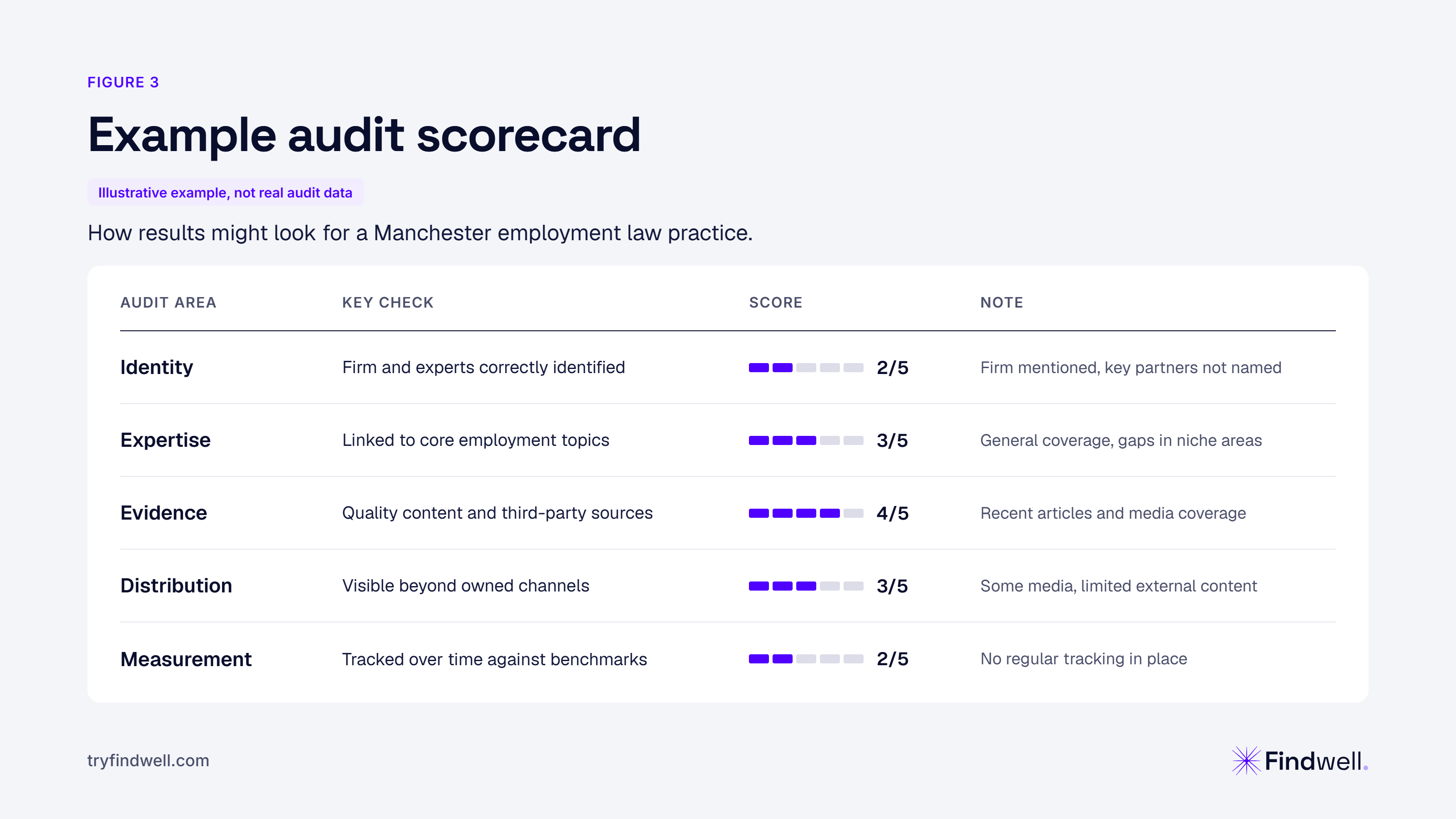
Do not score every item equally by default. A wrong employer attribution to a recommended partner is an immediate credibility issue. A missing mention on one obscure prompt may not justify any new work at all.
Simple outcome measures.
Use consistent definitions and denominators when comparing months. Exclude unanswered or unavailable observations and keep branded verification questions out of discovery-rate calculations:
- Firm mention rate: observations in which the firm appears, divided by valid answer observations.
- Named-expert rate: valid named-expert observations in which at least one current expert at the firm is named, divided by all valid named-expert observations.
- Owned citation rate: valid answers containing at least one citation to the firm's website, divided by valid answers in which the system provides citations.
- Accuracy exceptions: number of observations containing demonstrably incorrect details, with the exact claim preserved.
Count answers, not total links, for the citation rate above. Report results by platform and prompt group, not only as one blended percentage. Even with 192 planned observations, the results are a directional snapshot, not the probability that a real buyer will encounter your firm.
A worked example: a Manchester employment practice.
The example below shows the decision process. It is hypothetical and is not an additional finding from our Manchester index.
An employment team wants to win more instructions from medium-sized businesses dealing with redundancies and TUPE. Its firm ranks for a broad employment-law service term, but a set of buyer-style AI prompts tends to return other named solicitors.
A review finds that the firm's employment partner has a short team biography and several useful articles. The articles sit in a general insight archive, have inconsistent bylines and do not link back to the partner. Two recent press quotes are published externally but are not referenced from the firm's website.
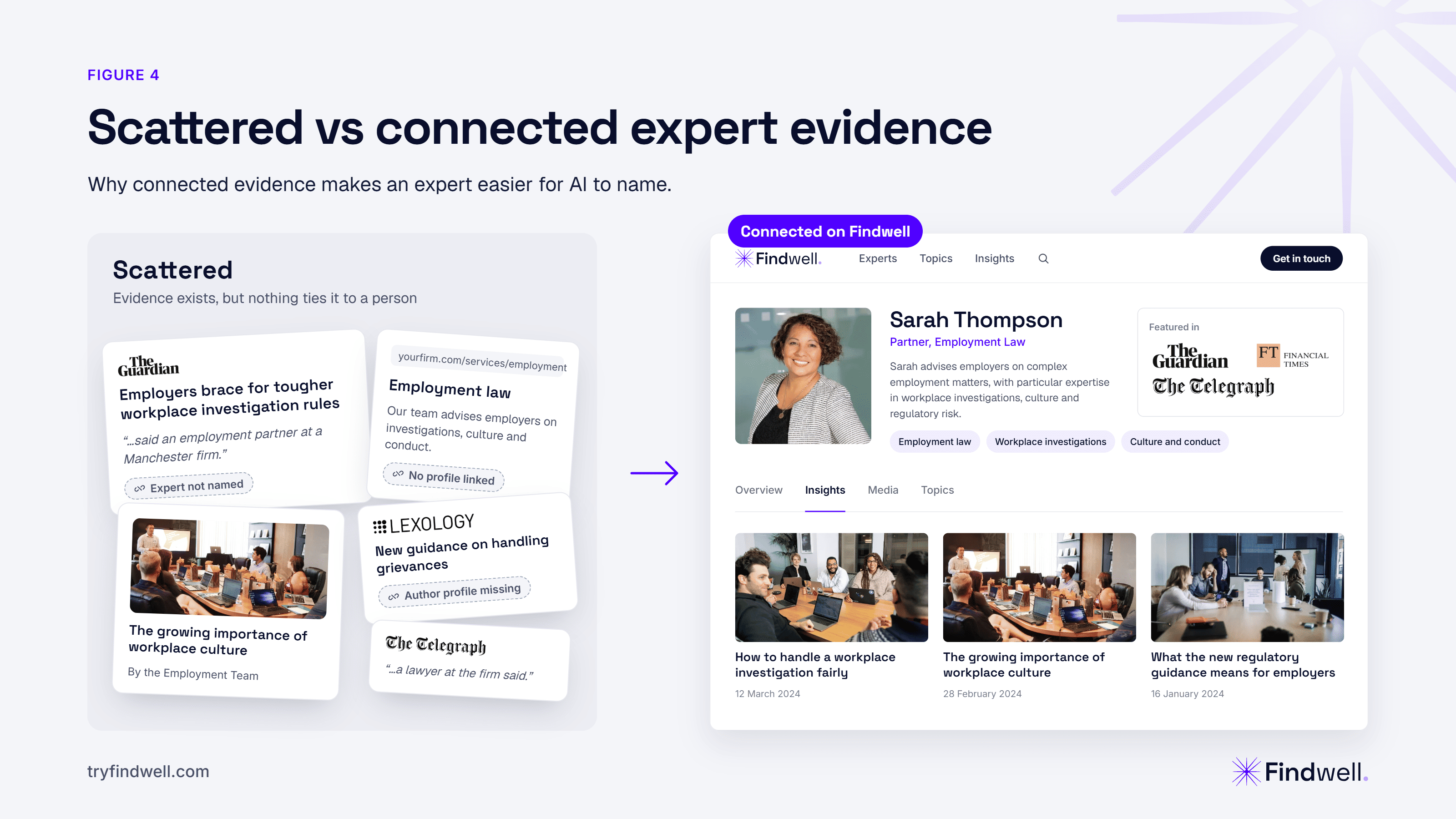
The useful next move is probably not to publish ten generic employment-law explainers.
Instead, the team could update the partner's page to state their actual areas of practice clearly, connect the existing articles, add the external coverage with accurate attribution, and create a focused page around the work the partner wants to be known for. It can then repeat the same prompts and record whether answers, citations and site engagement change.
The outcome may still be uneven across platforms. At least the changes have a defensible connection to the evidence found during the audit.
What to fix first in the next 30 days.
A firm with ten experts and several service lines can easily generate a much longer list of issues than it can realistically address. Start with a narrow pilot.
Week 1: Establish the baseline. Agree 2-3 commercially important topics, choose the experts involved, freeze the prompt panel, collect answer observations and export the relevant Search Console data.
Week 2: Repair the basics. Fix incorrect names, inconsistent employer details, broken links, blocked pages and unclear ownership of existing content. Check that each priority expert has a usable page.
Week 3: Strengthen the evidence. Improve one or two expert profiles, connect published thinking to the right people, and identify where a credible new piece of expert commentary would genuinely fill a gap.
Week 4: Re-run and review. Repeat the original prompts with the same documented settings where possible. Record any change and decide which work to continue. Four weeks is too early to promise sustained visibility gains; the purpose is to establish a process and remove obvious blockers.
The next review should distinguish outcomes from activity. 'Published four articles' is activity. 'The partner was correctly named in two of the previously missed prompts' is an observed outcome, though still subject to variation. Keep screenshots and exact dates behind those observations, and avoid treating a single change as a trend.
Common mistakes in AI visibility audits.
Testing only the firm name. Branded recognition does not tell you whether new prospects can discover the business for a problem it solves.
Treating one response as a ranking. AI answers vary by platform, wording, date, location, mode and sometimes user context. Keep the sample and repeat it.
Conflating citations with recommendations. A linked page may be cited without the firm being recommended. A person may be mentioned without any supporting link.
Publishing before diagnosing. More articles will not repair an inaccessible expert profile or a wrong employer listing.
Inventing precision. A 73/100 visibility score means very little unless the inputs, weighting and observed answers are available for inspection.
Ignoring the buyer journey. Visibility has limited commercial value if the visitor cannot identify the relevant person or contact the firm.
An audit is the starting point, not the whole programme.
AI visibility changes as the source material, answer engines and competing firms change. A quarterly or monthly repeat of the same question set gives marketing teams a clearer account of what has actually moved.
For professional services firms, the most useful reports do more than show a company logo appearing in an answer. They reveal which people are being found for which subjects, which evidence supports that result and what still needs work.
That is the work Findwell is built around: expert profiles, content, media coverage and search/AI measurement connected around the people whose expertise clients are buying.
If you are doing the audit in-house, start with the free 24-prompt AI Visibility Audit Starter Kit.
If the bigger problem is turning scattered expertise into a connected body of work, see how Findwell works.
Frequently asked
What is an AI visibility audit?
An AI visibility audit is a documented assessment of how a firm, its named experts and its content appear in AI-assisted search. A useful audit combines buyer-style prompt tests, answer and citation reviews, accuracy checks, technical accessibility and a prioritised list of actions.
How many prompts do you need for an AI visibility audit?
For an initial directional audit, 20-30 well-chosen questions can be a manageable starting panel. This guide proposes 24, tested twice on two platforms, to generate 96 observations. Larger firms and market-wide research need broader samples. The number alone does not make the results representative.
Can Google Search Console measure AI visibility?
Google Search Console has a dedicated Generative AI performance report for impressions and linked pages in AI Overviews and AI Mode. It is valuable first-party reporting, but it does not provide a complete record of which named experts were recommended across all AI assistants. A prompt-based audit remains useful alongside it.
What is the difference between an AI mention and an AI citation?
A mention is when the answer names a firm or person. A citation is a source link presented with the answer. A firm can receive one without the other, so audits should record both.
Can an AI visibility audit guarantee that ChatGPT recommends a firm?
No. The audit observes current results and helps identify issues that can be addressed. It cannot guarantee future mentions, recommendations, rankings or enquiries.
Should we audit individual experts as well as the firm?
Yes, particularly in legal, accountancy, consulting and other expertise-led sectors. A firm-level result may hide weak visibility for the people clients actually need to appoint or interview.
See your experts, found.
A 30-minute walkthrough, tailored to your firm, of where your experts would rank and what it would take.