AEO for law firms in 2026: how to get your experts found in AI search.
A practical guide to AEO for law firms: how to make your lawyers, expertise and content easier to find across Google, ChatGPT and other AI search tools.
 Tyler NgoMarketing Manager, Profile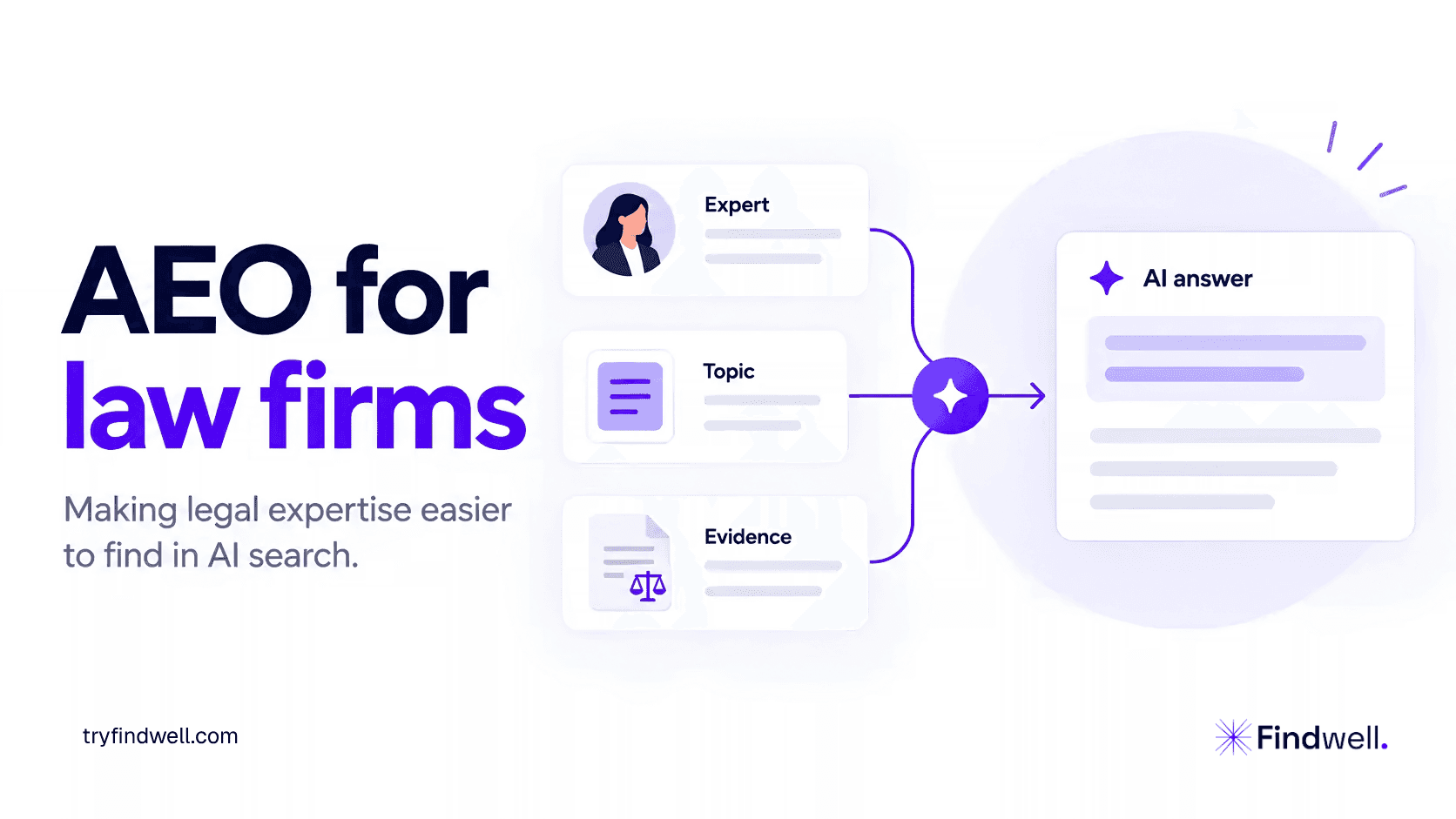
Key takeaways.
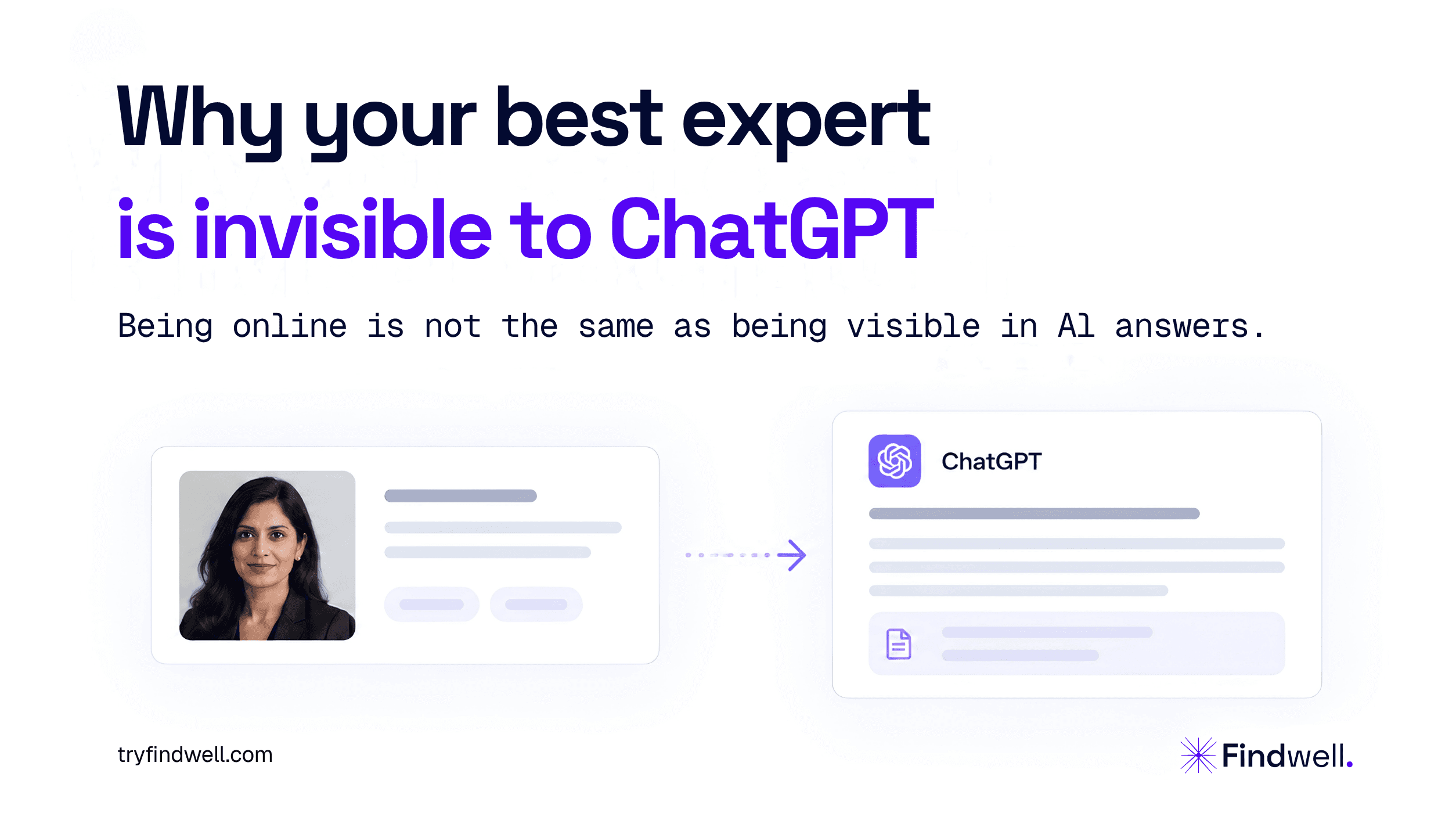
A law firm can have one of the country's best employment lawyers and still be almost invisible when someone asks ChatGPT a question about employment law.
The expertise is not the problem. The problem is that very little of it may exist online in a form that clearly connects that lawyer with the subjects they know best.
That is where answer engine optimisation, or AEO, comes in. For law firms, AEO is less about learning a new set of technical tricks and more about making expertise easier to find, understand and attribute to the right people.
That matters because search is changing. Ahrefs' 2026 analysis of 300,000 keywords found that the number-one organic result received 58% fewer clicks on searches where a Google AI Overview appeared than on comparable searches without one.
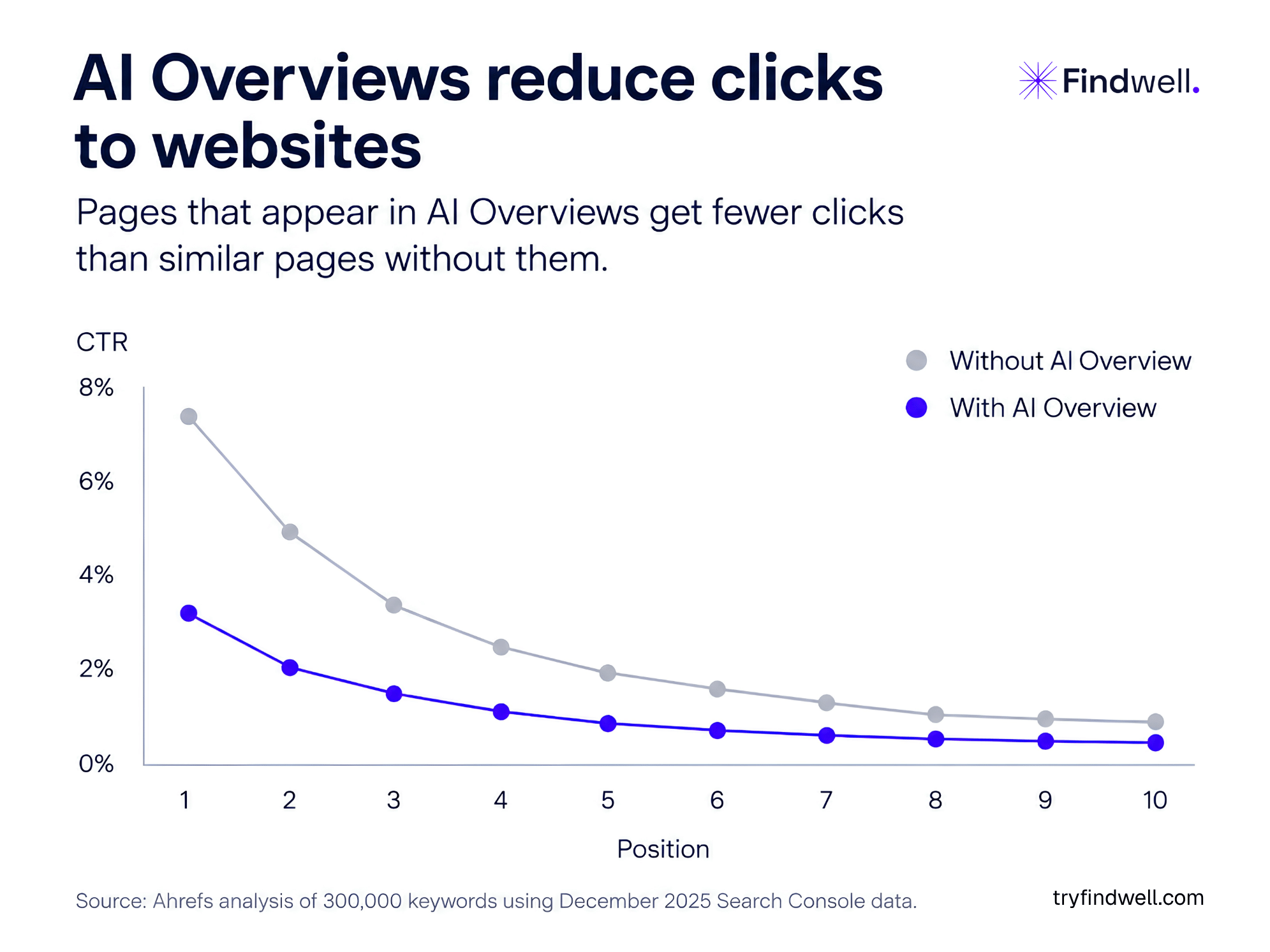
That does not make SEO less important. It changes what good visibility can look like.
For a law firm, the question is no longer only whether a page ranks. It is also whether a search or AI system can work out who your experts are, what they know and when that expertise is relevant.
What AEO means for a law firm.
AEO for law firms is the process of making a firm's lawyers, expertise and content easier for AI-powered search and answer systems to understand and potentially surface when people ask relevant questions.
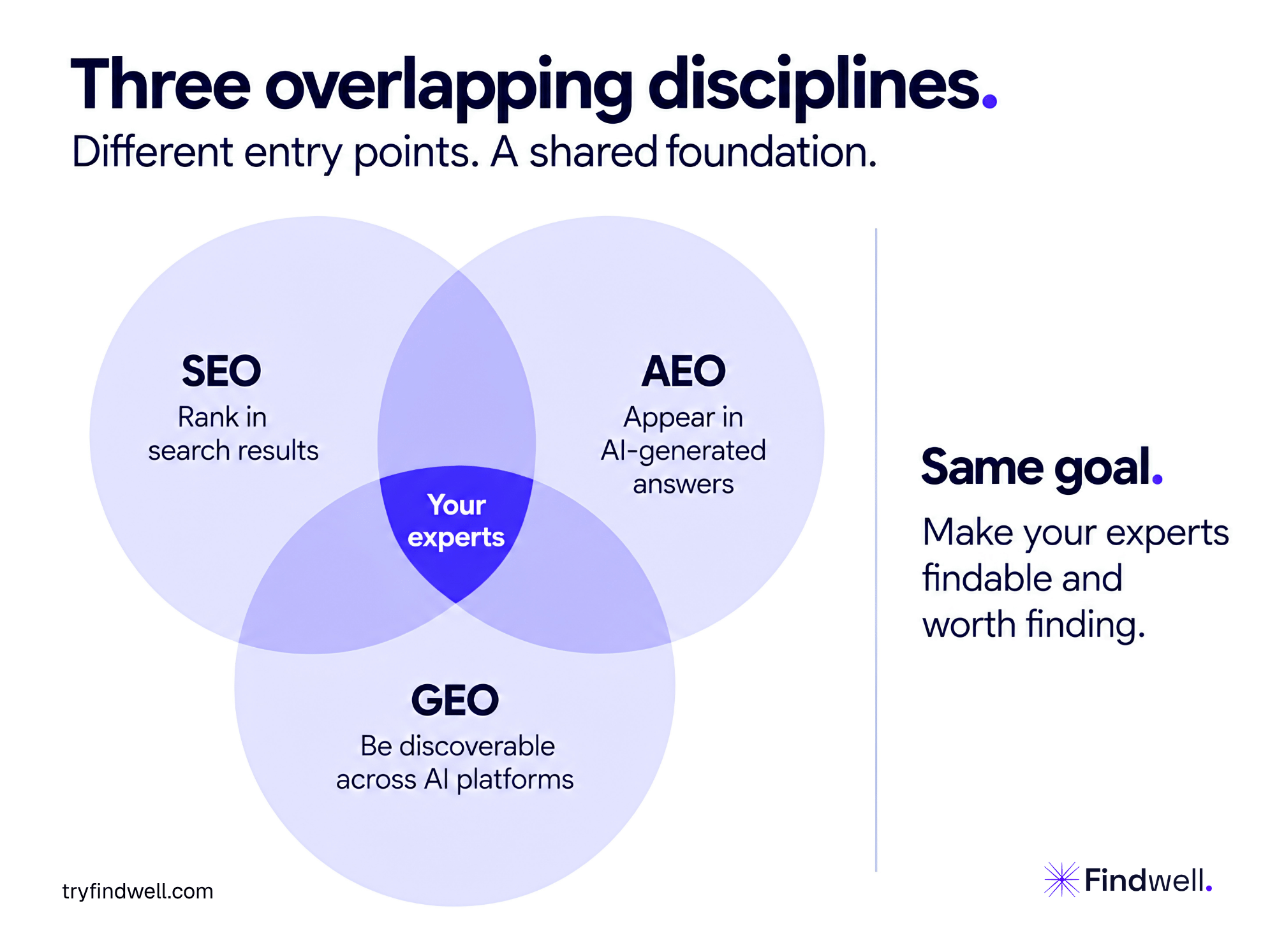
You may also see the term GEO, or generative engine optimisation, used for much of the same area.
The terminology is newer than the underlying work.
Google's own guidance on AI search still comes back to familiar foundations: useful content, crawlable pages, clear site structure and information that is genuinely valuable to users.
So AEO should not sit in a separate box from SEO. We cover the broader relationship between SEO, GEO and AEO for professional services firms in more detail here.
The difference is that visibility can now happen inside an answer as well as on a search results page. Findwell's AI visibility approach focuses on making those expert-topic relationships clearer and tracking the questions buyers actually ask.
| Traditional search | AI-assisted search |
|---|---|
| 'employment lawyer London' | 'Which UK employment lawyers have experience advising employers on TUPE during a restructuring?' |
The second query creates a different problem.
Having an employment-law page may not be enough. There also needs to be enough public evidence to connect the right lawyer with that specific subject.
Semrush's 2026 analysis of more than 600,000 keywords found that AI Overviews were increasingly appearing on commercial-intent searches as well as informational ones.
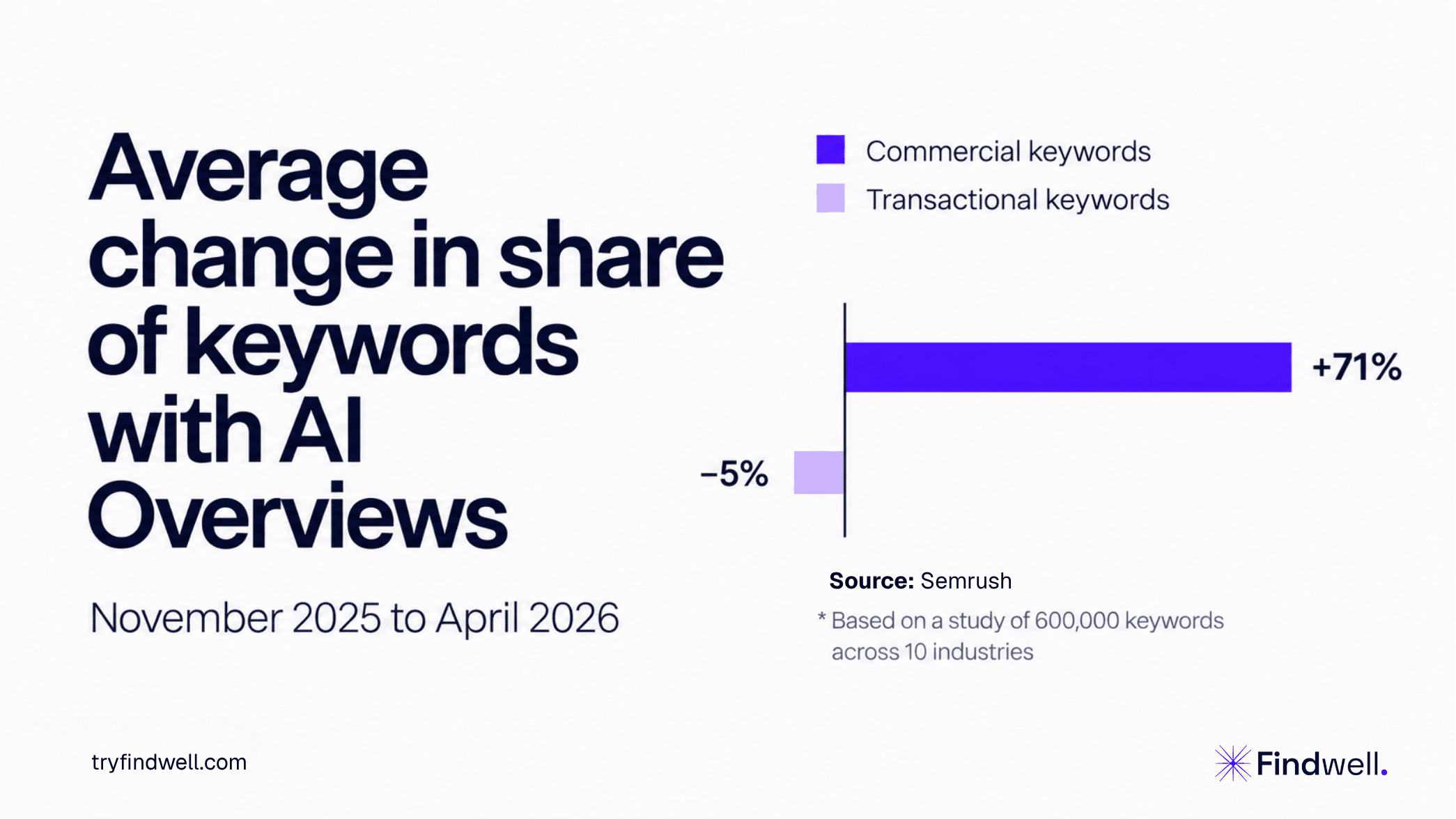
For law firms, that puts AEO somewhere between search visibility, brand authority and commercial discovery.
SEO and AEO compared.
AEO builds on the same foundations as SEO, but the end result looks different.
| AEO / AI search visibility | SEO | |
|---|---|---|
| Primary goal | Make useful information easier to understand and surface inside generated answers | Help pages rank for relevant searches |
| Typical focus | Experts, topics, answers, evidence and citations | Pages, keywords, rankings and clicks |
| What a user may see | A generated answer that may mention an expert, brand or supporting source | A search result leading to your website |
| What still matters | The same foundations, plus clear expert-topic relationships and attributable evidence | Crawlability, useful content, internal links and authority |
| How to measure it | Mentions, citations, topic visibility, referral traffic and commercial outcomes | Rankings, impressions, clicks, traffic and conversions |
AEO does not replace SEO. It extends the job of search visibility beyond getting a page onto a results page.
The real problem is not expertise. It's discoverability.
Most established law firms already contain a huge amount of specialist knowledge.
Partners answer difficult questions every day. They interpret new judgments, advise on unusual transactions and help clients deal with situations that would be difficult to explain in a generic legal guide.
But much of that knowledge never becomes public.
A standard partner biography tells people who someone is. It often says far less about the questions they can actually answer.
A typical partner page might contain a name, title, practice group, selected matters, awards and a short biography. All useful, but it may still tell a search system very little about the questions that person can actually answer.
Example: Sarah, restructuring partner.
Imagine a restructuring partner called Sarah.
Her profile says she specialises in restructuring and insolvency and has 18 years' experience advising companies, directors and creditors.
That tells you who Sarah is. It does not yet show the full range of questions she can answer.
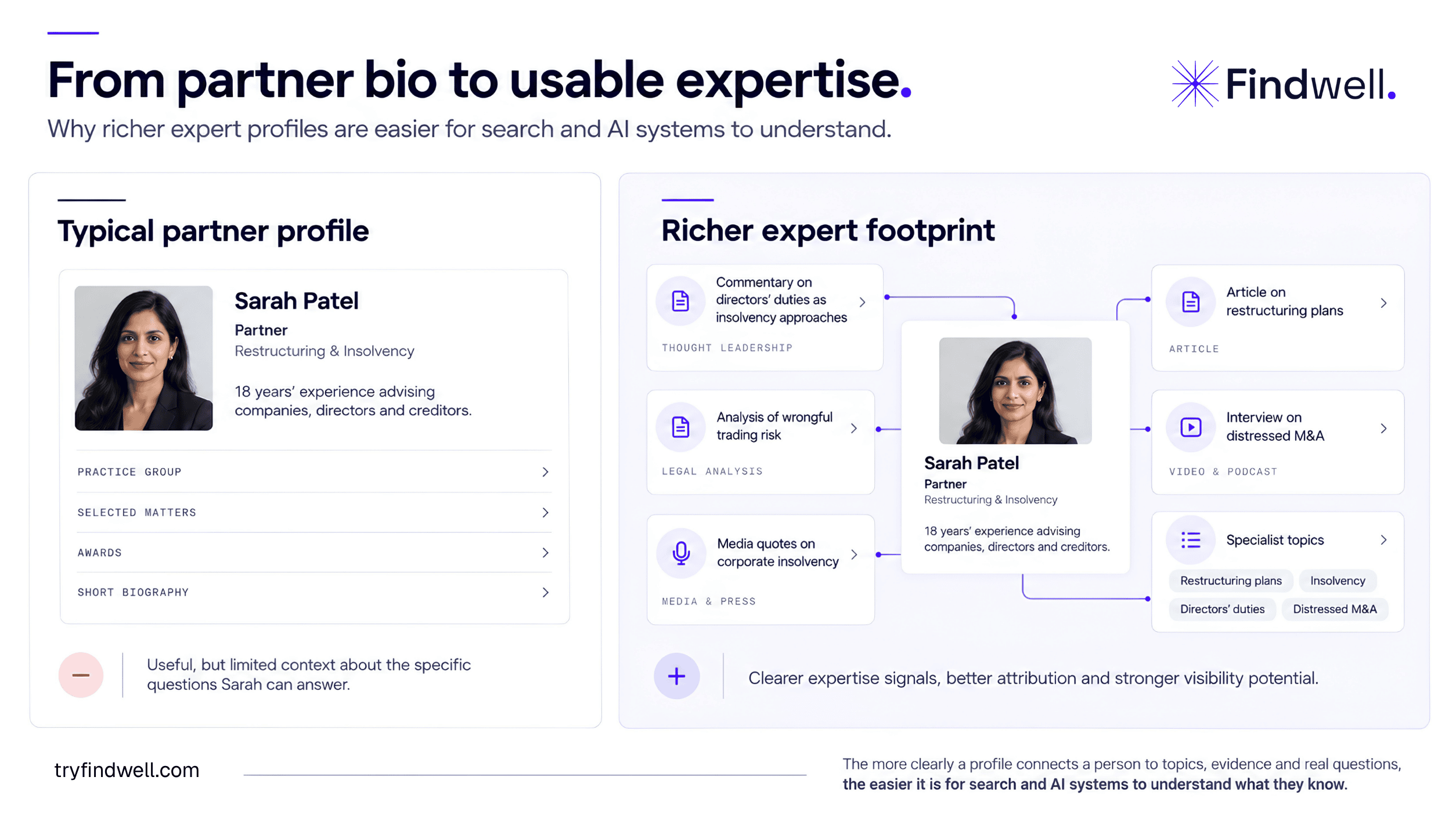
Now imagine the same profile also connects her to:
- commentary on directors' duties as insolvency approaches
- an article on restructuring plans
- analysis of wrongful trading risk
- an interview about distressed M&A
- media quotes on corporate insolvency
- a set of clearly defined specialist topics
Now it is much easier to understand what Sarah actually knows.
A biography tells you who someone is. An expert footprint shows what they know.
The underlying page structure matters too. We've broken down the expert-page structure that Google rewards.
That is the important distinction.
Publishing does not create the expertise. It creates public evidence that the expertise exists.
A simple framework for expert visibility.
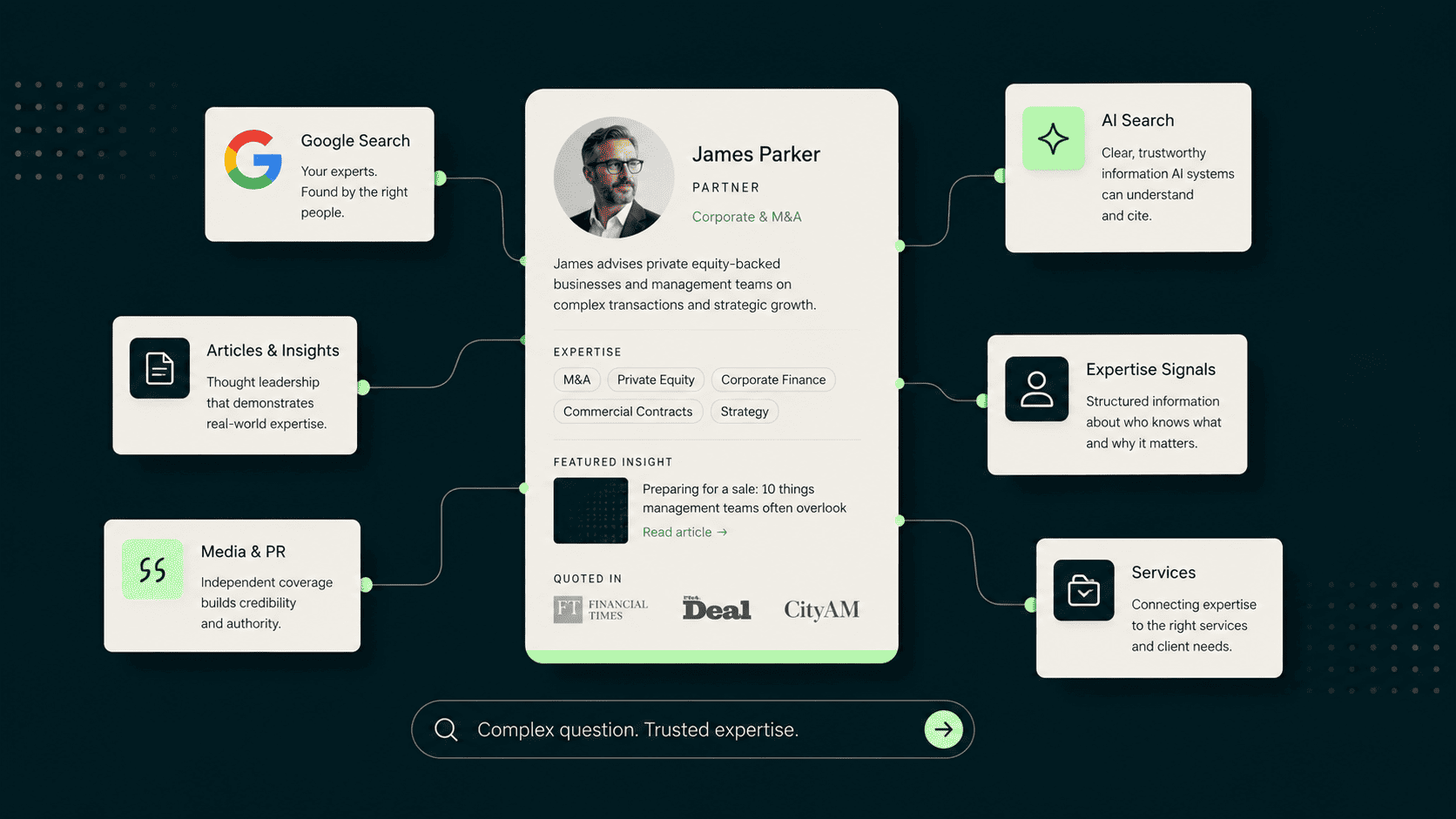
A useful way to think about expert visibility is as a chain: the expert, the topic, the evidence and the visibility that follows.
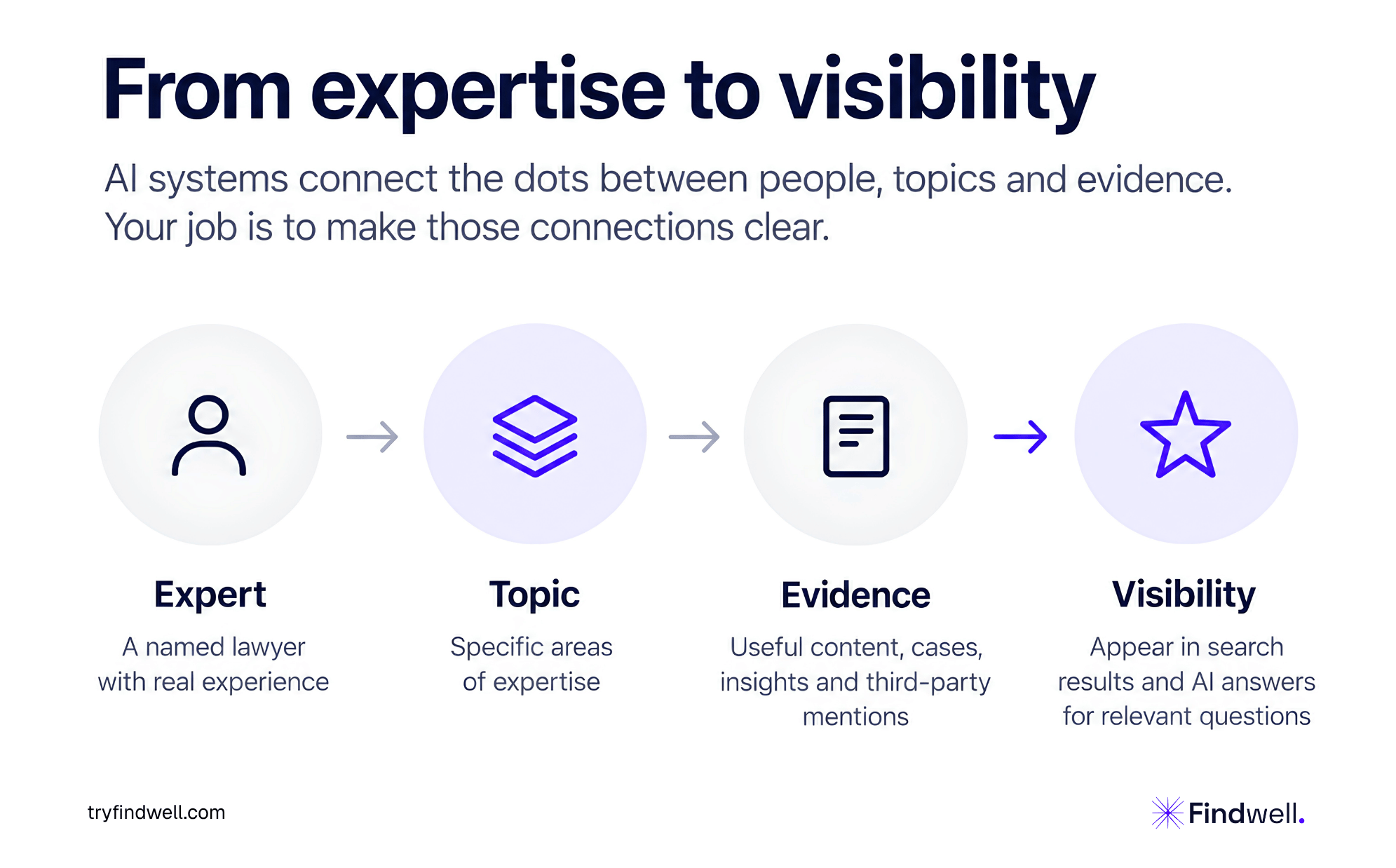
The expert is the person behind the knowledge.
The topic is the specific subject they are genuinely qualified to speak about.
The evidence is the material that supports that expertise: articles, commentary, media coverage, interviews, speaking appearances, credentials and analysis.
The visibility is whether that information can actually be found and connected.
That is also why Findwell's expert profile pages are built around more than a standard biography. The aim is to give each expert a clear home for the subjects they know, the content they have published and the coverage they have earned.
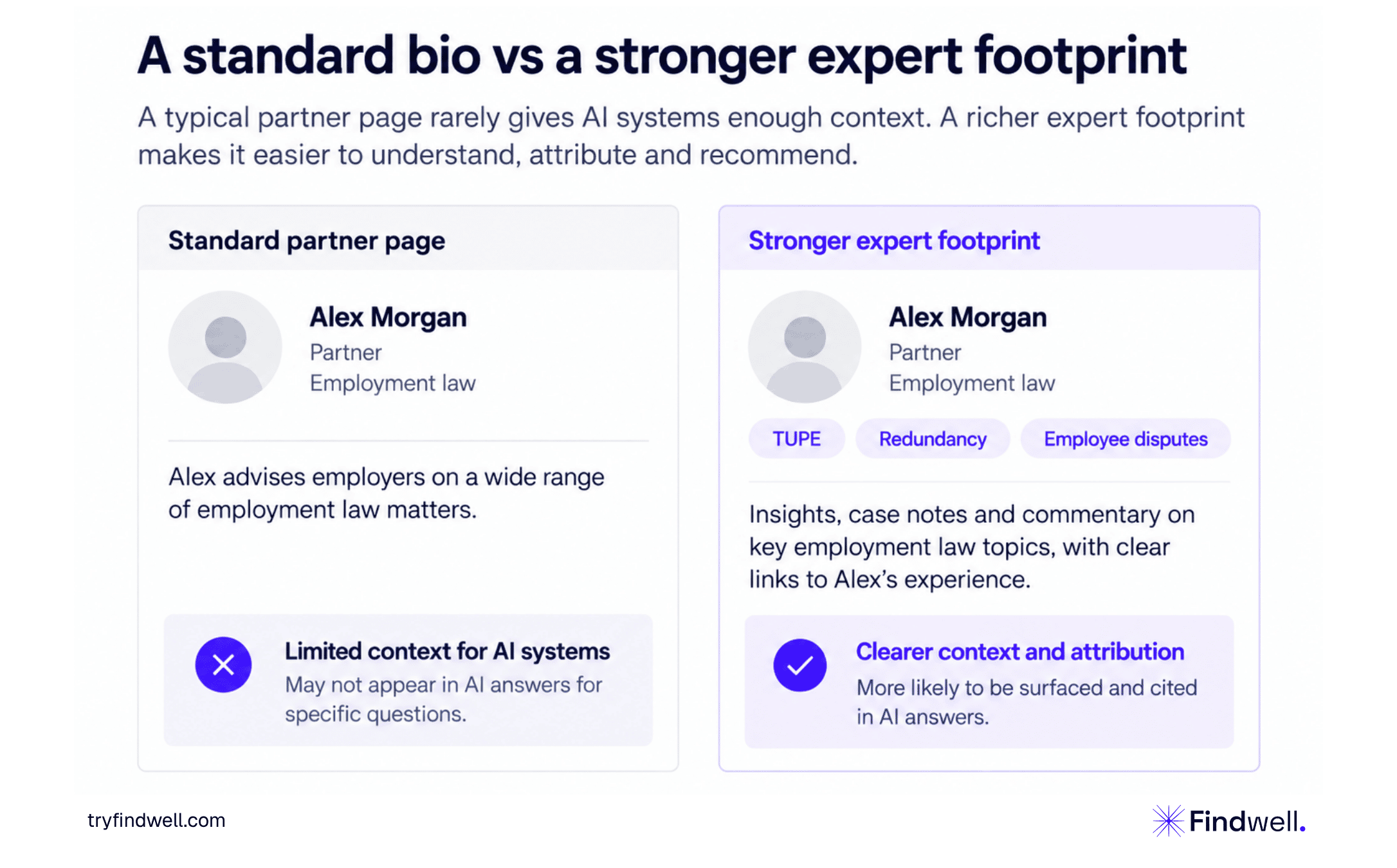
A standard partner page might show:
- job title and practice group
- a broad biography
- selected matters
- awards and credentials
- contact details
A stronger expert footprint also shows:
- clearly defined specialist subjects
- specific questions the lawyer is qualified to answer
- articles, commentary and practical guidance
- independent media coverage and external references
- current evidence of expertise linked back to the individual
The difference is not about making a biography longer. It is about making the relationship between the person, the subject and the evidence clearer.
What law firms should actually do.
There is no need to build a separate "AI website".
The better starting point is to make the expertise you already have clearer, deeper and easier to find.
1. Decide what you want to be known for.
Do not start by producing content around every keyword you can find. Start with the work the firm actually wants more of.
The topic strategy should follow commercial priorities, not keyword volume alone.
A restructuring practice might prioritise:
- directors' duties
- wrongful trading
- restructuring plans
- distressed M&A
- creditor enforcement
Then decide which expert should be associated with each topic.
That gives the content strategy a commercial purpose rather than turning it into a publishing exercise.
Findwell's topic pages are designed around this idea: start with the subjects the firm wants to own, then connect those subjects to the right experts.
2. Match those topics to real experts.
Do not automatically assign every subject to the most senior partner.
Choose the person with genuine depth in the area.
Over time, the website should make the relationship between topic → expert → evidence obvious.
That means a user should not have to infer someone's expertise from a generic practice-group page.
It also means each important expert needs a strong page on the firm's own domain.
That page should evolve as their public body of work grows. It should not remain the static biography written when they joined the firm five years ago.
3. Turn real client questions into useful content.
This is where law firms have an advantage over generic content publishers.
Your lawyers already know what clients are asking.
The opportunity is to turn those real questions into specific, useful content rather than broad explainers.
| Question 1 | Question 2 | Question 3 |
|---|---|---|
| What is TUPE? | Can an employer change contractual terms after a TUPE transfer? | When can an employer rely on an ETO reason to change terms following a TUPE transfer? |
The first question is generic.
The second and third require more judgement and are closer to the questions an experienced lawyer may already be answering for clients.
Google says its AI features can use query fan-out, running multiple related searches around a question before producing an answer. That makes coherent subject depth more useful than publishing a thin page for every tiny keyword variation.
The aim is not to publish every possible FAQ. It is to build a credible body of expertise around the questions that matter.
Clear titles matter too.
A headline such as "Our thoughts on recent developments" tells very little to a reader or a search system. A specific title tells both what the page is actually about.
Ahrefs' analysis of 1.4 million ChatGPT prompts found that pages ultimately cited by ChatGPT tended to be more closely aligned with the original query and related searches than pages that were retrieved but not cited.
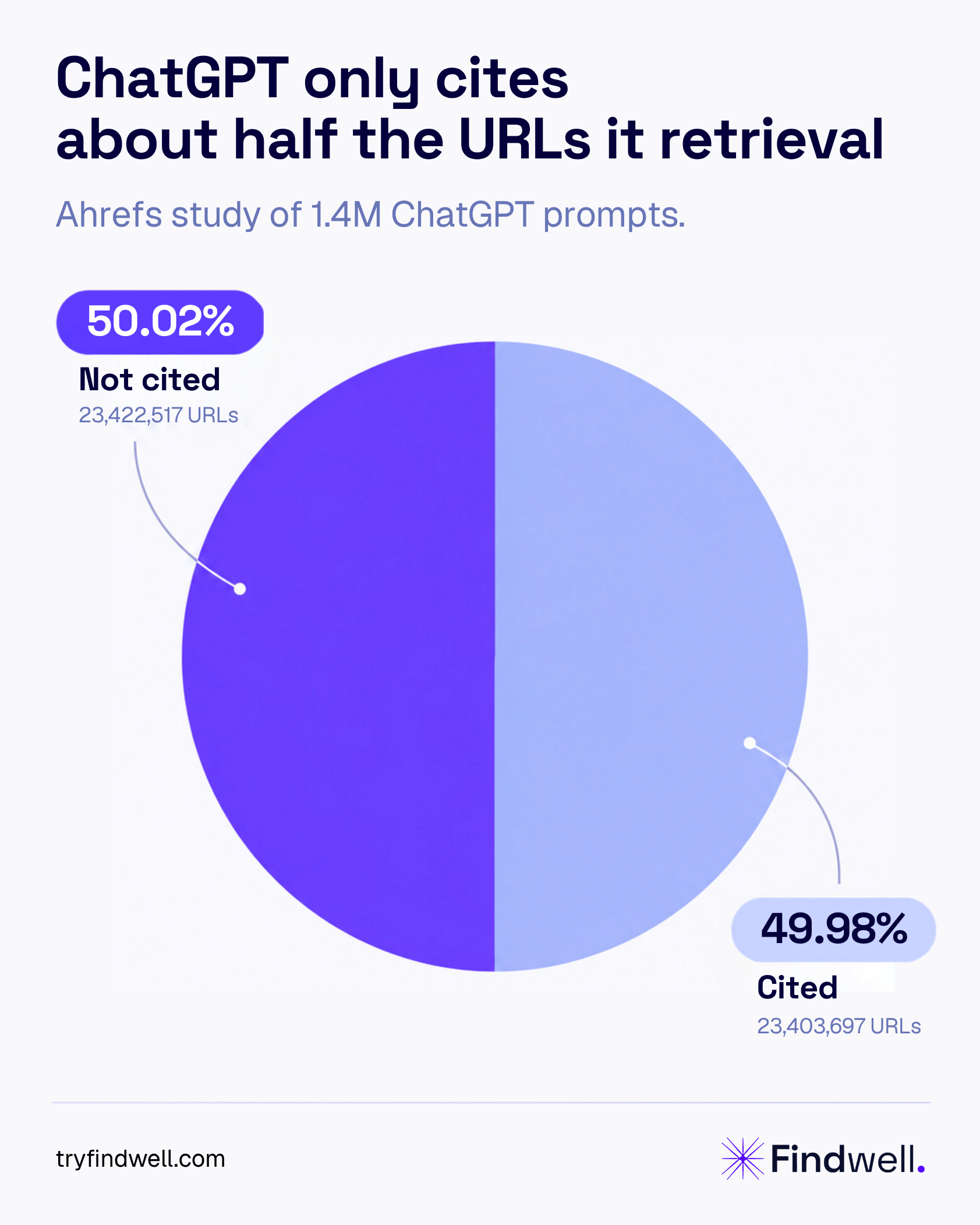
That does not mean title optimisation causes citations. It is a good reminder that specificity beats vagueness.
4. Connect owned expertise with third-party evidence.
A firm's own website will naturally describe its lawyers positively.
Independent sources provide a different kind of evidence.
Useful third-party evidence can include:
- media commentary
- interviews
- bylined articles
- conference appearances
- reputable professional publications
This does not mean PR is an "AEO ranking factor".
It means that if a lawyer is consistently associated with a subject across both the firm's own website and credible external sources, there is more public evidence connecting that person with the topic.
The same applies in the other direction.
Important expertise should not exist only on LinkedIn or a third-party publication. The firm should maintain a useful body of content on a domain it controls so profiles, articles, practice pages and media coverage can reinforce one another.
Findwell's content marketing for law firms model is built around that combination of owned content, named experts and external authority.
5. Make it crawlable, current and measurable.
The technical side matters, but it does not need to become mystical.
Google says pages need to be indexed and eligible for normal Search before they can appear as supporting links in AI Overviews or AI Mode. It also says there is no special AEO schema required.
Good foundations are still familiar:
- crawlable HTML content
- clear internal links
- descriptive page titles
- sensible headings
- canonical URLs
- appropriate structured data
- clear author attribution
- avoiding unnecessary duplication
For ChatGPT specifically, OpenAI says public sites can appear in ChatGPT Search and recommends allowing OAI-SearchBot if publishers want their content to be discoverable.
For a closer look at that problem, see why your best expert can be invisible to ChatGPT.
The other part is freshness.
Law changes. Regulation changes. Judgments change.
Priority content should be reviewed when the underlying law changes, when a major case affects interpretation, when an expert's role changes or when the page no longer answers the question properly.
Updating a strong page is often more useful than publishing another generic article on the same subject.
Don't overthink the technical side. There is no guaranteed ChatGPT citation formula, no special AEO schema and no need to build a second version of your website for AI. Get the fundamentals right first.
How to measure whether AEO is working.
There is no single metric that tells you whether a law firm is "winning AEO".
Track visibility by expert and topic, not only by overall brand mentions.
A better approach is to look at several signals together:
- Organic visibility: are the right pages earning impressions and rankings for priority topics?
- AI visibility: does the firm or expert appear for representative questions?
- Named experts: are individual lawyers being surfaced, or only the firm?
- Topic visibility: which specialist subjects are gaining visibility?
- Citations: which owned or third-party sources are being referenced?
- Competitive visibility: which firms or experts appear when yours do not?
- Referral traffic: are users reaching the site from AI platforms?
- Commercial outcomes: is that visibility contributing to enquiries or conversations?
| What to measure | How to track it | Why it matters |
|---|---|---|
| Mentions and citations | Manual checks, brand monitoring tools, Search Console (referral traffic) | Shows where your experts and content are being used in AI answers |
| Topic visibility | Test the key questions in ChatGPT, Claude, Perplexity, Gemini and Google AI Overview | Helps you understand which topics your experts are associated with |
| Referral traffic | GA4 (e.g. from chatgpt.com, claude.ai, gemini.google.com) | Measures how much traffic AI systems are sending to your site |
| Engagement and conversions | GA4, CRM, enquiries | Shows whether visibility is leading to real opportunities |
AI referral traffic is still much smaller than traditional search traffic, but it is growing. Semrush's analysis of 17 months of clickstream data found outbound referral traffic from ChatGPT increased 206% during 2025.
Google has also started introducing dedicated reporting for generative AI visibility in Search Console, giving site owners more first-party information about how pages appear across AI-powered search experiences in its official guidance.
For professional services firms, the useful question is not simply: Are we visible in AI?
It is: Are the right experts becoming visible for the right commercial topics?
Findwell's analytics and reporting is designed around that expert- and subject-level view.
Where Findwell fits.
The challenge for most firms is not finding expertise. It is getting that expertise out of busy lawyers and turning it into something structured, visible and repeatable.
The people with the most valuable knowledge are usually also the people with the least time to write.
Findwell gives each expert a page on the firm's own domain, then helps capture their knowledge, turn it into useful content, connect relevant media coverage and track how visibility changes over time.
Your lawyers provide the expertise. They should not have to become full-time content creators to make it visible.
See how Findwell works for law firms
Make your experts easier to find.
Law firms already contain the expertise clients are looking for.
The challenge is making enough of that expertise visible outside the meeting room.
Findwell helps firms bring expert profiles, content, media coverage and visibility reporting together so the people behind that expertise are easier to find.
Frequently asked
What does AEO mean for law firms?
AEO stands for Answer Engine Optimisation. For law firms, it means making lawyers, expertise and content easier for AI-powered search and answer systems to understand and potentially surface when people ask relevant questions.
Is AEO different from SEO for law firms?
Yes, but the two overlap heavily.
SEO commonly focuses on visibility in search results, while AEO also considers whether information can be understood and used inside generated answers. The same foundations still matter: useful content, strong technical SEO, clear site structure and authority.
Can ChatGPT recommend individual lawyers?
AI systems can mention named professionals depending on the question and the information available.
There is no guaranteed method for making a particular lawyer appear. The practical objective is to make genuine expertise easier to find, understand and corroborate.
How should a law firm measure AEO?
Track visibility by topic and expert rather than relying on one overall score.
Useful signals include organic impressions, rankings, AI mentions, citations, referral traffic, competitor visibility and enquiries.
See your experts, found.
A 30-minute walkthrough, tailored to your firm, of where your experts would rank and what it would take.