How multimedia makes experts more findable in search and AI.
A good video does more than fill a social feed. Jordan Greenaway and Isaac Raymond explain how video, audio and photography can turn one expert conversation into a wider body of searchable, reusable content.
 Tyler NgoMarketing Manager, Profile
Episode 1 · 16m
Watch the episode.
Worth Finding, Episode 1: How Multimedia Makes Experts More Findable
Multimedia is often treated as the thing that gets added after the content plan is finished.
Write the article. Draft the post. Build the campaign. Then ask whether somebody can turn it into a video.
Isaac Raymond argues for the reverse.
A recorded conversation can be the starting point for the whole content system. It captures the expert's actual language, tone and judgement, while producing material that can be adapted into video, audio, written insight, newsletters and social content.
That matters for professional-services firms because expertise is rarely the problem. The problem is getting enough of that expertise into public, useful formats that clients, journalists, search engines and AI systems can actually find.
Multimedia is not an add-on to the content plan.
A multimedia shoot does not have to produce one finished asset.
In the episode, Isaac describes the recording itself as the starting point. The full conversation may become a long-form video, but the same session can also create short clips, audio snippets, still photography and the raw thinking for articles or newsletters.
That changes the economics of expert content.
Instead of asking a busy partner, adviser or specialist to sit down six different times for six different channels, start with one good conversation and build out from there.
One expert conversation can become:
- a full-length video or podcast
- several short topic-led clips
- audio excerpts or audiograms
- a written article
- a newsletter
- still photography
- quotes and social posts
- material for the expert's profile page
This is also how Findwell approaches expert content: the useful material starts with a recorded conversation with the person whose name will appear on it, rather than generic copy written around a keyword.
Video gives an expert a face, voice and point of view.
Written expertise can tell you what somebody knows.
Video adds another layer: how they explain it.
You hear where they place emphasis, the examples they reach for, the phrases they use naturally and the confidence with which they handle a difficult point. For a prospective client or journalist assessing an unfamiliar expert, those signals can matter.
Findwell's own research found that 72% of people said they would click video first when a video panel appeared in a search for someone's name.
That does not mean every expert needs to become a creator.
It means that when somebody is already researching a person, video gives them another way to understand who that person is and whether they are worth listening to.
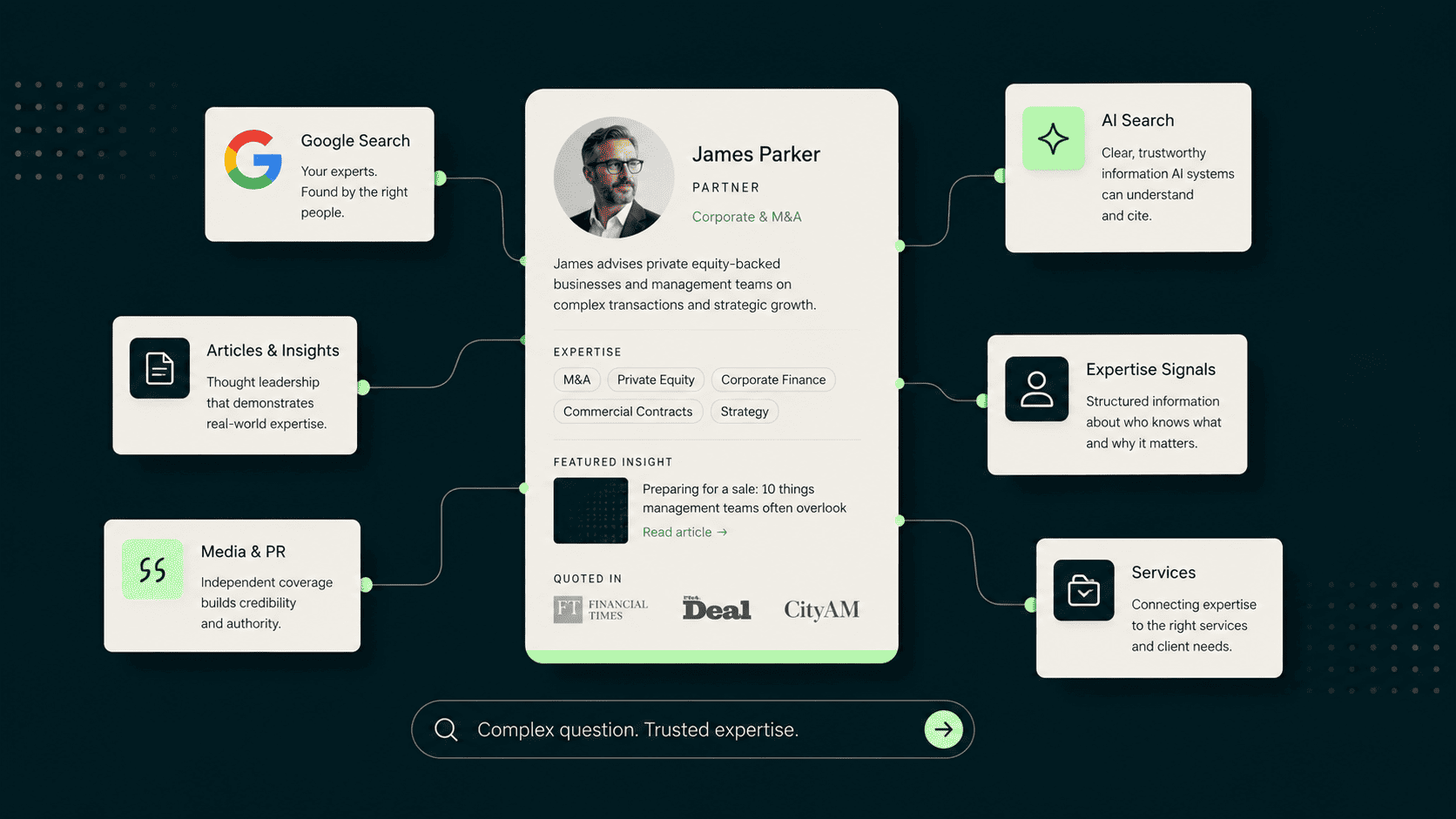
That is why video is built into Findwell's expert profile pages, alongside written thinking and media coverage rather than in a separate content silo.
Make the topic more searchable than the person.
A common mistake in expert marketing is starting with the person.
“What should our CEO talk about?”
A better starting question is:
What is the specific question this person is unusually well placed to answer?
The difference matters because most people do not begin by searching for an expert they have never heard of. They begin with the problem.
An economist may struggle to become the definitive voice on “economics”. An expert with genuine experience of a narrower issue, such as a particular ESG reporting requirement, has a much clearer subject to own.
The episode's advice to use clear titles, descriptions and thumbnails also lines up with the platforms' own guidance.
YouTube says its search system looks at relevance, engagement and quality, and that relevance can include how well the title, description and video content match a query. Its guidance on titles and thumbnails recommends accurate, succinct titles with the most important words near the beginning. YouTube also recommends giving each video a unique description that clearly explains what it covers.
That is a stronger reason to be specific than trying to reverse-engineer a magic keyword formula.
A useful expert video should make it immediately clear:
- what question it answers
- who is answering it
- why that person has something useful to add
Professional video does not need to look like influencer content.
One concern comes up repeatedly with senior experts: they do not want to look as if they are trying to become an influencer.
They usually do not need to.
The aim is not to copy the editing style of consumer social content. It is to make specialist knowledge easier to consume without stripping away the seriousness of the person delivering it.
| Expert-led professional video | Attention-first content |
|---|---|
| Starts with a useful specialist question | Starts with a hook regardless of depth |
| Draws on genuine experience | Can rely on generic commentary |
| Clean, confident production | Heavy editing can become the focal point |
| Lets the expert sound like themselves | Pushes the speaker into a creator persona |
| Optimised for clarity and credibility | Optimised mainly for immediate attention |
Shorter clips can work well when the question itself is narrow. Longer video is useful when the subject genuinely needs room.
The point is not to force every answer into a fixed length. It is to remove the parts that do not help.
Put video where the expert already lives online.
Publishing to YouTube is useful, but it should not be the end of the distribution plan.
If the video demonstrates an expert's knowledge of a subject, it should also sit alongside the rest of that person's public evidence.
That may mean embedding it on:
- the expert's profile page
- a relevant article
- a topic page
- an event or briefing page
- a newsletter or follow-up resource
Google's own video SEO guidance says videos can appear across the main search results, Video mode, Google Images and Discover. Google recommends making videos easy to find in the rendered page, providing stable thumbnails and relevant metadata, and using a dedicated watch page when the video itself is the main reason to visit the page.
For video-first pages, Google also supports 'VideoObject' structured data, which can provide details such as the video's name, thumbnail, upload date and duration. YouTube-hosted videos can also use labelled timestamps so Google can understand key moments.
This is not about adding technical decoration for its own sake. It is about making the relationship between the person, topic and video explicit.
For AI visibility, publish the words as well as the video.
The podcast discusses AI search frequently, but this is an area where it is worth being precise.
There is no documented rule saying that adding a video to a page automatically improves its visibility in ChatGPT or Google's generative answers.
What we can say with more confidence is that the surrounding web content still matters.
Google's current guidance for generative AI search says normal SEO foundations remain relevant and recommends valuable, unique, non-commodity content, including useful image and video content.
OpenAI's current publisher guidance says public website content can appear in ChatGPT Search and recommends allowing OAI-SearchBot if publishers want their pages to be discoverable, surfaced, cited and linked.
For an expert video, the practical implication is straightforward:
Do not publish the recording as a black box.
Give it a useful page. State the topic clearly. Name the expert. Add a transcript or edited written version of the argument. Connect it to the person's wider body of work.
That gives people a better page to use and gives search and AI systems more accessible context around what the video is actually about.
Findwell's AI visibility work follows the same principle: make the relationship between a named expert, the subjects they know and the evidence behind that expertise easier to understand.
One recording should keep working after publication day.
The biggest waste in multimedia is treating publication as the finish line.
A good recording can continue to produce useful material long after the full episode goes live.
For example:
Full conversation Publish the complete episode on YouTube and the Findwell site.
Question-led clips Turn the strongest self-contained answers into individual clips, each focused on one topic.
Written insight Build an article around the most useful argument rather than simply publishing a transcript.
Newsletter Use the conversation as source material for a short note with a clear point of view.
Expert profile Add the strongest clips and written pieces to the person's permanent profile.
Social distribution Use the clips and stills to point people back to the deeper asset.
The objective is not to repeat exactly the same content everywhere.
It is to let one piece of genuine expertise travel in the format that best suits each context.
The human reason for video matters more than the technical one.
It is easy to reduce multimedia to search tactics.
Titles. Metadata. Thumbnails. Structured data. Indexing.
Those things matter because discoverability matters.
But they are not the best reason to put an expert on camera.
Isaac's strongest point in the episode is simpler: video lets somebody see and hear the person behind the expertise.
For professional services, trust is often built before the first conversation. A prospective client wants to know whether this is somebody who can explain a difficult issue clearly. A journalist wants to know whether they will be good on air. A buyer wants to know whether the impressive biography belongs to somebody they would actually want in the room.
A written article can demonstrate knowledge.
A good video can demonstrate the person as well.
A practical multimedia workflow for expert-led firms.
If you are building multimedia into an expert visibility programme, start here:
- Choose the subject before the shoot. Start from real client questions and areas the expert genuinely owns.
- Record a proper conversation. Give the expert enough room to explain, disagree and use real examples.
- Identify the strongest standalone answers. These become short clips and future written pieces.
- Package each asset around a specific topic. Use clear titles, descriptions and thumbnails rather than vague campaign language.
- Publish the words as well as the recording. Add a transcript or editorial version to the relevant page.
- Connect everything back to the expert. Video, articles, media and topic pages should reinforce the same areas of expertise.
The aim is not to produce more content for the sake of it.
It is to make valuable expertise available in more of the places, formats and moments where somebody might go looking for it.
Make your experts worth finding.
Findwell gives every expert a structured home for their profile, thinking, video and media coverage, then connects that evidence to the topics they should be known for across search and AI.
See how Findwell works
Full transcript.
Lightly edited for clarity, punctuation and repetition. The meaning of the conversation has been preserved.
Introduction.
Jordan Greenaway: Welcome to Worth Finding, our new podcast from Findwell. In each episode, we take a different aspect of our work or a different aspect of content and discuss how it makes you more, or maybe less, findable.
On this episode, we're talking about multimedia. I'm delighted to be joined by Isaac Raymond, who's our Head of Multimedia at Findwell and Profile. We're going to break down how multimedia works, how it can contribute to search, AI search, thought leadership and a broader findability strategy.
Isaac, thanks for joining me.
Isaac Raymond: Thanks for having me.
What do we mean by multimedia?
Jordan: When we say multimedia, we don't just mean video. We mean audio, photography and other formats too. Talk me through what multimedia actually means and what your average day looks like.
Isaac: Multimedia can span a whole range of outputs. Obviously there is the video content, but on a multimedia shoot we're capturing audio as well. That can become little audio snippets or audiograms, and the insights can be adapted into other things.
It might become the starting point for an op-ed or another written piece. One recording can be the beginning of lots of different content.
Jordan: Something that's always interesting to me is somebody's digital profile. What appears when you search their name is increasingly shaped by photography and video as well as written content.
When you search somebody, you may see panels of videos and photos. Multimedia becomes part of that person's public profile.
Findability is not only about turning up when somebody searches an area of expertise. It is also about what appears when someone searches the individual's name. Is that something you think about when you're producing content?
Isaac: One hundred per cent.
We are visual people. If you want to add authority behind a voice and behind somebody's insights, having a face to the name is important.
That can be photography, video on your own platform or on social media, and images alongside articles. It all comes together to build a much clearer picture of the person behind the expertise.
One shoot, many outputs.
Jordan: Talk to me about repurposing content and getting value from one shoot across different platforms.
There can be a misconception that you shoot a 30, 45 or 90-second video and it exists on one platform. How do you think about reusing that material?
Isaac: For too long we've seen multimedia as an add-on. Really, it should be part of the strategy from the beginning.
You have a multimedia shoot and record a batch of content. That's your starting point.
The footage can be cut into clips for social media. The talking points can become a newsletter. You can use the transcript to build out the ideas that came up during the conversation.
One of the interesting things about a multimedia shoot is that, when you sit down to write, you're trying to get your ideas onto paper. When you're having a conversation, those ideas often come out in a more natural and accessible way.
In a market that's saturated with insight, people do not necessarily want everything presented like an academic paper. Sometimes they want something quicker and easier to understand.
Jordan: Accessibility is a big part of it.
In our own research, when people search someone's name and a video panel appears, 72% say they would click video first.
Part of that is because a short clip can be easier to consume than an article. But people also want the texture of someone's voice. They want to hear how that person sounds and get a sense of their personality.
Being found for the topic, not just the name.
Jordan: Findability is not only about taking control of a search for your own name.
If you're an expert in ESG, for example, you also want useful video to appear when someone searches technical questions in that area.
How do you approach that?
Isaac: If you want to become more findable around a topic, you need to be targeted about the content you're creating.
Find the topic you're going to speak about for a particular video, or choose a wider topic that can be broken down into individual videos. That starts in the strategy phase.
Then make the videos feel authentic and well produced. Think about the thumbnail, the title and the description, and make sure the language reflects what people are actually interested in.
People may not be searching for a CEO's name. They are more likely to be searching for a specific part of the industry or a question they need answered.
So those topics need to be clear in the title, description and thumbnail.
Jordan: I've always suggested niching down.
Do not try to become the most credible and findable voice on something as broad as economics from day one. But there may be far less useful video around a narrow issue such as a specific ESG reporting mandate, even though people are searching for it.
That gives the expert a much clearer place to start.
Multimedia and the wider content strategy.
Jordan: How should multimedia fit with the wider content strategy? Is it something you bolt on, or should everybody be setting the strategy together?
Isaac: It is not an add-on. Not now.
It has to sit at the centre of the strategy build-out.
You want to identify the subjects that are important and relevant to the audience, especially the more focused terms where you can genuinely offer something useful.
From day one, you are not going to be the next big influencer, and if you're a serious business that is probably not the objective anyway.
The people coming to you want somebody who knows what they're talking about.
How do you avoid looking like an influencer?
Jordan: This raises a concern I hear from clients.
You identify questions people are actually searching around an important B2B topic, then ask the client those questions on video and create short clips.
Some clients worry that it starts to feel too much like marketing themselves.
How do you make the content feel like genuine expertise rather than influencer content? Is it the visuals, the framing or the tone?
Isaac: Two things come to mind.
First, talk authentically about something that is relevant and that you are genuinely interested in. Otherwise, why should anybody else listen?
Talk about your industry, your experience and what you've actually seen. People can tell when that interest is not real.
Second, think about how you physically shoot and edit it.
If you're a serious business sharing specialist insight, you probably do not want every video to feel like lifestyle influencer content with constant flashy cuts and an oversized hook.
The aesthetic can be clean and professional without feeling overly corporate.
The production should match the kind of expertise you're trying to communicate.
Why video belongs on an expert profile.
Jordan: We've developed Findwell to give experts dedicated pages that bring all their insights together. Video is a core part of that.
Why do you think video is so important in that mix?
Isaac: Everybody processes information differently, so it is important to offer video for people who learn and absorb information visually.
But the best thing about video is that you can hear the person talking in their own tone of voice, with their passion and the phrases they naturally choose.
Those things may not come out in the same way on paper.
You get a feel for that person and their authenticity. It is not just a hidden voice behind a piece of writing. It is a real person, with a face and a personality, who clearly cares about the subject they're talking about.
Jordan: I like that answer because it's easy to make the case for video entirely technical.
You can talk about search, pages, metadata and findability, and those considerations matter.
But that is only part of the reason to do it.
Video can make a page more immersive and interesting for the visitor. We're not doing it just for a technical SEO reason. We are doing it because it can make the expert and their thinking easier to understand.
Closing.
Jordan: Isaac, thank you very much for sharing your insights.
That's it for this episode of Worth Finding, where each episode we break down what it takes to be findable.
If you'd like to find out more about how we make experts more findable, visit tryfindwell.com.
Thank you for listening.
See your experts, found.
A 30-minute walkthrough, tailored to your firm, of where your experts would rank and what it would take.