What is expert-led marketing? A practical guide for professional services firms.
Expert-led marketing starts with the people clients trust. Learn how firms can connect specialist knowledge, the press, search and AI-assisted discovery into one consistent approach
 Jordan GreenawayFounder, Profile
Expert-led marketing puts the people clients trust at the centre of a firm's marketing. It starts with what a named specialist knows, then builds a connected body of useful work around that expertise: on the firm's own website, in relevant media, across search, and wherever clients go to find answers.
For professional services firms, that is more than a change in content format. It changes the starting point for marketing. Instead of asking what to publish on each channel, the firm asks which experts it wants to be known for, which problems they can help solve, and what evidence would give a prospective client confidence to speak to them.
Expert-led marketing is a sustained approach to growth, not a campaign or a replacement for the firm's brand.
Key takeaways.
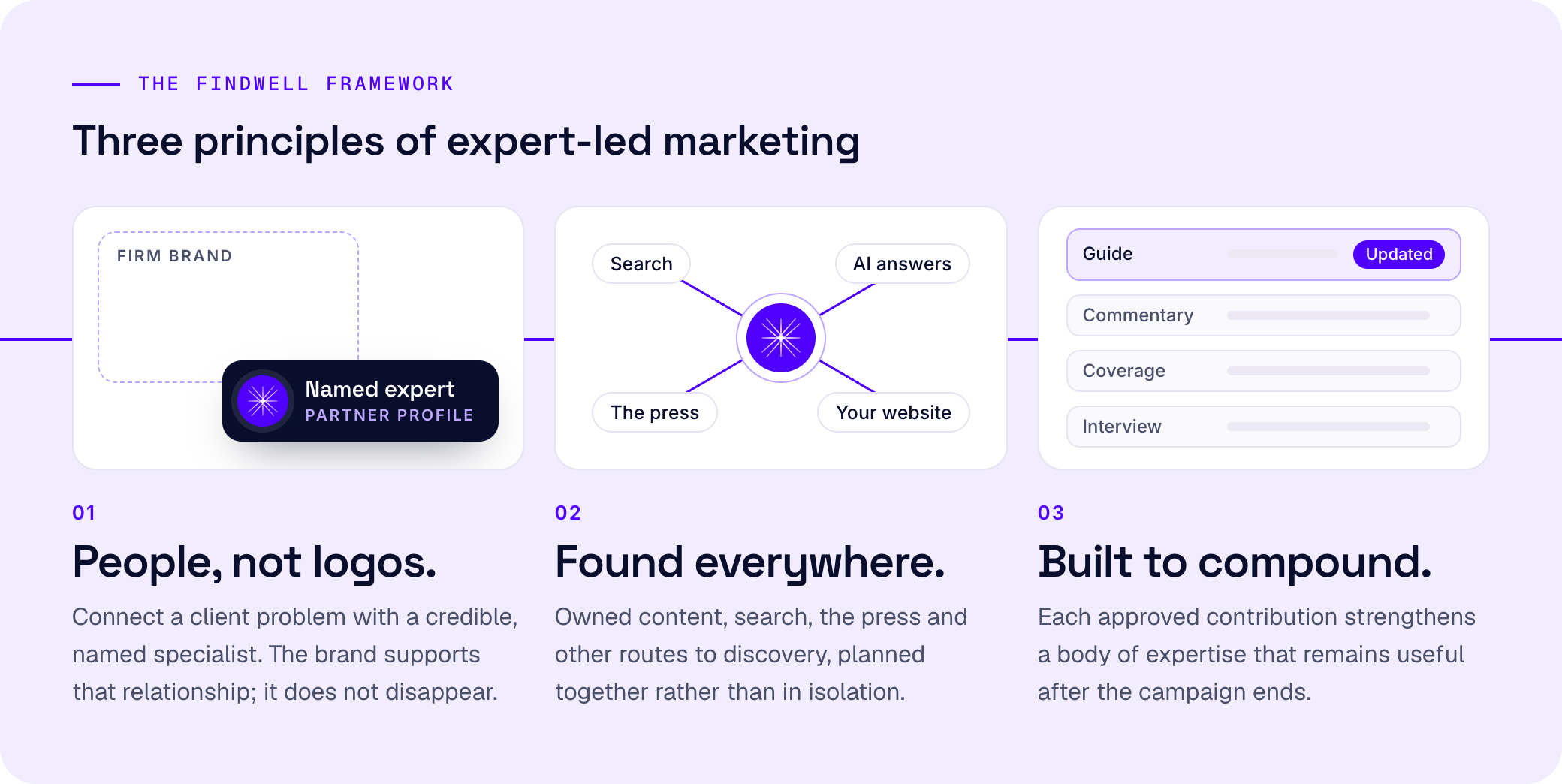
- People, not logos. Make it easy to connect a client problem with a credible, named specialist. The brand supports that relationship; it does not disappear.
- Found everywhere. Bring together owned content, search, the press and other relevant routes to discovery, rather than planning each in isolation.
- Built to compound. Each approved contribution should strengthen a body of expertise that remains useful after the campaign ends.
- Expert-led is broader than thought leadership. A strong point of view matters, but so do editorial ownership, distribution, measurement and what happens after publication.
- Measure discovery and decisions, not output alone. An expert mention, a citation, a qualified enquiry and an instruction are different outcomes.
What is expert-led marketing?
Expert-led marketing is a way of organising marketing around the expertise of identifiable people. It captures their judgement, makes it useful to an audience, publishes it with clear attribution and connects the resulting work across the places clients and journalists look for information.
A law firm might have an excellent reputation and a long list of services. But a director dealing with an internal investigation wants to know who has handled that kind of problem, what the difficult decisions are and whether the lawyer understands the commercial stakes. A recognisable name on a team page is a start. Demonstrated expertise gives that name meaning.
The same applies to accountants, advisers, consultants and other knowledge-led firms. A firm's reputation matters. So do the judgement and experience of the person who will actually do the work.
An expert-led programme therefore begins with a different set of questions:
- Who has the expertise that matters to the clients we want to serve?
- Which questions and decisions should that person become known for?
- What original explanation or evidence can they contribute?
- Where should that material live, travel and be measured?
The objective is not to turn professionals into influencers or require them to write constantly. It is to make their genuine expertise easier to discover and assess, while keeping it connected to the firm.
Why does expert-led marketing matter now?
Buyers look for evidence before they make contact.
A client may arrive through a referral, a media article, a technical search or an AI-generated answer. Whatever the route, they still need reasons to trust the person behind the advice.
In the 2026 Edelman–LinkedIn B2B Thought Leadership Impact Report, based on more than 1,100 management-level professionals, the researchers identify original thinking, proprietary evidence and human judgement as increasingly valuable as AI becomes part of buyer research. In its analysis of the findings, Edelman reports that 82% of surveyed B2B decision-makers say thought leadership is becoming more valuable as AI becomes a common source of business answers.
That is not evidence that every UK professional services buyer starts by searching for an individual. It does indicate why an original, well-supported view matters when generic explanations are easy to obtain.
Human contact remains part of the process. Gartner's May 2026 survey release says 69% of 645 B2B buyers preferred to validate AI-generated insights with sales representatives. This was a cross-sector survey, not a study of legal or accountancy clients. The useful lesson is narrower: digital information and human reassurance can work together.
Professional services firms already have valuable expertise, but it is not always visible.
Findwell's Manchester Law Firm Visibility Index 2026 reviewed 378 active law firms registered in Greater Manchester. In the study's 465 classified Google results from firm-level searches, only two results were pages centred on a named individual.
2 of 465 results were centred on a named lawyer.
Findwell, Manchester Law Firm Visibility Index, September 2026. This is a defined sample of firm-level search results, not a measure of every legal search, the quality of the lawyers or the likelihood of appearing in an AI answer.
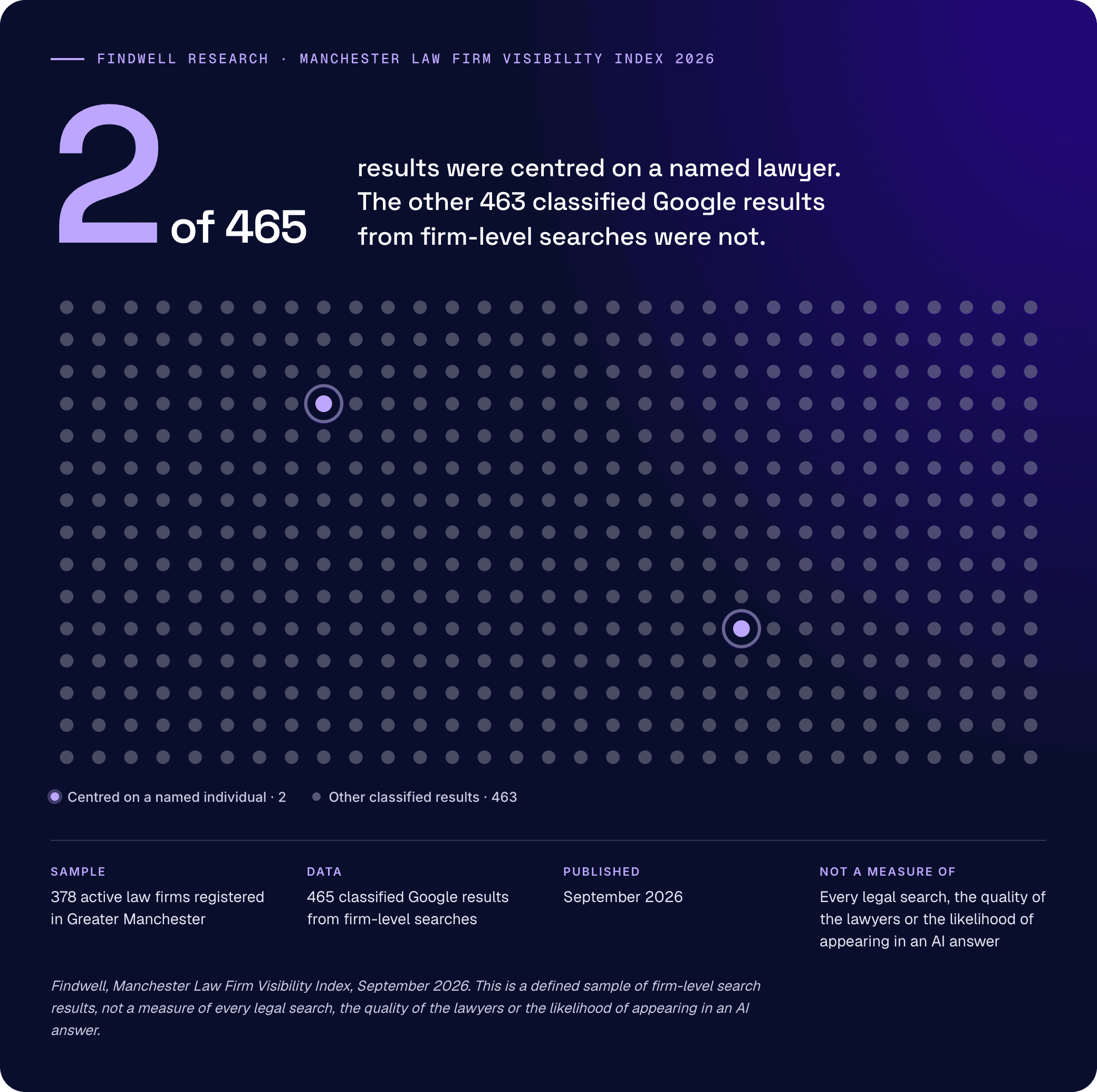
The striking distinction is between a firm appearing in search and a potential client being able to find the person whose expertise they need. The next editorial task is not simply to publish more pages. It is to connect a specialist to the questions they can genuinely answer.
Visible expertise is associated with stronger marketing practices.
Hinge's 2026 High Growth Study, drawing on 770 professional services firms globally, reports that high-growth firms were 2.5 times more likely to activate subject-matter experts than their peers.
The study is observational; it does not show that expert-led marketing caused growth. It does, however, underline how deliberately some firms use the expertise they already have.
Expert-led marketing, thought leadership and content marketing are not the same thing.
These approaches can support one another, but they answer different questions.
| Approach | The question it answers | Where it can fall short on its own |
|---|---|---|
| Thought leadership | What useful, original view can this person contribute? | A strong article may have little lasting visibility if it is not connected to the expert and distributed. |
| Content marketing | What should we publish for a defined audience? | A content calendar can become generic or channel-led without clear subject ownership. |
| Personal branding | What is this person known for? | Recognition may not connect to the firm's services, evidence or enquiries. |
| Expert-led marketing | How do we build a sustained, measurable programme around real expertise? | It requires editorial responsibility, coordination and an ongoing commitment, not a single post. |
A carefully argued opinion column is thought leadership. An expert-led programme asks what happens before it is written, how the argument is connected to the author's published work, who else needs to encounter it and how it contributes to the next useful piece.
That distinction is important for firms where expertise is the service. The goal is not content for its own sake. It is a more reliable way to bring the right professional into a buyer's consideration.
Three principles behind an expert-led approach.
Findwell expresses the approach through three principles: People, not logos. Found everywhere. Built to compound. They are a point of view about how to organise marketing, not independent research findings.
People, not logos.
Start with the person who can explain the problem. Identify the areas where their judgement is strongest, the evidence behind their experience and the questions that clients repeatedly ask.
This does not diminish the firm's name. The firm provides the professional standards, wider team and reputation behind the advice. But the buyer should not have to work backwards from a generic service page to discover who might actually help them.
Found everywhere.
A client might see a trade publication, a search result, a professional newsletter or an AI answer. A journalist might need a concise, attributable opinion. A referrer might need a reliable expert page to pass on.
These are different moments, but they should lead back to a consistent account of the person's expertise. Useful topic pages, expert profiles and dated media references help connect those moments on the firm's own domain.
Being found everywhere is an ambition for relevant discovery, not a promise that every expert will be named by every search engine or AI tool.
Built to compound.
A campaign produces a burst of activity. A sustained programme leaves behind an expanding, maintained body of evidence: explanations, technical commentary, independent coverage, interviews and answers to questions buyers actually ask.
Compounding only works if the material stays accurate. A five-year-old regulatory article may need updating, consolidating or removing. The goal is a stronger record of expertise, not an ever-growing archive of outdated posts.
How to build an expert-led marketing strategy.
There is no single content format that makes a programme expert-led. The essential work is choosing the right subjects, capturing genuine expertise and giving it a clear route to the people who need it.
Step 1. Map the experts to commercial questions.
Start with business needs, not a list of keywords. Bring together client enquiries, matter or project patterns, the firm's strategic priorities, search behaviour and the subjects on which its people have distinctive experience.
For example, "employment law" is too broad to give a specialist a recognisable position. "How should a board investigate allegations against a senior executive without compromising the process?" is a real decision with competing risks, where careful expert judgement matters.
A useful subject brief includes the intended client, the question, the expert who can answer it, the evidence available and the outcome the firm wants to understand. A search and AI visibility audit can help identify the gap between what clients ask and which experts currently appear.
Working output: one expert-to-subject map with a small set of priority questions, not a spreadsheet of hundreds of interchangeable keywords.
Step 2. Interview for judgement, then write with care.
The best material often begins with an informed conversation rather than a request for the expert to write 1,000 words. Ask what clients get wrong, when conventional advice fails, what has changed and which trade-offs matter.
Try questions that invite evidence rather than slogans:
- What does a client usually misunderstand before they approach you?
- When would you advise against the obvious course of action?
- Which example can we explain without breaching confidentiality?
- What is your view, and what evidence would change your mind?
An interviewer can capture the thinking. A human writer develops a coherent piece and the named expert checks and approves it. In regulated sectors, any legal, confidentiality or compliance review should happen before publication.
Findwell's expert content process is designed around up to an hour a month of an expert's time. That is a description of Findwell's working model, not a universal requirement for every firm.
Working output: a signed-off argument with a named owner, specific evidence and an editorial plan for its use.
Step 3. Give the expertise a permanent, attributable home.
A published opinion is most useful when a reader can see who stands behind it and find the rest of that person's work.
A well-maintained expert profile on the firm's own website can connect a specialist's subjects, relevant experience, commentary, media coverage and contact route. It should add to the firm's existing biographies, not compete with or replace them.
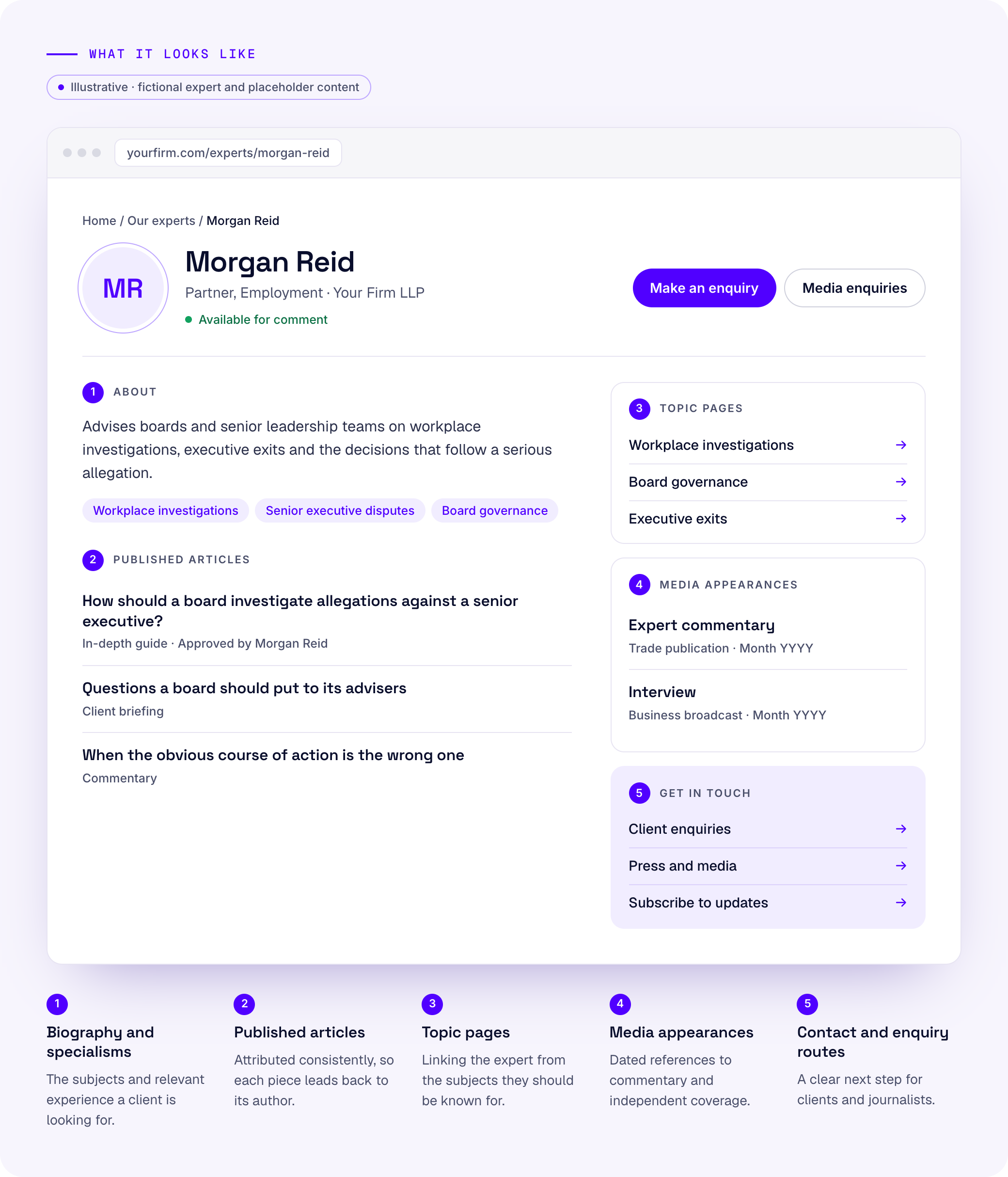
Link to the expert from appropriate service and topic pages. Attribute articles consistently. Use accurate role titles and dates, especially when someone changes position or a rule changes. Make the important text accessible without requiring a PDF download or sign-in.
Working output: a credible profile that links the person, the subject and the published evidence.
Step 4. Take one strong idea to the channels that suit it.
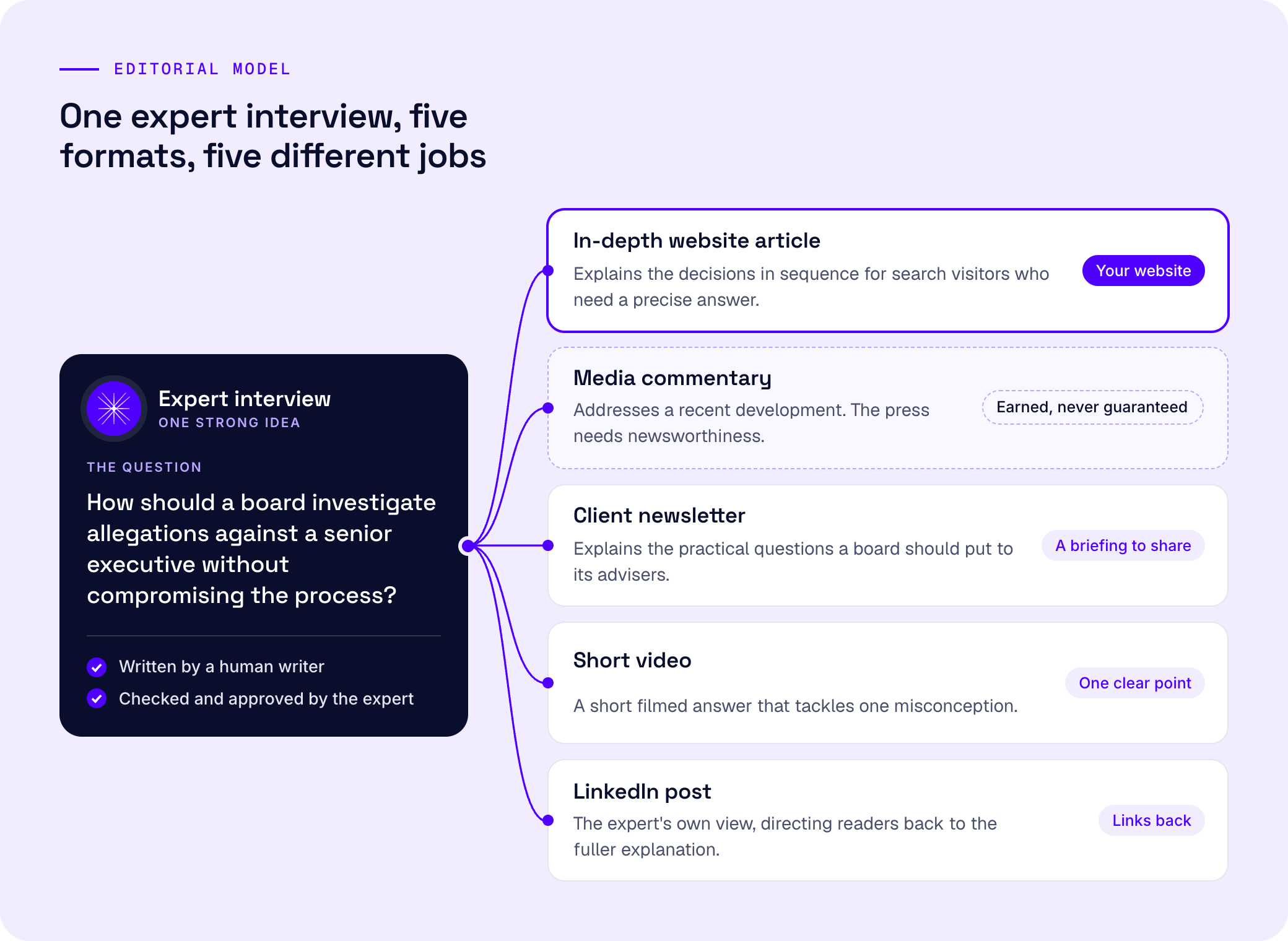
One expert interview can support different outputs, but copying the same paragraph everywhere is not a distribution strategy.
Take the board-investigation question above. A long-form website guide could explain the decisions in sequence. A trade press contribution might address a recent development. A short filmed answer could tackle one misconception. A client newsletter might explain the practical questions a board should put to its advisers. A LinkedIn post could contain the lawyer's own view and direct readers back to the fuller explanation.
Each format earns its place by doing a different job. The press needs newsworthiness; search visitors need a precise answer; clients may need a briefing they can share internally. Media coverage can add independent context, but no media placement, ranking or AI citation should be promised.
Working output: a short distribution plan specifying the audience, purpose, editor and destination for each format.
Step 5. Measure the visibility and the decisions that follow.
Counting the articles published tells you whether the team was busy. It does not tell you whether the right people became easier to find.
| Signal | What to track | What it does not prove |
|---|---|---|
| Search visibility | Impressions and visits to expert/topic pages for relevant queries | That a visitor is a qualified prospect |
| Named expert visibility in AI | The named people returned for a fixed set of prompts, platforms, dates and locations | A stable ranking or AI market share |
| Citations and source quality | Which owned or independent sources are cited, when citations are shown | That the source caused an instruction |
| Media interest | Relevant journalist enquiries and independently published coverage | That every placement leads to demand |
| Commercial engagement | Useful subscribers, qualified enquiries, meetings and known opportunities | That marketing alone caused the outcome |
Create a baseline, agree a review cadence and record the original evidence. Distinguish a firm mention, a named expert mention, a recommendation and a source citation. They answer different questions.
Analytics and reporting can help connect the published activity with visibility and enquiry signals by expert and subject. Measures should inform editorial decisions, not become a dashboard of numbers that nobody acts on.
A worked example for a professional services firm.
Illustrative scenario, not a reported client project or proof of results.
Imagine a mid-sized accountancy firm with a partner who advises owner-managed businesses on succession. The firm's website lists "tax and business advisory" services, but offers little evidence of how this partner thinks about decisions involving family members, timing and future ownership.
An expert-led approach could start with a genuinely useful question: What should an owner decide before handing a business to the next generation?
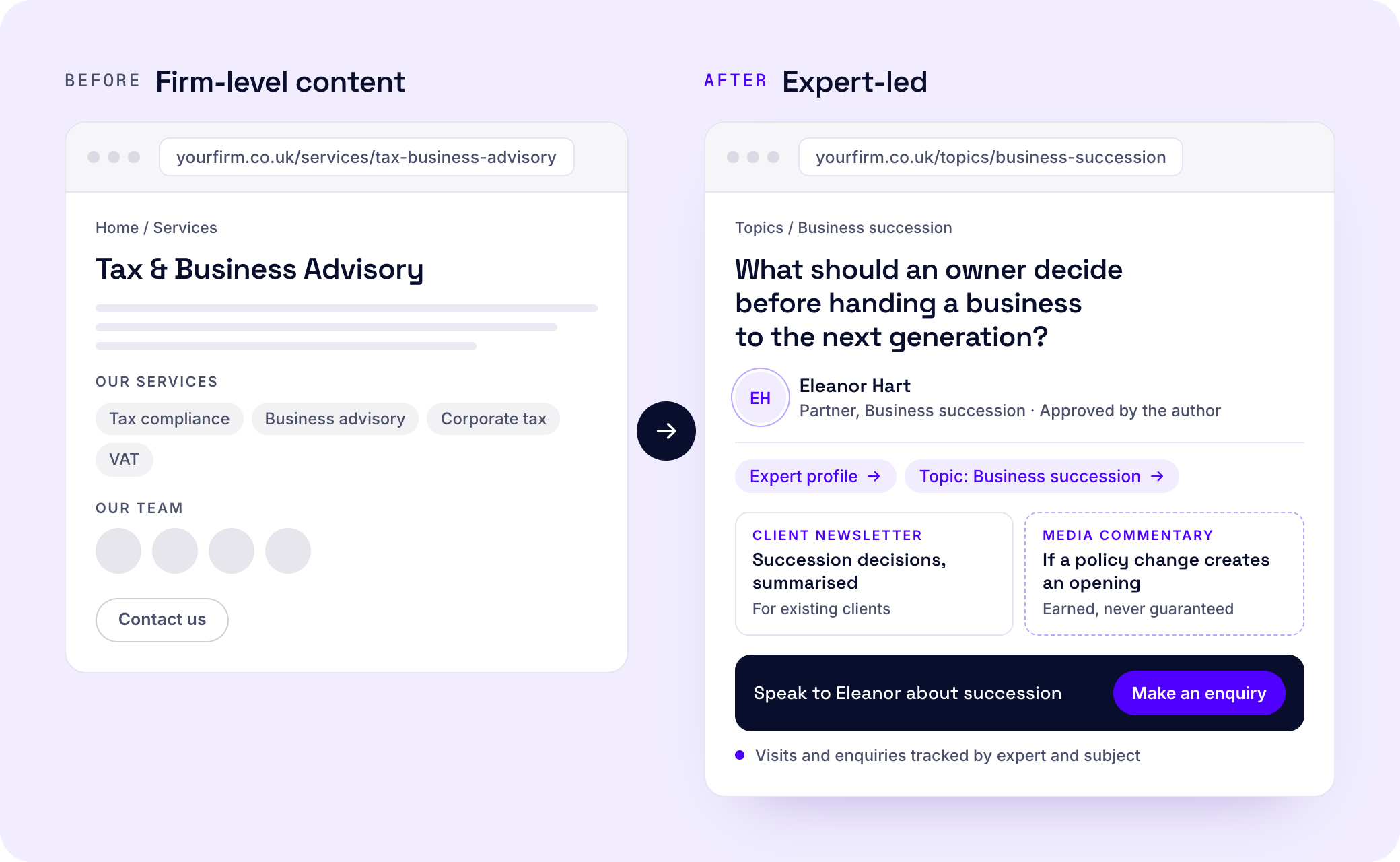
The partner is interviewed about recurring mistakes, trade-offs and the warning signs they have encountered. The editorial team checks the factual detail and develops an article with practical examples and carefully stated limits. The firm publishes it under the partner's name, connects it to the relevant expert and topic pages, and considers whether a new policy or research finding creates a genuine opportunity for independent media commentary.
A newsletter summarises the decisions for existing clients. A short follow-up explains one difficult point. After a few months, the team checks whether more people are finding that partner for succession-related questions and whether enquiries have become more relevant.
The method does not guarantee a ranking or a client win. It does replace a vague instruction to "publish more thought leadership" with a person, a subject, a body of evidence and a way to learn what resonates.
Where do search, PR and AI answers fit?
Search and AI-assisted discovery are useful routes to expertise, but they do not replace the underlying need for accurate information and independent trust.
In its October 2026 'What Is AI Reading?' analysis, Muck Rack reported that journalism accounted for 22% of the citations observed in its September sample, down from 27% in May. Owned media represented 15.2%. These are proportions within that study's citation dataset, not the chance that any particular Findwell page will be cited.
That is one reason not to treat an expert's website as the entire programme. Useful owned material and credible third-party appearances can play different roles. The mix also changes between AI products and over time, so isolated prompt checks are a poor substitute for repeatable measurement.
Google's guidance on AI features in Search says pages need to be indexed and eligible to appear with a snippet to qualify as supporting links in its AI features; there is no special AI-only markup that secures inclusion. Keep the substantive text accessible, maintain accurate titles and links, and make it clear which named person has contributed the expertise. Other AI products have their own discovery and citation behaviour.
The goal is to make authoritative evidence available and useful, then measure what actually happens. A search engine or AI assistant still chooses its own answer and sources.
Your first 30 days.
A good first month is about setting up a repeatable process, not declaring victory after a new page goes live.
| When | Action | Tangible output |
|---|---|---|
| Week 1 | Choose priority experts, client questions and relevant competitor/source gaps. | Expert-to-subject map and initial visibility baseline |
| Week 2 | Interview one expert, gather evidence, and complete the editorial/compliance review. | One approved argument and production brief |
| Week 3 | Publish or improve the expert profile and a substantial, useful owned article. | Connected expert, topic and evidence pages |
| Week 4 | Distribute into appropriate formats and assess baseline signals. | Distribution log, measurement plan and next editorial priorities |
If the work feels too large, start with one named expert and one commercially important question. Prove the editorial process before expanding it.
Put your experts front and centre
The firms most worth hearing from often have more specialist knowledge than their marketing currently reveals. Expert-led marketing is a way to close that gap, without making every partner a full-time writer or abandoning the firm brand.
Findwell is an expert-led marketing system. Our platform, technology and team work together to make every expert findable in search, AI answers and the press. The system has three connected parts:
- What your experts get — The platform: profiles, a directory, topic pages, newsletter and dashboard on the client's own website.
- How they get found — FindwellOS, the science of findability: expertise mapped, published work structured and visibility measured.
- Who does the work — Our team: strategists, writers, PR and media, and multimedia, working with the experts every month.
Findwell's writers produce the content and each expert approves it before publication. The programme is designed to make the work consistent and useful; it does not guarantee coverage, search rankings or AI citations.
If you want a practical way to start, the Expert-Led Marketing Playbook takes these ideas into a subject map, interview prompts, a distribution plan and an expert visibility scorecard.
Explore the Expert-Led Marketing Playbook
Book a call
Frequently asked
Do experts have to write their own content?
No. They do need to supply the expertise, check the factual accuracy and approve what is published in their name. Skilled interviewers and human writers can handle the work without losing the person's point of view. Findwell asks for up to an hour a month of an expert's time, rather than expecting them to write articles themselves.
Does this replace a firm's brand, website or existing marketing team?
No. Expert-led marketing works best when it adds substance to what the firm already has. The brand, service pages, marketing team and professional standards still matter. The change is to organise more of the work around named expertise rather than disconnected channel activity.
Is expert-led marketing just another name for SEO?
No. Search is one route to discovery. The same specialist may be found through press coverage, recommendations, newsletters, social media or a direct referral. The strategy coordinates those routes and uses evidence to understand what contributes to enquiries.
Will publishing more articles make an expert appear in ChatGPT?
Not necessarily. More content is not the same as better evidence. Pages must be useful, accurate and accessible, and search and AI systems decide independently what to retrieve or cite. Measure whether the right expert appears for representative questions rather than promising a particular ranking.
Will an expert-led strategy make a firm appear in ChatGPT or Google AI?
There is no guarantee. Relevant, accessible content and credible sources make expertise easier to evaluate, but AI products determine their own answers and citations. Test actual buyer questions repeatedly rather than assuming that more content means more mentions.
See your experts, found.
A 30-minute walkthrough, tailored to your firm, of where your experts would rank and what it would take.