2027 marketing budgets: Where should UK professional services firms invest?
How much should law, accountancy and consulting firms spend on marketing in 2027? The latest research points to a more useful question: which investments build buyer preference, generate qualified opportunities and deliver measurable commercial value?
 Tyler NgoMarketing Manager, Profile
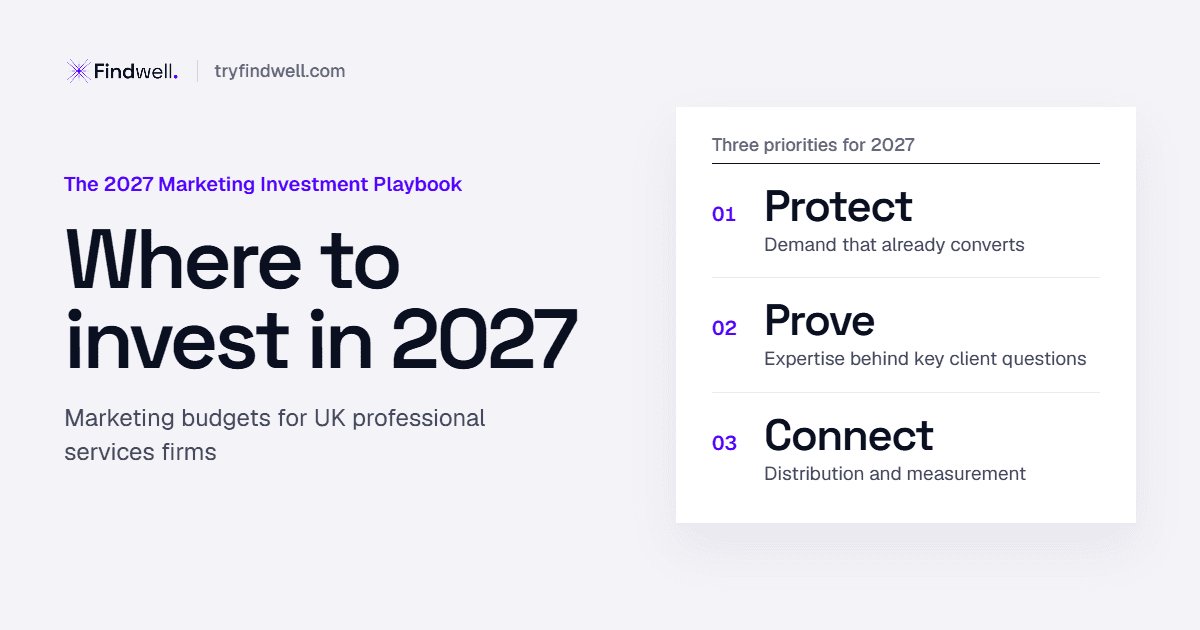
Key takeaways.
- There is no universal marketing budget target. In a survey of 130 UK law and accountancy firms, average marketing and business development activity spend was 3.1% of turnover, excluding salaries. Benchmarks with different samples or cost definitions cannot be compared directly.
- Budgets are being revised upwards, not necessarily spent faster. The Q3 2026 IPA Bellwether recorded a +14.3 net balance for overall UK budget revisions; that is not a 14.3% increase in expenditure.
- Buyers form preferences early. In 6sense's UK and Ireland B2B sample, 92% had the eventual winning supplier on their Day-1 shortlist. The finding is self-reported and not specific to professional services.
- Expert-led marketing offers a way to connect channels. Start with client questions and credible specialist insight, then plan the content, media outreach, distribution and measurement around it. This is Findwell's strategic recommendation, not a causal conclusion from the surveys.
- Measure commercial outcomes, not output alone. Qualified enquiries, pipeline contribution and incremental wins provide a more useful basis for budget decisions than article counts or AI mentions on their own.
Marketing budgets are easier to compare than marketing results. A firm can benchmark its spend against the market, increase investment in the channels attracting attention and still struggle to explain what that money has achieved.
For UK professional services firms planning 2027, the stronger approach is to protect the marketing activity that already generates qualified demand, invest in expertise that helps buyers choose the firm, and measure the commercial contribution of both.
That means looking beyond a percentage of turnover. It means understanding when buyers form preferences, where they encounter a firm's expertise, and which investments can reasonably be linked to enquiries, opportunities and new business.
It also makes the case for expert-led marketing: planning around the knowledge and judgement clients value, then making that expertise useful across search, PR, content, social and AI-assisted discovery. This is a strategic approach, not a claim that every channel should be replaced.
Findwell's 2027 Marketing Investment Playbook brings together 18 published sources on marketing investment, buyer behaviour, professional services and AI-assisted discovery. Here are the findings that matter most when deciding where the next pound should go.
How much should professional services firms spend on marketing in 2027?
There is no single percentage that every firm should aim for.
The Law Firm Marketing Club's Professional Services Marketing Survey found that 130 UK law and accountancy firms spent an average of 3.1% of turnover on marketing and business development activity in 2025, excluding salaries.
For a firm with £10 million in annual turnover, that would equate to £310,000 in activity spend. But it is a benchmark from a particular sample, not a recommendation for every firm.
Compare that with Gartner's 2026 CMO Spend Survey, which reported marketing budgets averaging 7.8% of company revenue.
The numbers look very different because the underlying businesses and cost definitions are different. Gartner's sample spans multiple industries and is dominated by very large enterprises. It is not a like-for-like benchmark for a UK law firm or accountancy practice.
Before adopting any industry figure, a firm should answer four questions:
- Does the benchmark include salaries, partner time and business development costs?
- Are the firms in the sample similar in size, sector and business model?
- How much of the current budget is already generating valuable enquiries or supporting client relationships?
- What additional commercial outcome would justify increasing investment?
A budget benchmark can help start the discussion. It cannot tell a firm which activity deserves the next £10,000.
What the latest research says about 2027 marketing priorities.
Recent research suggests that marketing investment is holding up, but priorities are shifting.
The Q3 2026 IPA Bellwether Report recorded a +14.3 percentage-point net balance for UK marketing budget revisions. This means more survey respondents increased their budgets than reduced them.
Public relations recorded the strongest positive balance at +15.3, followed closely by events at +15.1.
These figures measure the direction of budget revisions. They do not mean UK marketing expenditure increased by 14.3%, or that PR delivers a higher return than other channels.
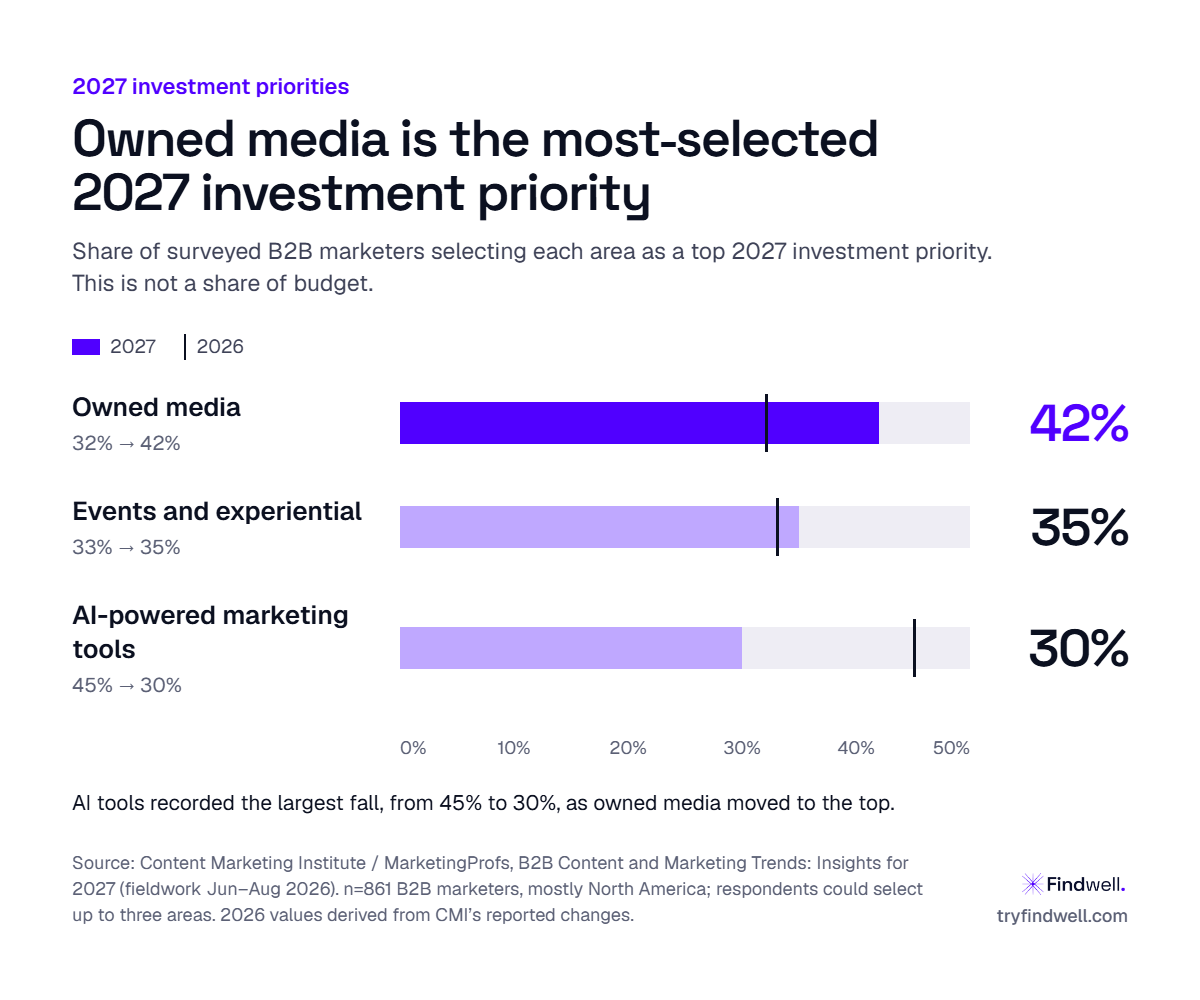
Meanwhile, the Content Marketing Institute and MarketingProfs' 2027 B2B research reveals another shift.
Of the B2B marketers surveyed:
- 42% selected owned media among their top investment priorities for 2027, up ten percentage points from the previous year.
- 35% selected events and experiential marketing.
- 30% selected AI-powered marketing tools, down 15 percentage points.
The survey is predominantly North American and includes relatively few professional services respondents. It should therefore be read as a broader B2B signal, not a forecast of UK professional services expenditure.
Still, the findings raise a relevant question.
As firms reconsider their investment in AI tools, paid channels and owned media, are they putting enough resources into the expertise and evidence that give buyers a reason to choose them?
A useful article by a recognised specialist, a well-maintained expert profile or a sector-specific briefing can continue supporting conversations long after publication. But content only becomes commercially valuable when the right audience encounters it and has a reason to act.
Publishing more is not, by itself, an investment strategy.
Why marketing needs to influence buyers before the first enquiry.
A significant part of a firm's commercial reputation is formed before anyone fills in a contact form.
In the 2026 6sense B2B Buyer Experience Report, UK and Ireland respondents reported that:
- 92% had the eventual winning supplier on their shortlist from Day 1.
- 77% of purchases went to the supplier favoured before seller contact.
- 90% had ranked their shortlist before first contact.
- 85% of first contact was initiated by the buyer.
These findings come from self-reported B2B purchasing experiences across several categories, rather than a study exclusively of professional services.
Nevertheless, they challenge a familiar approach to marketing measurement.
If a law firm only measures enquiries submitted through its website, it may miss the research that led a general counsel to consider the firm in the first place.
The same applies to an accountancy practice recommended by another business owner, or a consultancy whose research has been circulated internally before a procurement discussion.
By the time a prospective client makes contact, much of the work of establishing credibility may already have happened.
For marketing teams, this creates two distinct responsibilities.
First, make the firm's expertise easy to discover and assess. Buyers need to understand who has relevant experience, what they think about the problem and why the firm is worth considering.
Second, make it easy to take the next step. Clear service pages, relevant enquiry routes and responsive follow-up still matter. Being known is valuable, but it does not replace converting demand.
The budget needs to support both.
What is expert-led marketing, and why does it matter in 2027?
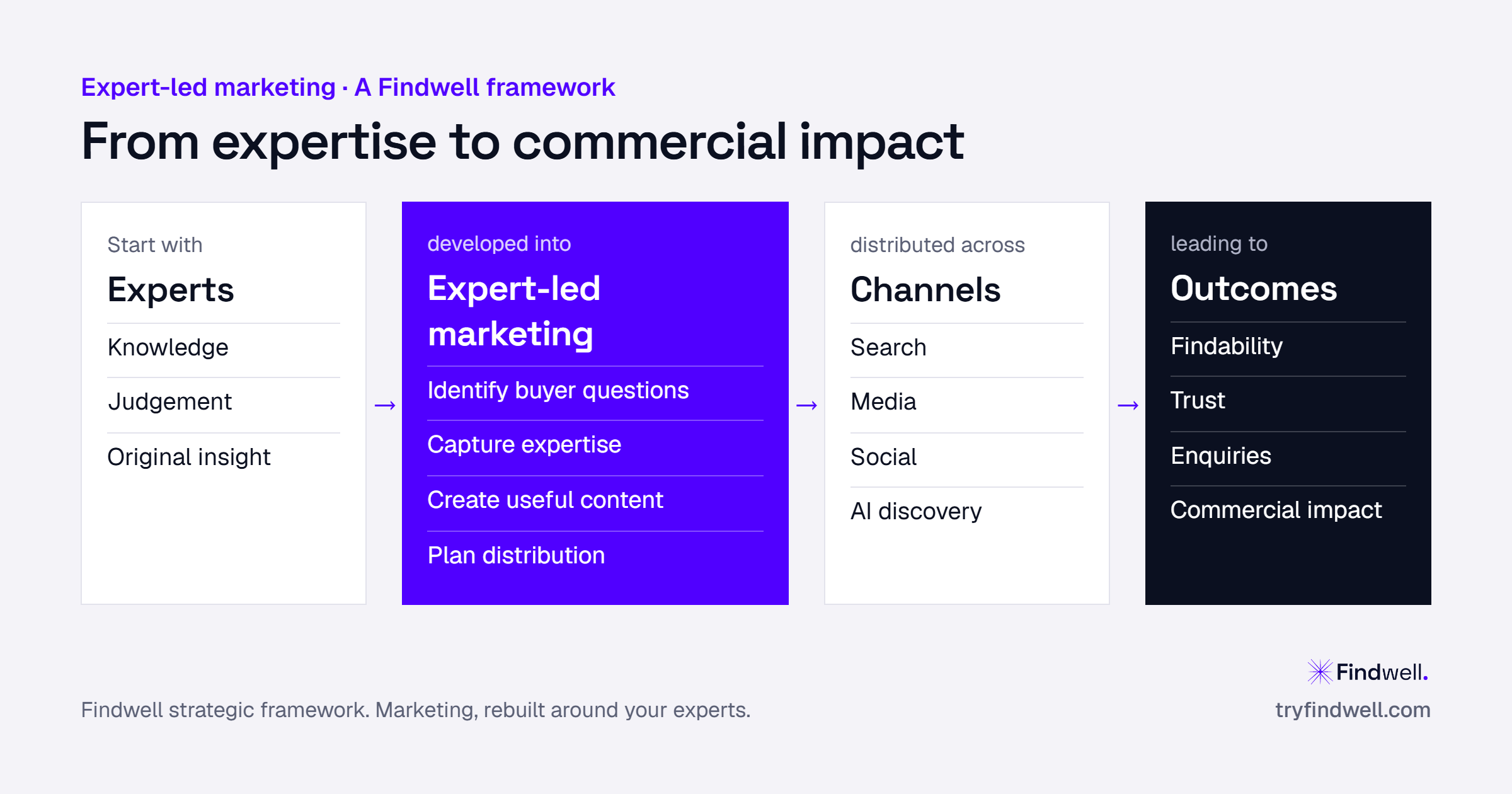
Expert-led marketing puts a firm's specialists and their real-world judgement at the centre of its marketing strategy. It starts with questions clients need answered, draws on the people best placed to answer them and makes their insight available in the places buyers research and make decisions.
For a law firm, that might mean a partner explaining the commercial implications of a new regulation. For an accountancy practice, it could be an adviser addressing a problem clients have not yet recognised. For a consultancy, it might be a sector-specific point of view that a client can share with colleagues.
The important shift is from treating channels as isolated production targets to planning around one useful piece of expertise and the different ways it can reach buyers. An expert interview might inform an article on the firm's website, a briefing for existing clients, a relevant media pitch and short-form commentary for professional networks. Different channels need different formats, but the underlying judgement should be consistent.
In practice, a firm can build this approach around three decisions:
- Choose the expertise that matters commercially. Identify the client questions, sectors and service lines where the firm has something distinctive and useful to say.
- Turn that knowledge into material buyers can trust. Capture the specialist's reasoning, experience and examples rather than relying on generic summaries.
- Distribute deliberately and assess the response. Make the insight accessible through the firm's own website and relevant third-party channels, then track engagement, qualified enquiries and opportunities.
This is the principle behind Findwell's approach to expert-led marketing. It does not mean every marketing activity must feature a named expert: effective demand capture, service-page conversion, relationships and measurement remain essential. Nor does publishing expert content guarantee coverage, search rankings or inclusion in AI answers.
Where should professional services firms invest their marketing budgets?
An expert-led approach can connect the firm's message across channels, but it still needs a disciplined budget. Rather than treating every channel as a separate spending decision, it helps to organise investment around the work each activity must accomplish.
We identify six jobs in the 2027 Marketing Investment Playbook.
| Budget priority | What it needs to accomplish | What to measure |
|---|---|---|
| Demand capture | Help buyers with an existing need find and contact the firm | Qualified enquiries by service line |
| Expert-led content | Explain complex issues through credible expertise and original insight | Engagement from relevant buyers and accounts |
| PR and distribution | Take useful expertise to audiences beyond the firm's own website | Relevant coverage, referrals and contributed enquiries |
| Relationships | Support referrals, client development and buying-group confidence | Sales conversations and opportunity quality |
| Measurement | Connect activity to enquiries, opportunities and business outcomes | Sourced and influenced pipeline, wins and margin |
| Testing | Learn which new activities deserve further investment | Incremental contribution and test results |
This is a planning framework developed by Findwell, not a classification used in the underlying studies.
The point is not that every firm should spend equally across these six areas.
A firm with strong referrals but weak online visibility may have a different priority from one that attracts substantial website traffic but converts few enquiries.
Likewise, cutting high-performing paid search to increase thought leadership spend would be difficult to justify without evidence that the change improves commercial outcomes.
Find the weak point in the buyer journey before changing the marketing mix.
The full playbook includes a worked £250,000 allocation showing how these trade-offs could be modelled, together with worksheets for testing different budget scenarios.
The priorities are not the same for every professional services sector.
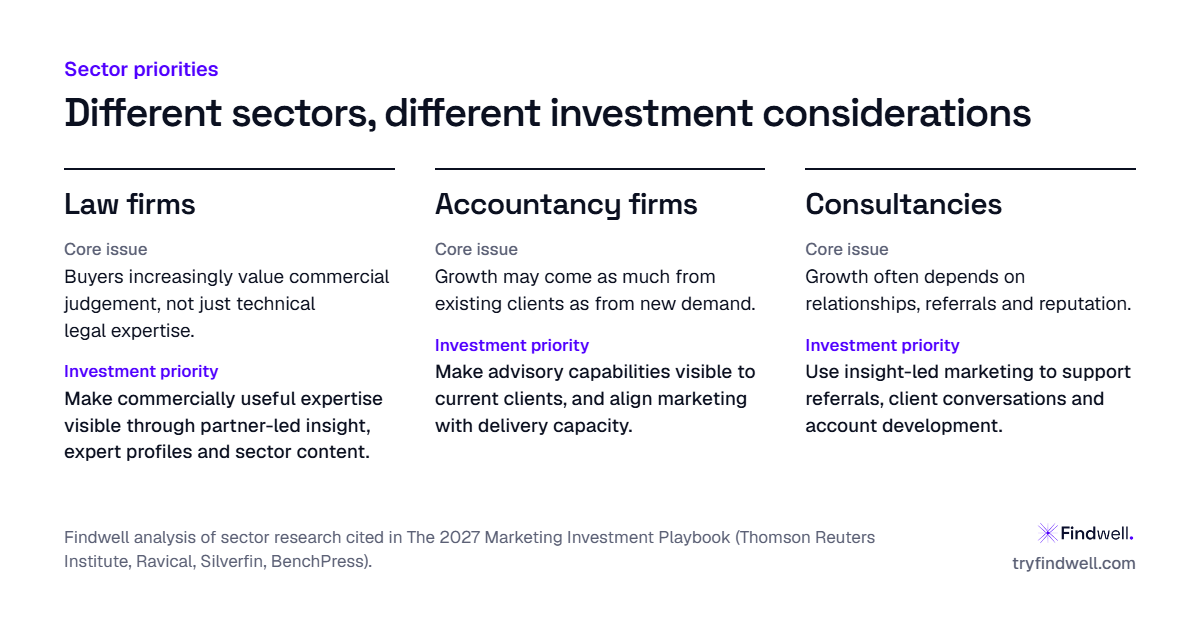
The research also suggests that law firms, accountancy practices and consultancies should approach marketing investment differently.
Law firms: make commercial judgement visible.
Technical competence is expected. What increasingly distinguishes a law firm is its ability to explain what legal developments mean for the client's business.
The Thomson Reuters Institute's 2026 State of the UK Legal Market found that 37% of UK legal buyers cited business savviness as a reason to favour a firm, compared with 31% in the previous study.
That has practical implications for content and PR investment.
An article explaining a regulatory change may demonstrate technical knowledge. A briefing that explains how the change affects a particular sector, which decisions clients need to make and what the risks of delay might be is more useful to a commercial decision-maker.
For law firms, three investments deserve consideration:
- Partner-led briefings focused on the commercial consequences of legal developments.
- Expert profiles that demonstrate sector experience and judgement, not simply qualifications.
- Clear routes from specialist content to relevant practice teams and enquiries.
The objective is not more commentary on every legal development. It is to make the firm's most valuable expertise easier for prospective clients to recognise.
Accountancy firms: start with the clients you already have.
For accountancy practices, the nearest growth opportunity may sit within existing relationships.
Ravical's 2026 research among 500 UK SME clients found that, among respondents using another provider for advisory services, 35% said their main accountant had never offered or recommended the service.
At the same time, Silverfin's All Accounted For 2026 research highlights capacity constraints. In its UK practitioner sample, 46% reported receiving more advisory requests than they could fulfil.
Together, these findings point to an important distinction: creating more demand and unlocking more value from existing clients are not necessarily the same problem.
A practice may benefit more from making its advisory capabilities visible to current clients than from launching another broad acquisition campaign.
That might involve specialist service pages, timely client communications, practical briefings or more structured account reviews.
But marketing must also reflect delivery capacity. Generating enquiries that a practice cannot service is unlikely to strengthen its client relationships.
Consulting firms: use expertise to support referrals and relationships.
Consultancies often grow through relationships, reputation and recommendation.
In the 2026 Consultancy BenchPress research, 72% of firms spending between 6% and 15% of revenue on marketing reported growth, compared with 56% of firms overall.
This is an association, not evidence that the spending level caused the growth. Larger or faster-growing businesses may simply have more resources available.
The more useful lesson is to assess how marketing supports the relationships through which consultancy work is won.
Strong research, sector perspectives and practical commentary can give existing clients, partners and referrers something specific to share.
For consultancies, thought leadership should not be judged solely by the number of direct leads it generates. Its contribution to referrals, client conversations and account development also deserves attention.
How should AI visibility affect the 2027 marketing budget?
AI is changing how people research businesses and professional expertise. But being mentioned in an AI-generated answer is not the same as winning a client.
A useful distinction is between:
- Mentions: Whether an AI answer names the firm or a particular expert.
- Citations: Whether it references a page published by the firm or an independent source.
- Accuracy: Whether the answer correctly describes the firm's services, expertise and location.
- Commercial outcomes: Whether greater visibility contributes to relevant enquiries or opportunities.
These are different measurements and should not be treated as interchangeable.
A practical starting point is to identify 20–30 questions that real buyers ask within a practice area, then track how the firm's expertise appears across relevant search and AI experiences over time.
That might include questions about a regulatory issue, an industry-specific risk or the type of adviser needed for a particular commercial challenge.
The investment case should include the underlying work: clear specialist information, useful original content, credible third-party references and technically accessible pages.
Google's guidance on AI features in Search confirms that established SEO practices remain relevant. There is no special technique that guarantees inclusion in AI Overviews or AI Mode.
For professional services firms, the stronger priority is to publish expertise worth finding and make sure it can be discovered, understood and verified.
AI visibility is an additional part of the buyer discovery picture. It should not replace established measures of marketing performance.
How can firms demonstrate marketing ROI in 2027?
The challenge is not just deciding where to invest. It is knowing whether the investment was worthwhile.
A programme can generate attention, coverage and enquiries without producing enough profitable new business to justify its cost.
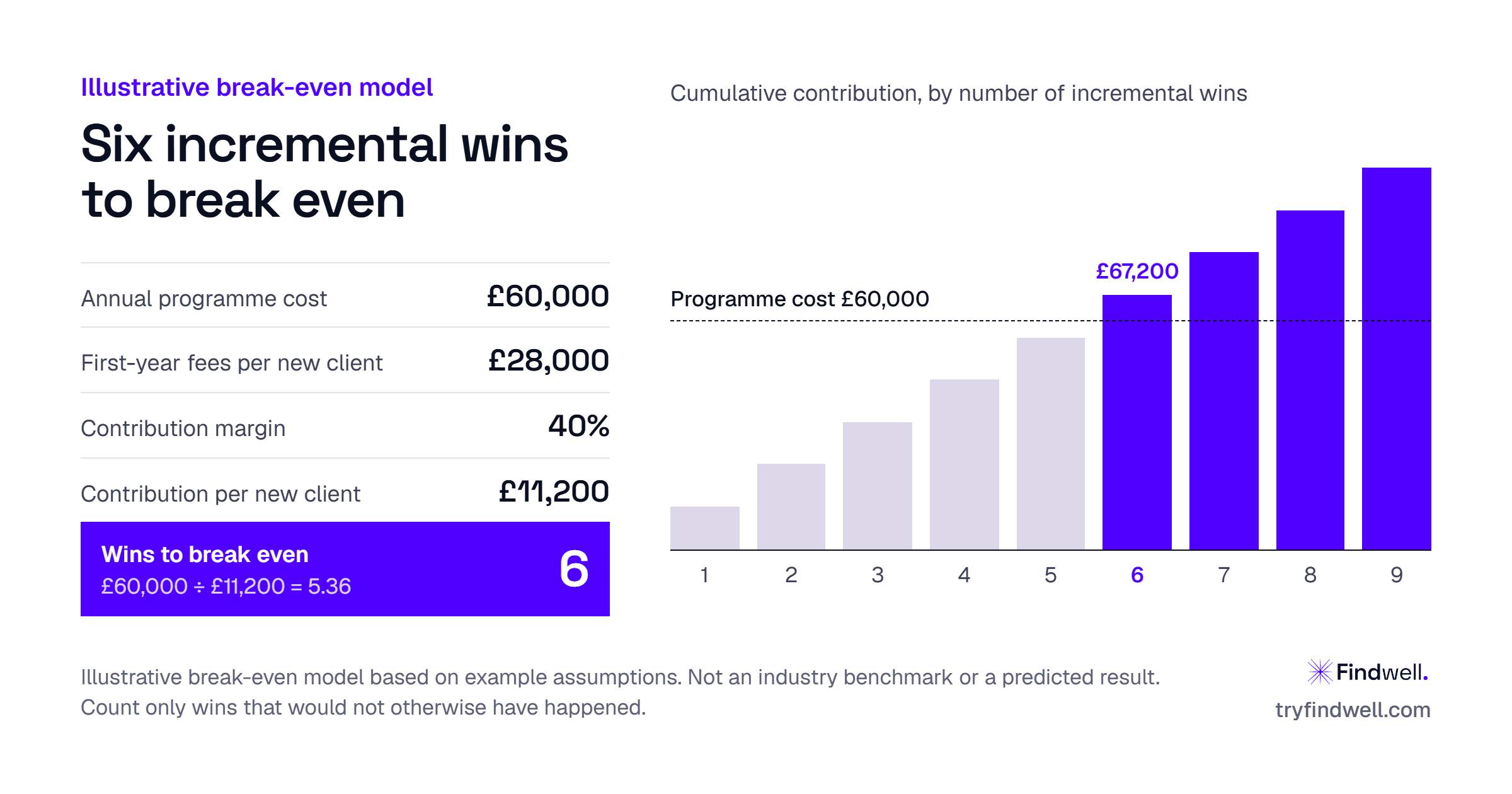
One way to make the decision more concrete is to calculate the number of incremental client wins required to break even.
Consider an illustrative marketing programme with these assumptions:
| Measure | Example |
|---|---|
| Annual programme cost | £60,000 |
| First-year fees per new client | £28,000 |
| Contribution margin | 40% |
| Contribution per new client | £11,200 |
| Incremental wins required to break even | 6 |
At £11,200 contribution per win, five additional clients would not fully cover the £60,000 programme cost. Six would.
The calculation is straightforward, but the difficult question is whether those six clients would have been won without the programme.
This is why attributed revenue and incremental revenue should not automatically be treated as the same thing.
Marketing reporting can separate three useful views:
- Sourced pipeline: Opportunities where marketing generated the initial contact.
- Assisted pipeline: Opportunities where marketing supported the buying journey.
- Influenced pipeline: Opportunities with some recorded marketing exposure.
These categories need consistent definitions and should not simply be added together, since the same opportunity may appear in more than one.
For firms with long buying cycles, client interviews and CRM evidence can also help explain how buyers first became aware of the firm and what influenced their decision.
The aim is not to claim certainty where it does not exist. It is to make decisions using better evidence.
A practical 90-day plan for reviewing marketing investment.
A firm does not need to redesign its entire marketing strategy before testing a stronger approach.
The first 90 days can be used to establish a clearer picture of what is working and where investment might be better directed.
Days 1–30: establish the baseline.
Review qualified enquiries, pipeline sources, existing client opportunities and the performance of key service pages.
Identify the commercial questions buyers are asking and the specialists best placed to answer them.
Look for gaps between the expertise the firm has and what prospective clients can actually discover.
Days 31–60: publish and distribute useful expertise.
Choose a small number of commercially important topics.
Develop content from interviews with the relevant experts, using their experience, judgement and examples rather than producing generic commentary. This is expert-led marketing in practical terms: the client's question determines the subject, and the specialist's insight supplies the substance.
Plan distribution alongside production. Consider relevant trade media, search, newsletters, LinkedIn and the material business development teams need for client conversations.
Days 61–90: review what changed.
Assess the quality of engagement, relevant enquiries, early pipeline signals and the response from existing clients.
If a new format generates attention but little engagement from the intended audience, investigate the topic, targeting, distribution or conversion path before producing more.
Ninety days will not establish the lifetime value of a client or prove the full impact of a long-term brand investment. It can, however, provide evidence for deciding what to continue, change or stop.
The question to take into your 2027 budget meeting.
A useful marketing budget should explain more than how much the firm plans to spend.
It should identify which buyers the firm needs to reach, what those buyers need to know, whose expertise can help them and how the investment will be assessed.
For some firms, the priority will be protecting established sources of demand. For others, it will be using an expert-led marketing approach to make specialist judgement easier to find and trust, strengthening referrals or improving the connection between marketing activity and commercial results.
The right mix depends on the firm's starting point.
The important question is not simply how much marketing costs, but what each part of the budget needs to change.
Download the 2027 Marketing Investment Playbook.
For a more detailed view of the evidence, download Findwell's 2027 Marketing Investment Playbook.
The free 34-page report includes:
- UK and international marketing budget benchmarks, with guidance on interpreting them.
- Research on buyer shortlists, trust, thought leadership and AI discovery.
- Dedicated investment considerations for law firms, accountancy practices and consultancies.
- An illustrative £250,000 budget allocation.
- A break-even model, two planning worksheets and a 90-day action plan.
Download the free 2027 Marketing Investment Playbook.
About the research: The playbook is an editorial synthesis of 18 published sources, selected with an emphasis on UK and professional services evidence. It distinguishes third-party findings from Findwell's analysis and recommendations. The research evidence cut-off is 5 November 2026.
See your experts, found.
A 30-minute walkthrough, tailored to your firm, of where your experts would rank and what it would take.