How to get cited by ChatGPT: What actually works in 2026.
Getting cited by ChatGPT is not about one trick or ranking factor. This guide looks at what current research actually shows about how AI systems select sources, use evidence and decide what to cite.
 Tyler NgoMarketing Manager, Profile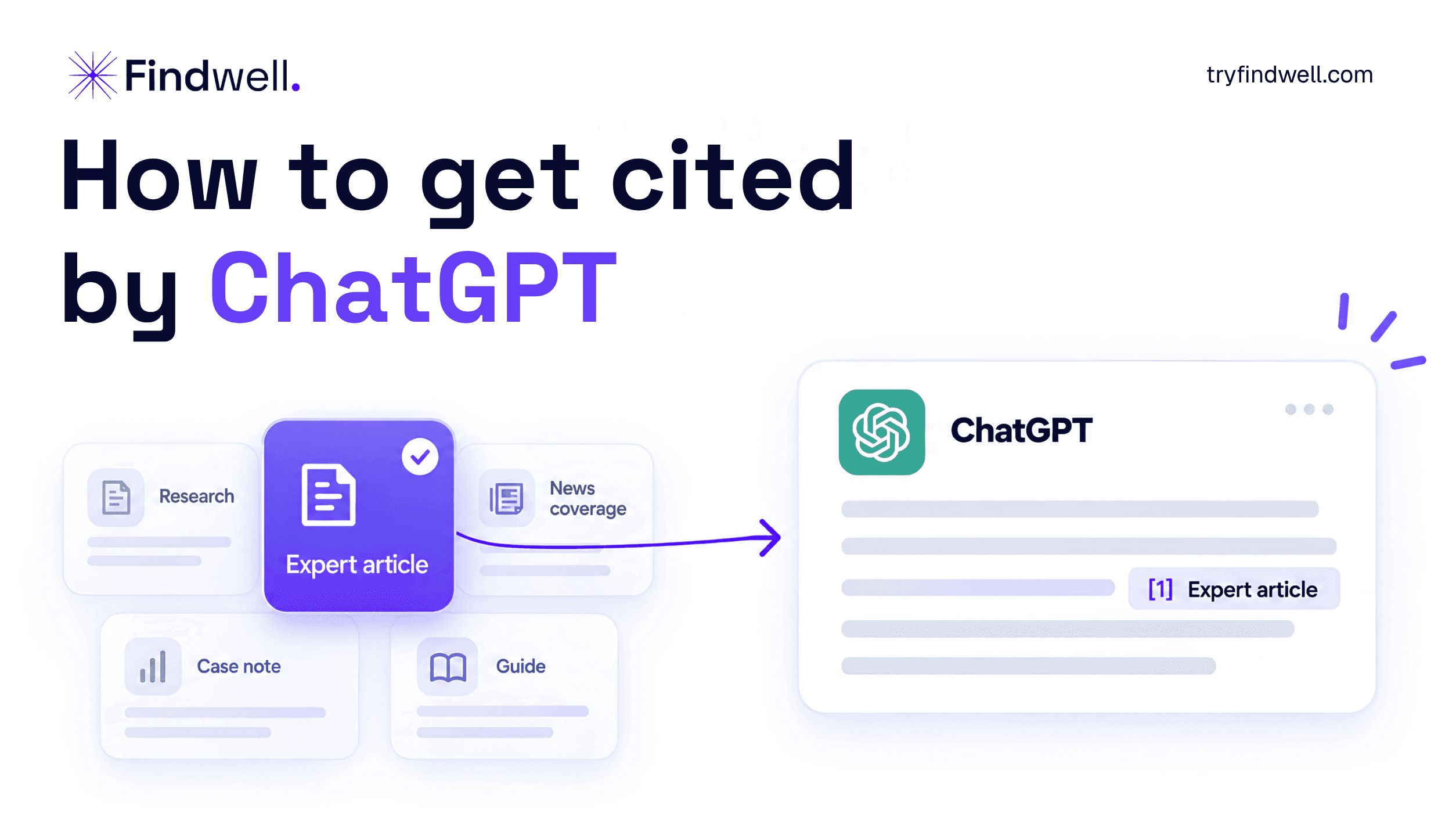
Most advice about getting cited by ChatGPT starts at the wrong end of the problem.
It starts with formatting tricks. Put the answer in 40 words. Turn every heading into a question. Add schema. Create an llms.txt file. Publish more FAQs.
Some of those things may be harmless. None of them gets to the more important question:
Why does one source survive the selection process and become part of an AI answer when another does not?
A useful answer is starting to emerge.
In May 2026, researchers ran 252,000 controlled citation trials across six language models, changing one content factor at a time. Topical relevance and source position had the strongest effects on which source received the first citation. Formatting-only changes had little impact.
The study is a preprint, so it should not be treated as a universal ranking formula, but its experimental design makes it more useful than another correlation study of pages that happened to be cited.
That points towards a simpler idea.
If you want to become a source for AI answers, start by becoming a better source.
This guide looks at what recent first-party data, controlled research and large citation datasets actually tell us about that job.
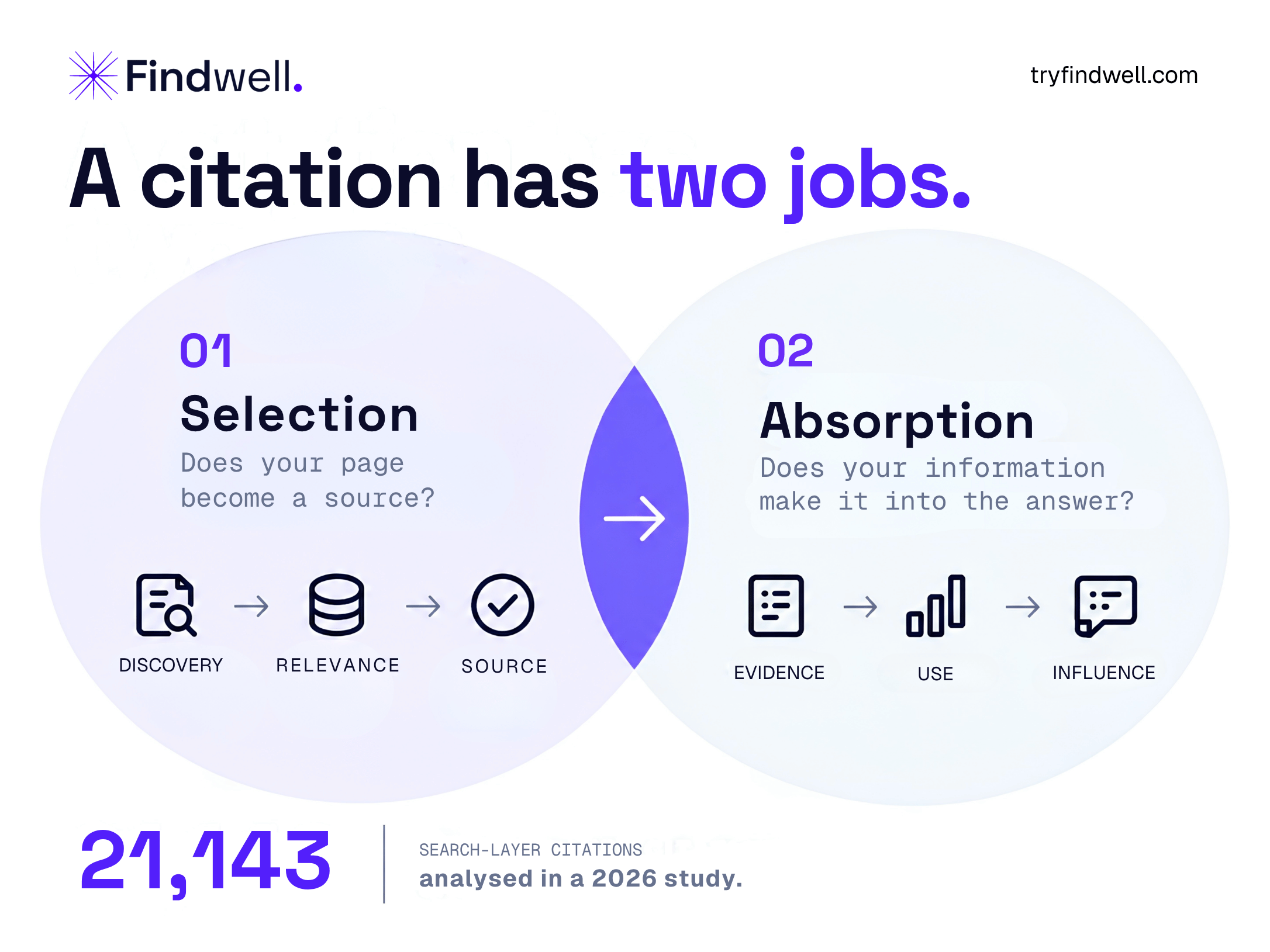
A citation has two jobs: selection and absorption.
It helps to separate two things that often get bundled together.
The first is selection. Does an AI system choose your page as one of the sources behind an answer?
The second is absorption. Once selected, does your page actually contribute language, facts, evidence, comparisons or structure to the answer?
A 2026 academic paper proposed exactly this distinction after analysing 602 controlled prompts, 21,143 valid search-layer citations and 18,151 fetched pages across ChatGPT, Google AI Overview/Gemini and Perplexity.
The researchers found that citation breadth and citation influence were not the same thing. Some systems cited more sources, while others relied more heavily on a smaller set of sources.
Pages with stronger influence tended to be semantically aligned and richer in extractable evidence such as definitions, numerical facts, comparisons and procedural steps.
This changes how you should think about "ChatGPT SEO".
A page can fail because it is never discovered. It can be discovered but lose source selection. It can be cited but contribute almost nothing useful to the final answer.
Those are different problems.
For a broader diagnosis of why an individual expert may not appear at all, see why your best expert is invisible to ChatGPT.
First, win source selection.
Before ChatGPT can cite your page, the page needs a route into the answer.
Make the page available.
OpenAI's current publisher guidance says public websites can appear in ChatGPT Search and recommends allowing OAI-SearchBot if publishers want their content to be discoverable, surfaced, cited and linked.
That is a technical prerequisite, not a ranking tactic.
Check the basics:
- the page is public
- the canonical URL is correct
- important content is not hidden behind a login
- you have not accidentally blocked OAI-SearchBot
- the page is reachable through normal internal links
- the useful information is present in accessible page content
Do not spend hours rewriting headings if the page is difficult to discover in the first place.
Make the topic obvious.
The controlled 252,000-trial study is useful here because it tested factors against one another rather than simply looking at pages that happened to perform well.
Topical relevance was one of the strongest factors in first-citation selection. Formatting changes on their own were much weaker.
That sounds obvious, but a surprising amount of professional-services content makes relevance unnecessarily hard to judge.
Compare these two titles:
| Title 1 | Title 2 |
|---|---|
| Our latest insights on workplace change | Can an employer change contractual terms after a TUPE transfer? |
The first could mean almost anything.
The second tells the reader, search engine and retrieval system exactly what problem the page addresses.
That does not mean every title needs to copy a prompt word for word. It means specificity has value.
A strong page normally makes three things clear early:
- What subject is this about?
- What question or decision does it help with?
- Who has the expertise behind the answer?
If those answers are buried, the page is asking every retrieval system to do extra work.
Search still matters, but the job has changed.
Microsoft describes traditional search and AI grounding as sharing a common foundation in crawling, understanding and ranking the web, while being optimised for different outcomes. Search helps a person decide what to read. Grounding helps an AI system decide what information to use in an answer.
Google makes a similar point in its current generative search guidance: normal SEO foundations remain relevant, alongside valuable, unique and non-commodity content.
So this is not an argument for abandoning SEO.
It is an argument for thinking beyond the blue link.
A page still needs to be discoverable. But its usefulness is increasingly judged not only by whether a human might click it, but by whether the information inside it is clear enough to support an answer.
Then give the answer something worth using.
This is where a lot of AI optimisation advice becomes too mechanical.
It talks about the shape of the page before asking whether the page contains anything worth extracting.
The citation-absorption research is useful because the pages with greater influence were richer in concrete evidence. That included:
- definitions
- numerical facts
- comparisons
- procedural steps
These are not magic formats.
They have something else in common.
They give an answer engine a specific unit of information to work with.
Consider the difference.
Weak: Cyber risk is becoming increasingly important for businesses, and organisations should make sure they are prepared for future threats.
There is nothing technically wrong with the sentence. There is also very little to use.
More useful: A cyber-risk adviser could instead explain the three controls they see most often missing during an incident response review, how each failure changes the response, and which one should be fixed first.
The second version contains judgement, structure and practical information.
The same applies to legal, financial and consulting content.
Weak: There are several options available to a company in financial difficulty.
More useful: A restructuring expert could distinguish three routes, explain the conditions that make each one viable, set out the trade-offs in a short table, and identify the decision that usually has to be made first.
The page has not been "written for AI".
It has simply become a more useful source.
That distinction matters.
Information gain is a better goal than AI-friendly prose.
Google's 2026 generative search guidance explicitly recommends valuable, unique, non-commodity content.
For professional-services firms, information gain often already exists inside the business.
It sits in:
- the judgement a partner applies when facts are ambiguous
- the questions clients repeatedly ask before instructing
- exceptions that rarely make it into generic explainers
- patterns seen across multiple engagements
- original survey or client data
- practical distinctions between two apparently similar options
- a framework an expert uses to make a difficult decision
The content job is to get that knowledge into a form that can be found and understood.
This is why simply generating more pages around every possible query is a weak strategy.
If fifty pages all restate the same public information, you have increased volume without adding much evidence.
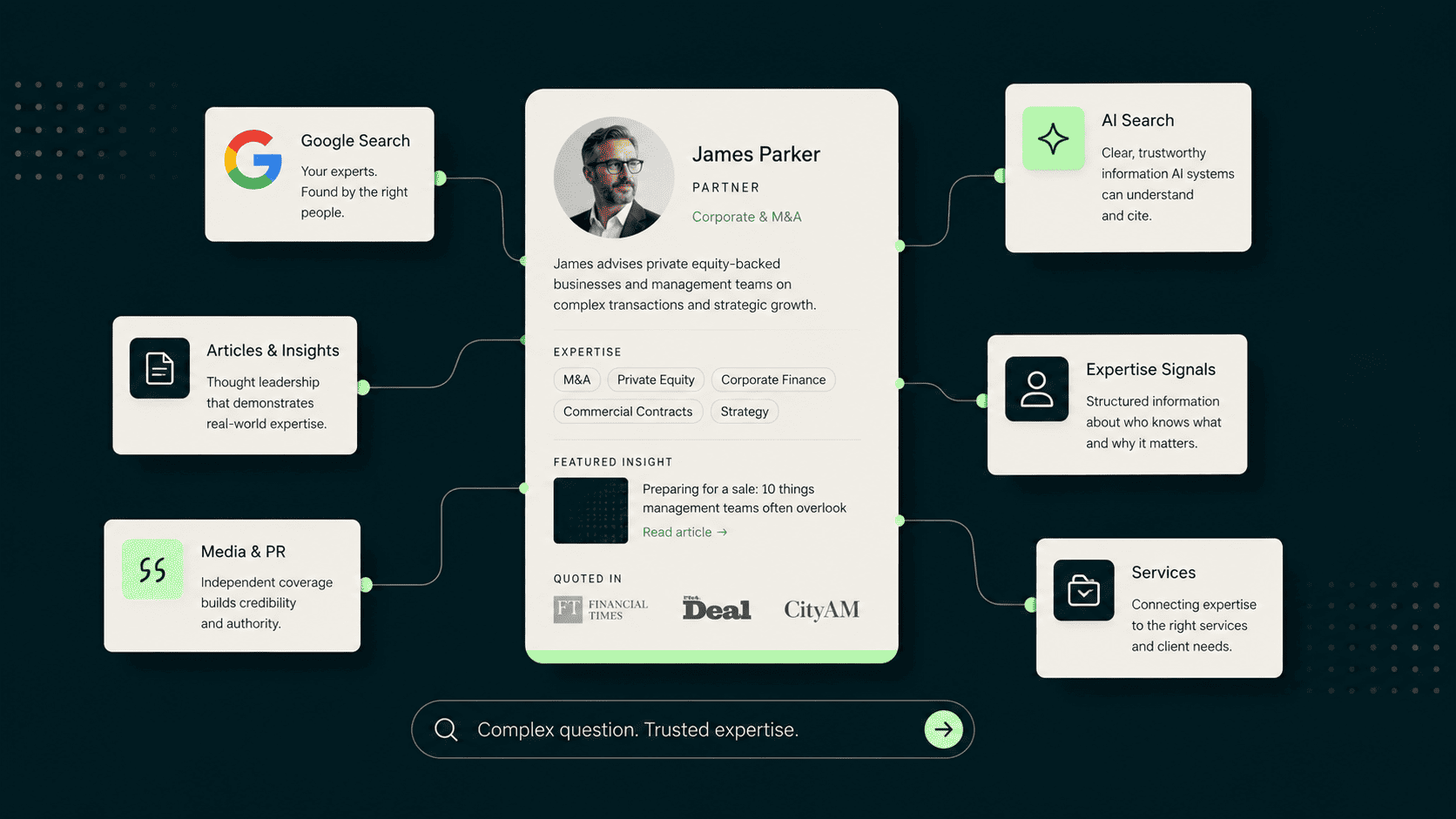
Findwell's expert content is built around extracting useful knowledge from the people who already hold it, rather than asking them to become full-time writers.
Your website is only one part of the evidence network.
A strong website matters.
It is not the whole source environment.
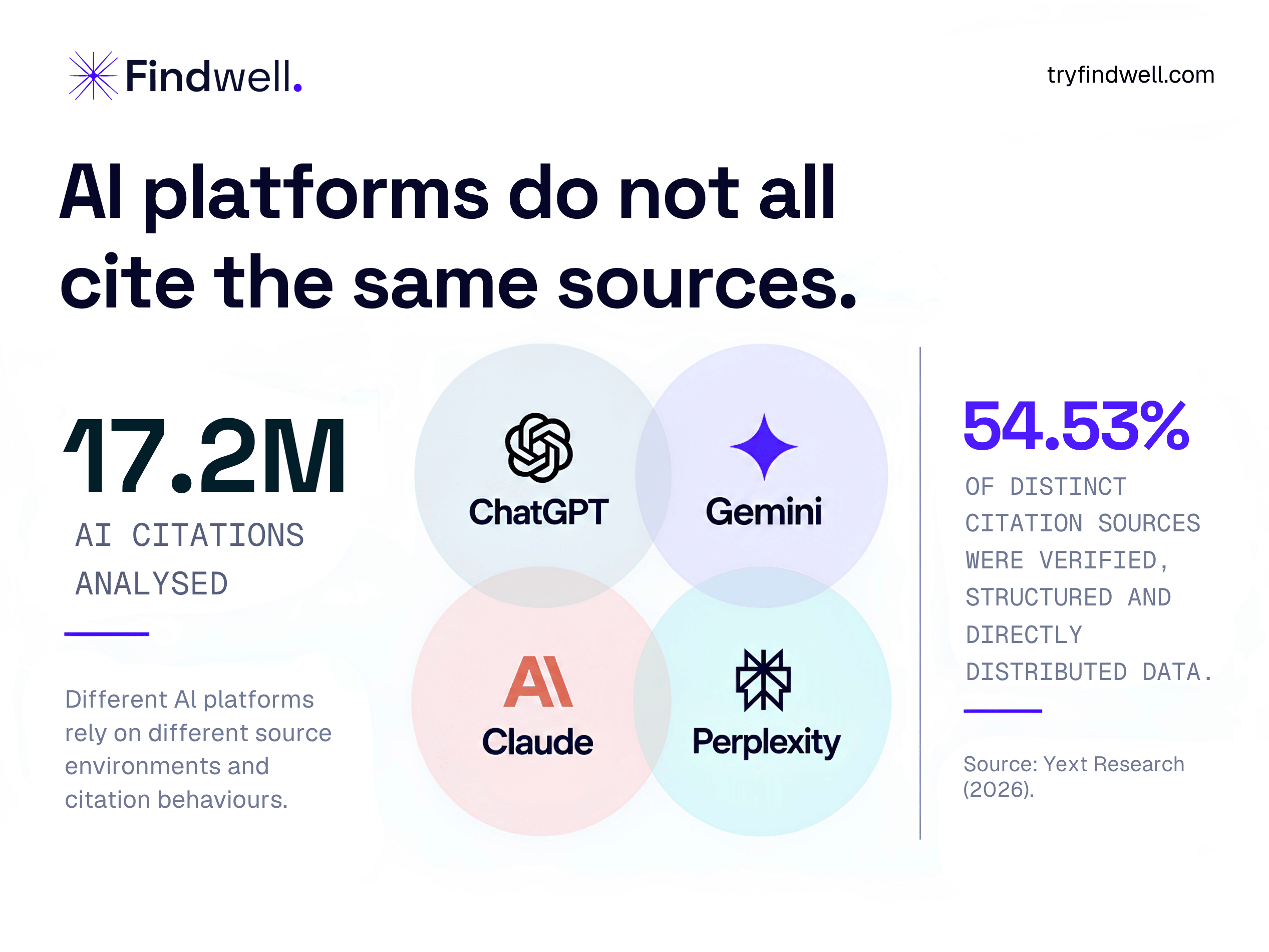
Yext Research analysed 17.2 million citations across ChatGPT, Perplexity, Gemini and Claude. The most important finding was not that one source type "wins". It was that the engines retrieve differently.
In Yext's dataset, verified, structured and directly distributed data represented 54.53% of distinct citation sources. Websites generated more citations per individual URL, but the wider source ecosystem mattered heavily.
Conductor reached a similar conclusion from a different dataset. It tracked seven AI experiences, seven intent categories and seven months of citation behaviour from September 2025 to March 2026.
Its conclusion was that source preferences remained meaningfully different not only between companies, but even between products from the same company. ChatGPT and ChatGPT Search did not behave identically. Google AI Overviews and AI Mode did not behave identically either.
So a useful citation strategy cannot be:
Optimise one article and expect every AI platform to treat it the same way.
For a professional-services firm, the public evidence around an expert might include:
- the firm's own expert profile
- authored insight
- original research
- industry publications
- recognised directories
- regulator or professional-body material
- conference or event pages
- journalism
- podcasts and interviews
- client-safe case examples
- other authoritative references
The objective is not to manufacture mentions everywhere.
It is to make the public picture of the expertise more complete and easier to verify.
That is also why relevant media coverage can matter without turning "get more PR" into a universal AI tactic.
A citation-worthy page in practice.
Imagine a firm publishes this article:
Before: 2026 employment law update
The page is 700 words long. It opens with two paragraphs explaining that employment law is changing quickly.
The author is "Insights Team". It summarises five developments already covered elsewhere.
Important factual claims have no nearby source. The final paragraph says clients should contact the firm for advice.
Nothing about the page is terrible. Nothing about it is particularly useful either.
Now imagine the same underlying expertise is rebuilt around a real client question.
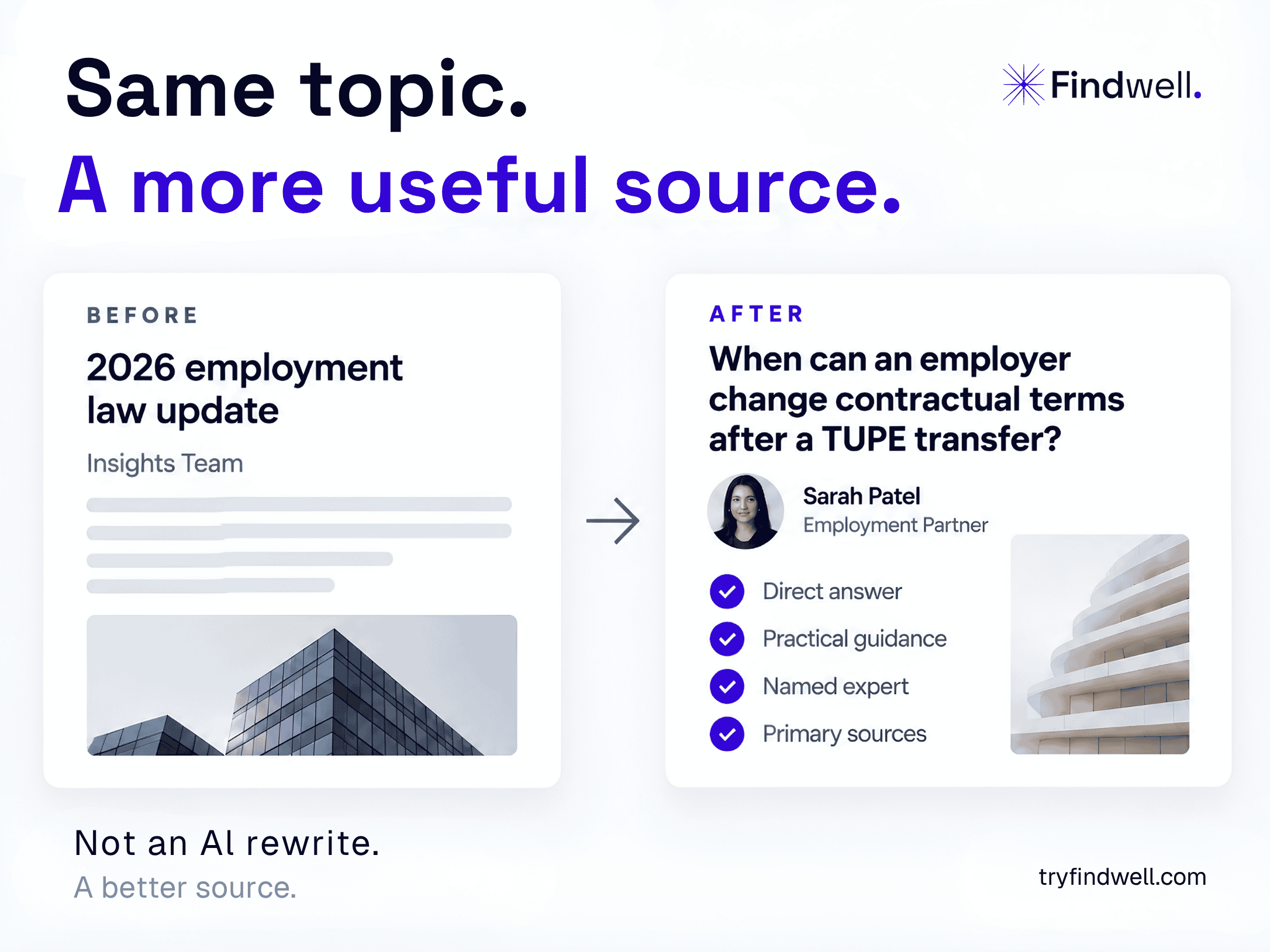
After: When can an employer change contractual terms after a TUPE transfer?
The page:
- answers the core question near the beginning
- is attributed to a named employment partner
- distinguishes the main scenarios rather than treating them as one issue
- includes a short comparison table
- links important legal claims to the relevant primary material
- explains where the expert sees businesses make mistakes in practice
- identifies what information a decision-maker should gather before acting
- shows a meaningful review date
- links back to the expert's profile and related specialist analysis
The second page has not had an "AI rewrite".
It has stronger topic definition, better evidence, clearer attribution and more useful information.
That is what citation optimisation should look like when it is working properly.
Five popular tactics deserve less confidence.
There is a large gap between "possible implementation choice" and "proven citation factor".
| Advice you will hear | What the evidence currently supports |
|---|---|
| Keep every answer to a fixed word count | There is no established universal length threshold across queries, models and content types. Clarity matters more than hitting an arbitrary number. |
| Turn every heading into a question | Specific headings can improve clarity, but controlled research suggests topical relevance is much more important than formatting alone. |
| Add schema to get cited | Structured data can be useful web infrastructure, but there is no reliable evidence that adding schema by itself causes ChatGPT citations. |
| Create an llms.txt file and AI will find you | It is optional. It does not replace crawlability, useful content or normal web discovery. Google says no special AI file is required for its generative search features. |
| Rank number one and ChatGPT will cite you | Search visibility supports discovery, but AI systems make their own retrieval and source-selection decisions. |
The common problem with these tactics is that they reduce a source-selection problem to a formatting checklist.
Formatting helps when it makes information easier to understand. Formatting is not the information.
Use first-party citation data before guessing.
One of the most useful changes in 2026 is that publishers are starting to get actual AI citation data.
In February, Microsoft launched AI Performance in Bing Webmaster Tools in public preview.
The dashboard includes:
- total citations
- average cited pages
- grounding query phrases
- page-level citation activity
- citation trends over time
The particularly interesting field is grounding queries.
These are phrases used when retrieving content that was subsequently referenced in AI-generated answers.
That gives you a way to work backwards from real citation behaviour.
Instead of asking:
What content do AI systems like?
you can ask:
Which of our pages are already being cited, and what retrieval queries are bringing them into answers?
Then compare those pages with closely related pages that are indexed but rarely cited.
Look for differences in:
- subject specificity
- completeness
- evidence
- authorship
- freshness
- internal linking
- whether the page actually answers the grounding query
Microsoft explicitly cautions that its citation metrics do not represent ranking, authority or placement within an individual answer. Grounding-query data is also sampled.
That limitation is useful.
It stops citation counts from becoming another vanity score.
Start with pages that have already earned citations. Identify the grounding queries attached to them. Compare them with relevant pages that are not being cited. Use the differences to form a hypothesis, improve the weaker page, then watch the data over time.
Google has also rolled out dedicated generative AI performance reporting in Search Console worldwide as of August 31, 2026, giving site owners a first-party view of visibility in features such as AI Overviews and AI Mode.
These datasets do not tell you everything about ChatGPT.
They do mean publishers have more first-party evidence than they did a year ago.
What I would change on a page today.
If I were reviewing an existing page for citation potential, I would not start with a new AI checklist.
I would read it like an editor and investigate it like a search practitioner.
| Questions | Answers |
|---|---|
| Is the subject narrow enough to be useful? | A page trying to explain an entire practice area is often less useful than a page that answers one meaningful decision well. |
| Does the useful answer appear early enough? | The reader should not need to survive four paragraphs of scene-setting before the page starts doing its job. |
| Is there anything here another page could not say? | Look for actual expert contribution: a distinction, a number, a procedure, a comparison, an example or an observation from practice. |
| Can the important claims be checked? | Link to primary evidence where appropriate. Name the author. Connect the analysis to a credible expert. |
| Does the page belong to a wider body of expertise? | One isolated article is weaker context than a coherent expert profile connected to multiple relevant pieces of work. |
| Is the page still true? | Update facts and analysis when the substance changes. Do not simply change the publication date. |
These changes are not glamorous.
They are also far more defensible than pretending we know a hidden ChatGPT ranking formula.
What getting cited by ChatGPT does not mean.
A citation is useful evidence of visibility. It is not the final commercial outcome.
A page can be cited without the expert being named.
An expert can be named without their own page being cited.
A user can see a brand inside an answer and never click.
A citation can also disappear on another run of the same question.
That is why a mature AI visibility programme should eventually look beyond citation count.
You need to understand:
- which buyer questions you appear for
- which experts are named
- which URLs are cited
- which sources support competitors
- how accurate the answer is
- how stable visibility is across repeated tests
- whether visibility produces visits, enquiries or other commercial signals
We will cover that measurement problem separately.
For law firms looking at the broader strategy behind expert visibility, see our AEO for law firms guide.
There is no citation formula, but there is a better standard.
We know more about AI citation behaviour than we did a year ago.
We now have controlled experiments, large cross-platform citation datasets and first-party tools showing which pages are actually being referenced.
The evidence still does not support a universal recipe.
Models differ. Retrieval systems differ. Query intent matters. The same platform can change. Observational studies can find correlations without proving causes.
But the direction is becoming clearer.
Be discoverable. Be specific. Add information worth using. Make expertise attributable. Build evidence beyond one page. Measure what is actually being cited.
That is a stronger strategy than writing for an imaginary machine reader.
It also produces better content for the human reader you wanted in the first place.
Make your expertise easier to find and use.
Findwell brings expert profiles, expert-led content, relevant media coverage and AI visibility reporting together so the knowledge inside professional-services firms is easier to discover, understand and reference.
See how Findwell works
Frequently asked
How do I get my website cited by ChatGPT?
There is no guaranteed submission or ranking formula. Start with accessibility, clear topical relevance, useful original information and strong attribution. OpenAI also recommends allowing OAI-SearchBot if you want public website content to be discoverable and cited in ChatGPT Search.
Does my page need to rank highly on Google first?
Not necessarily for the exact question being asked. Search discoverability remains an important foundation, but AI systems can use different retrieval queries and make separate source-selection decisions.
What kind of content is easiest for AI systems to use?
There is no universal winning format. Recent controlled and observational research suggests that semantic relevance and extractable evidence matter. Useful definitions, factual evidence, comparisons and procedural information can give an answer system concrete material to work with.
Should I optimise only for ChatGPT?
No. Large citation studies show meaningful differences between ChatGPT, Gemini, Claude, Perplexity and other AI experiences. Build a strong public evidence base first, then measure how different platforms actually use it.
See your experts, found.
A 30-minute walkthrough, tailored to your firm, of where your experts would rank and what it would take.